

DFP 58T94
EN English
Operating instructions
DISHWASHER — Contents
Operating instructions,1 Precautions and advice, 2-3
Assistance, 10
Product Data, 11
Installation, 14-15
Description of the appliance, 16 Refined salt and rinse aid, 17 Loading the racks, 18-19 Detergent and dishwasher use, 20 Wash cycles, 21
Special wash cycles and options, 22 Care and maintenance, 23 Troubleshooting, 24
FR Français
Mode d’emploi
LAVE-VAISSELLE — Sommaire
Mode d’emploi, 1 Précautions et conseils, 3-4 Assistance, 10
Fiche produit, 11 Installation, 25-26 Description de l’appareil, 27
Sel régénérant et Produit de rinçage, 28 Charger les paniers, 29-30
Produit de lavage et utilisation du lave-vaisselle, 31 Programmes, 32
Programmes spéciaux et Options, 33 Entretien et soin, 34
Anomalies et remèdes, 35
DE Deutsch
Gebrauchsanleitung
GESCHIRRSPÜLER – Inhaltsverzeichnis
Gebrauchsanleitung, 1 Vorsichtsmaßnahmen und Hinweise, 4-5 Kundendienst, 10
Produktdatenblatt, 12 Installation, 36-37
Beschreibung Ihres Geschirrspülers, 38 Regeneriersalz und Klarspüler, 39 Beladen der Körbe, 40-41
Spülmittel und Verwendung des Geschirrspülers, 42 Programme, 43
Sonderprogramme und Optionen, 44
Reinigung und Pflege, 45
Störungen und Abhilfe, 46
PT Português
Instruções de uso
MÁQUINA DE LAVAR LOUÇA — Índice
Instruções de uso, 1 Precauções e conselhos, 5-6 Assistência, 10
Ficha do produto, 12 Instalação, 47-48 Descrição do aparelho, 49
Sal, regenerador e abrilhantador, 50 Carregar os cestos, 51-52
Detergente e uso da máquina de lavar louça, 53 Programas, 54
Programas especiais e opções, 55 Manutenção e cuidados, 56 Anomalias e soluções, 57
TR İngilizce
Kullanım talimatları
BULAŞIK MAKİNESİ — İçindekiler
Kullanım talimatları, 1 Önlem ve öneriler, 6-7-8 Ürün bilgi sayfası, 13 Montaj, 58-59
Cihazın tanımı, 60
Rafine tuz ve durulama maddesi, 61 Rafların yerleştirilmesi, 62-63
Deterjan ve bulaşık makinesi kullanımı, 64 Yıkama çevrimleri, 65
Özel yıkama çevrimleri ve seçenekler, 66 Temizlik ve bakım, 67
Sorun Giderme, 68 Yardım, 69
PL Polski
Instrukcja obsługi
ZMYWARKA — Spis treści
Instrukcja obsługi,1
Zalecenia i środki ostrożności, 8-9 Serwis Techniczny, 10
Karta produktu, 13 Instalacja, 70-71 Opis urządzenia, 72
Sól regeneracyjna i środek nabłyszczający, 73 Ładowanie koszy, 74-75
Środek myjący i obsługa zmywarki, 76 Programy, 77
Programy specjalne i opcje, 78 Konserwacja i obsługa, 79
Nieprawidłowe działanie i możliwe środki zaradcze, 80
1

EN Precautions and advice
 This appliance was designed and manufacturedincompliancewithinternational safety standards. The following information has been provided for safety reasons and should be read carefully.
Keep this instruction manual in a safe place for future reference. If the appliance is sold, given away or moved, make sure the manual is kept with the machine.
Read the instructions carefully, as they include important information on safe installation, use and maintenance.
This appliance was designed for domestic use or similar applications, for example:
— farmhouses;
— use by guests in hotels, motels and other residential settings;
— bed & breakfasts.
Remove the appliance from all packaging and make sure it was not damaged during transportation. If it was damaged, contact the retailer and do not proceed any further with the installation process.
General safety
• This appliance should not be operated by children younger than 8 years, people with reduced physical, sensory or mental capacities, or inexperienced people who are not familiar with the product, unless they are given close supervision or instructions on how to use it safely and are made aware by a responsible person of the dangers its use might entail.
• Children must not play with the appliance.
• It is the user’s responsibility to clean and maintain the appliance. Children should never clean or maintain it unless they are given supervision.
• The appliance was designed for domestic use inside the home and is not intended for commercial or industrial use.
• The appliance must be used to wash domestic crockery in accordance with the instructions in this manual.
• The appliance must not be installed outdoors, even in covered areas. It is extremely dangerous to leave the machine exposed to rain and storms.
• Do not touch the appliance when barefoot.
• When unplugging the appliance always pull the plug from the mains socket. Do
not pull on the cable.
• The water supply tap must be shut off and the plug should be removed from the electrical socket at the end of every cycle and before cleaning the appliance or carrying out any maintenance work.
• The maximum number of place settings is shown in the product sheet.
• If the appliance breaks down, do not under any circumstances touch the internal parts in an attempt to perform the repair work yourself.
• Do not lean or sit on the open door: this may cause the appliance to overturn.
• The door should not be left open as it may create a dangerous obstacle.
• Keep detergent and rinse aid out of reach of children.
• The packaging material should not be used as a toy.
• Knives and other utensils with sharp edges must be placed either with the points/blades facing downwards in the cutlery basket or horizontally on the tip-up compartments or in the tray/third basket, if available.
Disposal
• To dispose of any packaging materials, follow local legislation so that the packagings may be reused.
• The European Directive 2012/19/EU relating to Waste Electrical and Electronic Equipment (WEEE) states that household appliances should not be disposed of using the normal solid urban waste cycle. Exhausted appliances should be collected separately in order to optimise the cost of reusing and recycling the materials inside the machine, while preventing potential damage to the atmosphere and public health. The crossed-out dustbin symbol shown on all products reminds the owners of their obligations regarding separated waste collection.
For further information relating to the correct disposal of household appliances, owners may contact the relevant public authority or the local appliance dealer.
Saving energy and respecting the environment
Saving water and energy
• Only begin a wash cycle when the dishwasher is full. While waiting for the dishwasher to be filled, prevent unpleasant
2

odours with the Soak cycle (if available, see
Wash Cycles).
• Select a wash cycle that is suited to the type of crockery and to the soil level using the Table of Wash Cycles:
— For dishes with a normal soil level, use the Eco wash cycle, which guarantees low energy and water consumption levels.
— If the load is smaller than usual activate
the Half Load option (see Special wash cycles
and options, if available).
• If your electricity supply contract gives details of electricity-saving time bands, run the wash cycles when electricity prices are lower. The Delayed Start option can help you organise the wash cycles accordingly
(see Special wash cycles and options, if available).
FR Précautions et conseils
 CET appareil a été conçu et fabriqué conformément aux normes internationales de sécurité. Ces consignes sont fournies pour des raisons de sécurité, il faut les lire attentivement.
Conserver ce mode d’emploi pour pouvoir le consulter à tout moment. En cas de vente, de cession ou de déménagement, s’assurer qu’il accompagne bien l’appareil.
Lire attentivement les instructions : elles fournissent des conseils importants sur l’installation, l’utilisation et la sécurité de l’appareil.
Cet appareil est conçu pour un usage domestique ou autres applications similaires, telles que :
— fermes ;
— utilisation par les clients d’hôtels, de motels ou autres locaux de type résidentiel ;
— chambres d’hôtes.
Déballer l’appareil et s’assurer qu’il n’a pas été endommagé pendant le transport. S’il est abîmé, ne pas le raccorder et contacter le revendeur.
Sécurité générale
• Cet appareil électroménager peut être utilisé par des enfants âgés de plus de 8 ans et par des personnes dont les capacités physiques, sensorielles ou mentales sont réduites, ou encore sans l’expérience ou la connaissance nécessaire, mais sous l’étroite surveillance d’un adulte responsable ou après que ces personnes
aient reçu des instructions relatives à une utilisation en toute sécurité de l’appareil et compris les dangers qui lui sont inhérents.
• Les enfants ne doivent pas jouer avec l’appareil.
• Le nettoyage et l’entretien de l’appareil doivent être effectués par l’utilisateur. Ils ne doivent pas être effectués par des enfants sans surveillance.
• Cet appareil est conçu pour un usage de type non professionnel à l’intérieur d’une habitation.
• Cet appareil est destiné au lavage de vaisselle à usage domestique et selon les instructions reportées dans cette notice.
• Ne pas installer l’appareil à l’extérieur, même dans un endroit protégé, car il est extrêmement dangereux de l’exposer à la pluie et aux orages.
• Ne pas toucher au lave-vaisselle pieds nus.
• Ne jamais tirer sur le câble pour débrancher
la fiche de la prise de courant.
• Fermer le robinet de l’eau et débrancher la fiche de la prise de courant après chaque utilisation et avant d’effectuer tous travaux de nettoyage et d’entretien.
• Le nombre maximal de couverts est indiqué
dans la fiche produit.
• Encasdepanne,éviteràtoutprixd’accéder aux mécanismes internes pour tenter une réparation.
• Ne pas s’appuyer à la porte ouverte ou s’y asseoir : l’appareil pourrait basculer.
• Ne pas garder la porte ouverte pour éviter de buter contre elle en risquant de se faire mal.
• Garder les produits de lavage et de rinçage
hors de la portée des enfants.
• Les emballages ne sont pas des jouets pour enfants.
• Les couteaux et ustensiles de cuisine à bords tranchants doivent être disposés, pointes et lames tournées vers le bas, dans le panier à couverts ou, à plat, sur les clayettes rabattables du panier supérieur ou bien encore, si le modèle en est équipé, dans le plateau ou troisième panier.
Mise au rebut
• Mise au rebut du matériel d’emballage : se conformer aux réglementations locales de manière à ce que les emballages puissent être recyclés.
• La directive européenne 2012/19/EU sur les déchets d’équipements électriques et électroniques (DEEE), prévoit que les électroménagers ne peuvent pas être
3

traités comme des déchets solides urbains normaux. Les appareils usagés doivent être collectés séparément afin d’optimiser le taux de récupération et le recyclage des matériaux qui les composent et réduire l’impact sur la santé humaine et l’environnement Le symbole de la poubelle barrée est appliqué sur tous les produits pour rappeler qu’ils font l’objet d’une collecte sélective.
Pour tout autre renseignement sur la collecte des électroménagers usés, prière de s’adresser au service public préposé ou au vendeur.
Economies et respect de l’environnement
Faire des économies d’eau et d’électricité
• Ne faire fonctionner le lave-vaisselle que quand il est rempli au maximum de sa capacité. Dans l’attente de remplir l’appareil, lancer le cycle de Trempage pour éviter la formation de mauvaises
odeurs (si disponible — voir Programmes).
• Sélectionner un programme adapté au type de vaisselle et à son degré de salissure, consulter pour cela le Tableau des programmes :
— pour de la vaisselle normalement sale, choisir le programme Eco (économique), il limite la quantité d’eau et d’électricité utilisée.
— pour une quantité réduite de vaisselle, choisir l’option Demi-charge (si disponible voir
Programmes Spéciaux et Options).
• Si le contrat de fourniture d’électricité prévoit des tranches horaires à prix réduit, effectuer les lavages pendant ces heures creuses. L’option Départ différé peut aider à organiser les lavages dans ce sens (si
disponible voir Programmes Spéciaux et Options).
DE VorsichtsmaßnahmenHinweise und
 Das Gerät wurde nach den strengsten internationalen Sicherheitsvorschriften konzipiert und hergestellt. Nachstehende
Hinweise werden aus Sicherheitsgründen angegeben und sollten aufmerksam gelesen werden.
Bewahren Sie diese Bedienungsanleitung sorgfältig auf, damit Sie sie jederzeit zu Rate ziehen können. Im Falle eines Verkaufs, einer
Übergabe oder eines Umzugs muss sie dem
Gerät stets beiliegen.
Lesen Sie die folgenden Hinweise aufmerksam durch, denn sie liefern wichtige Informationen hinsichtlich der Installation, des Gebrauchs und der Sicherheit.
Dieses Gerät wurde für den Hausgebrauch oder ähnliche Anwendungen konzipiert, zum Beispiel:
— Bauernhäuser
— Nutzung durch Kunden in Hotels, Motels und anderen Wohnbereichen
— Frühstückspensionen
Nehmen Sie das Verpackungsmaterial ab und prüfen Sie Ihr Gerät auf eventuelle Transportschäden. Schließen Sie das Gerät im Falle einer Beschädigung bitte nicht an, sondern fordern Sie den Kundendienst an.
Allgemeine Sicherheit
• Dieses Haushaltsgerät darf von Kindern ab acht Jahren und von Personen mit eingeschränkten körperlichen, s e n s o r i s c h e n o d e r g e i s t i g e n Fähigkeiten oder ohne Erfahrung und der notwendigen Kenntnis verwendet werden, vorausgesetzt, sie werden streng von einer verantwortungsbewussten Person überwacht oder sie haben eine ausreichende Einweisung in die sichere
Nutzung des Geräts erhalten und die damit verbundenen Gefahren verstanden.
• Kinder dürfen nicht mit dem Gerät spielen.
• Die Reinigung und die Wartung des
Geräts müssen vom Benutzer ausgeführt werden. Diese Arbeiten dürfen nicht von unbeaufsichtigten Kindern ausgeführt werden.
• DiesesGerätistfürdennichtprofessionellen
Einsatz in privaten Haushalten bestimmt.
• Das Gerät darf nur zum Spülen von
Haushaltsgeschirr und gemäß den Anleitungen dieses Handbuchs verwendet werden.
• Das Gerät darf nicht im Freien aufgestellt werden, auch nicht, wenn es sich um einen geschützten Platz handelt. Es ist äußerst gefährlich, das Gerät Regen und Gewittern auszusetzen.
• Berühren Sie den Geschirrspüler nicht, wenn Sie barfuß sind.
• Ziehen Sie den Netzstecker nicht am Netzkabel aus der Steckdose, sondern nur am Netzstecker selbst.
• Vor Reinigungsund Wartungsarbeiten
4

mussamEndejedesZyklusderWasserhahn zugedreht und der Netzstecker aus der
Steckdose gezogen werden.
• Die höchstzulässige Anzahl an Gedecken ist auf dem Produktdatenblatt angegeben.
• Versuchen Sie bei etwaigen Störungen keinesfalls, Innenteile selbst zu reparieren.
• Stützen Sie sich und setzen Sie sich nicht auf die offen stehende Gerätetür; das Gerät könnte umkippen.
• Die Gerätetür sollte nicht offen gelassen werden, da man darüber stolpern könnte.
• Bewahren Sie das Spülmittel und den
Klarspüler außerhalb der Reichweite von Kindern auf.
• Verpackungsmaterial ist kein Spielzeug für
Kinder.
• Messer und anderes Besteck mit scharfen
Kanten müssen mit der Spitze/Klinge nach unten in den Besteckkorb gegeben oder horizontal auf die Klappfächer oder auf das Tablett/den dritten Korb gelegt werden, sofern dies bei Ihrem Modell vorhanden ist.
Entsorgung
• Befolgen Sie die lokalen Vorschriften;
Verpackungsmaterialkannwiederverwertet werden.
• Die europäische Richtlinie 2012/19/EG
über Elektround Elektronik-Altgeräte (WEEE) sieht vor, dass Haushaltsgeräte nicht mit dem normalen Hausmüll entsorgt werden dürfen. Die Altgeräte müssen getrennt gesammelt werden, um die Rückführung und das Recycling der Materialen zu optimieren, aus denen die Geräte hergestellt sind, und um mögliche Belastungen der Gesundheit und der Umwelt zu verhindern. Das
Mülleimersymbol ist auf allen Produkten dargestellt, um an die Verpflichtung zur getrennten Abfallsammlung zu erinnern. Für weitere Informationen hinsichtlich der ordnungsgemäßen Entsorgung von Haushaltsgeräten wenden Sie sich bitte an Ihren Händler oder an die zuständige kommunale Stelle.
Energie sparen und Umwelt schonen
Wasser und Strom sparen
• Setzen Sie den Geschirrspüler nur bei voller Ladung in Betrieb. Um in der Zwischenzeit, d. h. bis das Gerät ganz gefüllt ist, die Bildung unangenehmer Gerüche zu vermeiden, setzen Sie den Einweichzyklus in Gang (sofern verfügbar –
siehe Spülprogramme).
• Wählen Sie ein für das zu spülende
Geschirr und den Verschmutzungsgrad geeignetes Programm. Ziehen Sie hierzu die Programmtabelle zu Rate:
— Verwenden Sie für normal verschmutztes Geschirr das umweltfreundliche Sparprogramm Eco, das einen niedrigen Wasserund Stromverbrauch gewährleistet.
— Aktivieren Sie bei geringfügiger Beschickung die Option Halbe Füllung
(sofern verfügbar – siehe Sonderprogramme und
Optionen).
• SiehtIhrStromliefervertragBilligstromzeiten
vor, empfiehlt sich, das Gerät in diesen
Zeiten in Betrieb zu setzen. Die Option
Verzögerter Start kann dabei helfen, die Spülgänge entsprechend zu organisieren
(sofern verfügbar – siehe Sonderprogramme und Optionen).
PT Precauções e conselhos
 O aparelho foi projetado e construído conforme as normas internacionais de segurança. Estas advertências são fornecidas por razões de segurança e devem ser lidas com atenção.
É importante conservar este manual para poder consultá-lo em qualquer momento. Em caso de venda, cessão ou mudança, certifique-se que o mesmo fique junto ao aparelho.
Ler atentamente as instruções: nelas estão presentes informações importantes sobre a instalação, o uso e a segurança.
Este aparelho foi projetado para o uso doméstico ou para aplicações simples, como por exemplo:
— casas de férias;
— uso por parte de clientes em hotéis, motéis e outros ambientes de tipo residencial;
— bed and breakfast.
Desembale o aparelho e controle que não tenha sofrido danos durante o transporte. Se estiver danificado, não o acenda e contacte o revendedor.
Segurança geral
• Este eletrodoméstico pode ser utilizado por crianças com mais de 8 anos e
5

pessoas com capacidades físicas, sensoriais ou mentais reduzidas, ou sem experiência e conhecimentos necessários, desde que sob rigorosa vigilância de uma pessoa responsável ou após terem recebido instruções relativas ao uso seguro do aparelho e à compreensão dos perigos associados ao uso.
• As crianças não devem brincar com o aparelho.
• A limpeza e manutenção do aparelho devem ser efetuadas pelo utilizador.
Não deve ser efetuada por crianças sem vigilância.
• O aparelho foi concebido para um uso de tipo não profissional dentro do ambiente doméstico.
• O aparelho deve ser utilizado para a lavagem de louças de utilização doméstica, conforme as instruções escritas neste manual.
• Esta máquina de lavar louça não pode ser instalada ao ar livre, nem mesmo num lugar protegido por um telhado: é muito perigoso deixá-la exposta à chuva e aos temporais.
• Não toque na máquina com os pés descalços.
• Não retire a ficha da tomada de corrente puxando o cabo, mas segure a ficha.
• É necessário fechar a torneira da água e tirar a ficha da tomada da corrente elétrica no final de cada ciclo, antes de efetuar operações de limpeza e manutenção.
• O número máximo de louças é indicado na ficha do produto.
• Em caso de avarias, jamais aceda aos mecanismos internos para tentar reparar sozinho.
• Não se apoie nem se sente sobre a porta aberta: o aparelho pode voltar-se.
• A porta não pode ficar aberta para evitar o perigo de tropeçar.
• Mantenha o detergente e o abrilhantador fora do alcance das crianças.
• As embalagens não são brinquedos para crianças.
• As facas e utensílios com rebordos afiados devem ser colocados com as pontas/lâminas viradas para baixo no cesto dos talheres ou em posição horizontal nas peças basculantes no tabuleiro/terceiro cesto, nos modelos em que esteja presente.
Eliminação
• Eliminação do material de embalagem: respeite a normas locais, assim as embalagens poderão ser reaproveitadas.
• A diretiva Europeia 2012/19/EU relativa aos resíduos de equipamentos elétricos e eletrónicos (REEE) prevê que os eletrodomésticos não devem ser eliminados no normal fluxo dos resíduos sólidos urbanos. Os aparelhos em fim de vida devem ser recolhidos separadamente para otimizar a taxa de recuperação e reciclagem dos materiais que os compõem e impedir potenciais danos à saúde e ao meio ambiente. O símbolo do cesto do lixo cancelado está indicado em todos os produtos para lembrar o dever de coleta seletiva.
Para mais informações sobre a correta eliminação dos eletrodomésticos, os proprietários poderão contactar o serviço de coleta público ou os revendedores.
Economizar e respeitar o ambiente
Economizar água e energia
• Use a máquina de lavar louça somente com carga plena. Enquanto espera que a máquina fique cheia, previna os maus cheiros com o ciclo de Amolecimento (se
disponível — ver Programas).
• Selecione um programa adequado ao tipo de louças e ao grau de sujidade consultando a tabela dos programas:
— para louças normalmente sujas, utilize o programa Eco, que garante baixos consumos energéticos e de água.
— se a carga for reduzida, utilize a opção
Meia carga (se disponível — ver Programas
especiais e opções).
• Se o seu contrato de fornecimento de energia elétrica previr faixas horárias de economia energética, efetue as lavagens nos horários com tarifa reduzida. A opção Início Posterior pode ajudar a organizar as lavagens nesse sentido (se
disponível — ver Programas especiais e opções).
TR Önlem ve öneriler
 Bu makine, uluslararası güvenlik standartlarına uygun olarak tasarlanmış ve üretilmiştir. Aşağıdaki bilgiler güvenlik nedeniyleverilmiştirvedikkatleokunmalıdır.
6

Bu kullanım kılavuzunu, gelecekte referans olarak kullanmak üzere saklayın. Cihazı satarsanız, birine hediye ederseniz veya başka bir yere taşırsanız, kullanım kılavuzunu da vermeyi ihmal etmeyin.
Güvenli montaj, kullanım ve bakım hakkında önemli bilgiler içerdiğinden talimatları dikkatle okuyun.
Bu cihaz, evde kullanmanın yanı sıra benzeri uygulamalarda da kullanılmak üzere tasarlanmıştır; örneğin:
— çiftlik evleri;
— oteller, moteller ve diğer yerleşim türü ortamlarında müşteriler tarafından;
— oda-kahvaltı sistemiyle hizmet veren turistik tesisler.
Cihazı ambalajından çıkarın ve nakliye sırasında hasar görüp görmediğini kontrol edin. Hasar görmüşse, satıcıyla temasa geçin ve montaj işlemine başlamayın.
Genel güvenlik
• Bu cihaz, gözetim altında olmadan veya ürünün nasıl güvenli bir şekilde kullanılacağına dair talimatlar verilmeden ya da kullanımının neden olacağı tehlikeler konusunda sorumlu bir kişi tarafından uyarılmadan 8 yaşından küçük çocuklar, fiziksel, ruhsal veya akli durumları yeterli olmayan kişiler ya da ürünü tanımayan tecrübesiz kişiler tarafından kullanılmamalıdır.
• Çocuklar cihazla oynamamalıdır.
• Cihazın temizlenmesi ve bakımı kullanıcının sorumluluğundadır. Çocuklar gözetim altında olmaksızın kesinlikle temizlik veya bakım işi yapmamalıdır.
• Cihaz ev içi kullanım için tasarlanmıştır ve ticari veya endüstriyel kullanım amaçlanmamıştır.
• Cihaz, ev bulaşıklarının bu kullanım kılavuzunda belirtilen şekilde yıkanması için kullanılmalıdır.
• Cihaz, üzeri kapatılarak olsa bile açık alanlara kurulmamalıdır. Makinenin yağmur ve fırtınaya maruz bırakılması son derece tehlikelidir.
• Ayaklarınızçıplakkencihazadokunmayın.
• Cihazı fişten çekerken, daima fişi duvardaki elektrik prizinden çekin, kablodan çekmeyin. Kablosunu çekmeyin.
• Her yıkama çevriminden sonra, cihazı
temizlemeden önce veya bakım yapmadan önce su musluğu kapatılmalı ve fiş elektrik prizinden çıkarılmalıdır.
• Maksimum yerleşim ayarı sayısı ürün bilgi sayfasında belirtilmiştir.
• Makine arızalanırsa, hiçbir koşulda makineyi kendiniz tamir etmeye çalışmayın ve makinenin iç kısımlarına dokunmayın.
• Cihazın açık kapağına yaslanmayın, üzerine oturmayın; cihaz devrilebilir.
• Kapak, tehlikeli bir engel yaratabileceği için açık bırakılmamalıdır.
• Deterjan ve parlatıcıyı çocukların erişemeyeceği bir yerde muhafaza edin.
• Ambalaj malzemeleri oyuncak gibi kullanılmamalıdır.
• Bıçaklar ve diğer keskin kenarlı nesneler, uç kısımları/bıçakları çatal-bıçak sepeti içinde aşağı doğru gelecek veya açılırkapanır bölmelerin üzerinde ya da tepsinin/üçüncü sepetin (varsa) içinde yatay duracak biçimde yerleştirilmelidir.
Elden Çıkarma
• Ambalaj malzemelerini elden çıkarırken, bu malzemelerin yeniden kullanılabilmesi için yerel yönetmeliklere uyun.
• Atık Elektrikli ve Elektronik Ekipmanların (WEEE) elden çıkarılması hakkında Avrupa birliği Direktifi 2012/19/EU, elektrikli ev aletlerinin normal evsel atıklar gibi elden çıkarılmaması gerektiğini belirtmektedir. Kullanım ömrünü tamamlayan cihazlar, halk sağlığına ve atmosfere verilebilecek olası zararların önlenmesi ve makinenin üretiminde kullanılan malzemelerin yeniden kullanım ve geri dönüşüm masraflarının azaltılması için ayrı olarak toplanmalıdır. Tüm ürünlerin üzerinde bulunan üzeri çarpı işaretli çöp kovası simgesi, bu ürünlere ait atıkların ayrı bir şekilde toplanması gerektiği konusunda ürünün kullanıcılarını uyarır.
Konutlarda kullanılan elektrikli cihazların doğru bir şekilde elden çıkarılması konusunda ayrıntılı bilgi edinmek için ilgili kamu kurumuna ya da yerel bayinize başvurabilirsiniz.
Enerji tasarrufu ve çevreye saygı
Su ve enerji tasarrufu
• Sadece bulaşık makinesi dolu olduğu zaman yıkama çevrimini başlatın. Bulaşık
7

makinesinin dolmasını beklerken, sudan geçirme çevrimiyle istenmeyen kokuların oluşmasını önleyin (varsa, bkz. Yıkama
Çevrimleri).
• Yıkama Çevrimleri Tablosunu kullanarak bulaşıkların kirlilik seviyesine ve bulaşık tipine uygun olan yıkama çevrimini seçin: -Normalkirlilikseviyesindekitabaklariçin, düşük enerji ve su tüketimi seviyelerini temin eden Ekonomik yıkama çevrimini kullanın.
— Normalden az miktarda bulaşık varsa, Yarım Yükleme seçeneğini kullanın(varsa,
Özel yıkama çevrimleri ve seçeneklerine bakın).
• Elektrik tedarikçiniz indirimli elektrik tarifeleri hakkında bilgi vermişse, yıkama çevrimlerini elektrik fiyatlarının düşük olduğu zamanlarda gerçekleştirin. GECİKMELİ BAŞLATMA seçeneği, yıkama çevrimlerini buna göre organize etmenize yardımcı olabilir (varsa, Özel
yıkama çevrimleri ve seçeneklerine bakın ).
PL Zaleceniaiśrodkiostrożności
 Niniejsze urządzenie zostało zaprojektowane i wyprodukowane zgodnie z m i ę d z y n a r o d o w y m i n o r m a m i bezpieczeństwa. Poniższe ostrzeżenia podanezostałyzewzględówbezpieczeństwa i należy je uważnie przeczytać.
Należy zachować niniejszą książeczkę instrukcji dla przyszłych konsultacji. W przypadku sprzedaży, odstąpienia lub przeprowadzki należy dopilnować, aby została przekazana wraz z urządzeniem nowemu właścicielowi.
Uważnie przeczytać instrukcję: zawiera ona ważne informacje dotyczące instalacji, użytkowania i bezpieczeństwa.
To urządzenie zostało zaprojektowane do użytku domowego lub podobnych zastosowań, na przykład:
— w domach kolonijnych;
-doużytkuprzezklientówwhotelach,motelach i innych obiektach typu mieszkaniowego;
— w pensjonatach bed and breakfast.
Rozpakować urządzenie i sprawdzić, czy nie zostałouszkodzonepodczastransportu.Jeśli okazałobysięuszkodzone,niepodłączaćgo, lecz skontaktować się ze sprzedawcą.
Bezpieczeństwo ogólne
• Niniejsze urządzenie może być używane przez dzieci powyżej 8 roku życia oraz osoby o ograniczonych zdolnościach fizycznych, zmysłowych i umysłowych lub nie posiadające jego odpowiedniej znajomości lub doświadczenia, pod warunkiem, że znajdują się one pod ścisłym nadzorem odpowiedzialnej za nie osoby bądź też otrzymały instrukcje dotyczące bezpiecznego użytkowania urządzenia oraz zrozumiały związane z nim zagrożenia.
• Dzieci nie powinny bawić się urządzeniem.
• Czyszczenieorazkonserwację urządzenia musiprzeprowadzaćużytkownik.Niemogą być one przeprowadzane przez dzieci bez nadzoru.
• Urządzenie jest przeznaczone do użytku nieprofesjonalnegowewnątrzpomieszczeń mieszkalnych.
• Urządzenie powinno być używane do mycia naczyń w warunkach domowych zgodnie z niniejszymi instrukcjami.
• Urządzenia nie należy instalować na świeżym powietrzu, nawet w miejscu zadaszonym, gdyż wystawienie go na działanie deszczu i burz jest bardzo niebezpieczne.
• Nie dotykać zmywarki, stojąc boso na podłodze.
• Przy wyjmowaniu wtyczki z gniazdka nie ciągnąć za kabel, lecz trzymać za wtyczkę.
• Po zakończeniu każdego cyklu i przed przystąpieniem do czyszczenia i konserwacji urządzenia należy zamknąć zawór wody i wyjąć wtyczkę z gniazdka.
• Maksymalna ilość nakryć jest podana w karcie produktu.
• W razie uszkodzenia w żadnym wypadku nie ingerować w wewnętrzne mechanizmy urządzeniainiepróbowaćgosamodzielnie naprawiać.
• Nie opierać się ani nie siadać na otwartych drzwiach: urządzenie mogłoby się przewrócić.
• Nie należy pozostawiać otwartych drzwi zmywarki, gdyż można się o nie potknąć.
• Trzymać detergenty i płyn nabłyszczający z dala od dzieci.
• Opakowania nie są zabawkami dla dzieci.
• Noże i przyrządy o ostrych krawędziach należy wkładać do kosza na sztućce, tak aby czubki/ostrza były skierowane do dołu, lub układać w położeniu poziomym na półeczkach lub na tacy/trzecim koszu w
8

modelach,wktórychsąonezainstalowane.
Utylizacja
• Utylizacja materiałów opakowaniowych: dostosować się do lokalnych przepisów; w ten sposób opakowanie będzie mogło zostać ponownie wykorzystane.
• Dyrektywa wspólnotowa 2012/19/EU w sprawie zużytego sprzętu elektrycznego i elektronicznego (WEEE) przewiduje, że sprzęt gospodarstwa domowego nie powinienbyćusuwanyjakonieposortowane odpady komunalne. Zużyte urządzenia powinny podlegać selektywnej zbiórce w celu uzyskania maksymalnego wskaźnika odzysku i recyklingu ich materiałów składowych oraz uniknięcia ewentualnych zagrożeńdlazdrowiaiśrodowiska.Symbol przekreślonego kosza umieszczany jest na wszystkich produktach w celu przypominania o obowiązku segregacji odpadów.
W celu uzyskania bliższych informacji na tematprawidłowegozłomowaniaurządzeń gospodarstwa domowego ich właściciele mogą się zwrócić do właściwych służb publicznych lub do sprzedawców tych urządzeń.
Oszczędność i ochrona środowiska
Oszczędność wody i energii
• Uruchamiać zmywarkę tylko z pełnym ładunkiem. W oczekiwaniu na napełnienie maszyny zapobiegać przykrym zapachom przy pomocy cyklu namaczania (jeśli jest on
dostępny — zob. Programy).
• Wybierać programy odpowiednie do rodzaju naczyń i stopnia zabrudzenia, stosując się do Tabeli programów:
— dla naczyń normalnie zabrudzonych stosować program Eco, który zapewnia niskie zużycie energii i wody.
-przyograniczonymładunkuwłączyćopcję
Połowa ładunku (jeśli jest on dostępny — zob.
Programy specjalne i opcje).
• Jeśli zawarta umowa na dostawę energii elektrycznej przewiduje strefy czasowe oszczędności energetycznej, uruchamiać zmywarkę w godzinach obowiązywania niższej taryfy. Opcja Opóźnienia startu możepomocwtakiejorganizacjizmywania
(jeśli jest ona dostępny — zob. Programy specjalne i opcje).
9

EN Assistance
Before contacting Assistance:
•Check whether the problem can be resolved using the
Troubleshooting guide (see Troubleshooting).
•Restart the programme to check whether the problem has ceased to exist.
•If the problem persists, contact the Authorised Technical
Assistance Service.
 Never use the services of unauthorised technicians. Please have the following information to hand:
•The type of malfunction.
•The appliance model (Mod.).
•The serial number (S/N).
This information can be found on the appliance data plate
(see Description of the appliance).
PT Assistência
Antes de contactar a Assistência:
•Verifique se pode resolver sozinho a anomalia(veja Anomalias e Soluções).
•Reinicie o programa para controlar se o inconveniente foi resolvido.
•Em caso negativo, contacte o Serviço de Assistência Técnica
Autorizado.
 Nunca recorra a técnicos não autorizados.
Comunique:
•o tipo de defeito;
•o modelo da máquina (Mod.);
•o número de série (S/N).
Estas informações encontram-se na placa de identificação situada no aparelho (veja Descrição do Aparelho).
FR Service
Avant d’appeler le service d’assistance technique:
•Vérifier s’il est possible de résoudre l’anomalie soi-même
(voir Anomalies et remèdes).
•Faire repartir le programme pour s’assurer que l’inconvénient a été résolu.
•Si ce n’est pas le cas, contacter un Service d’Assistance
Technique agréé.
 Ne jamais faire appel à des techniciens non agréés. Communiquer:
•le type d’anomalie;
•le modèle de l’appareil (Mod.);
•le numéro de série (S/N).
Ces informations figurent sur la plaque signalétique apposée sur l’appareil (voir Description de l’appareil).
DE Kundendienst
Bevor Sie den Kundendienst anfordern:
•sollten einige Kontrollen vorab selbst durchgeführt werden (siehe Störungen und Abhilfe).
•Starten Sie das Programm erneut, um sicherzustellen, dass die Störung behoben wurde.
•Ist dies nicht der Fall, wenden Sie sich bitte an den autorisierten Kundendienst.
 Beauftragen Sie bitte niemals unbefugtes Personal. Geben Sie bitte Folgendes an:
•die Art der Störung
•das Gerätemodell (Mod.)
•die Seriennummer (S/N).
Diese Informationen können Sie auf dem am Gerät befindlichen Typenschild ablesen (siehe Beschreibung Ihres Geschirrspülers).
PL Serwis Techniczny
Przed zwróceniem się do Serwisu Technicznego:
•Sprawdzić, czy problemu nie można rozwiązać samodzielnie (patrz Nieprawidłowości w działaniu i sposoby ich usuwania).
•Ponownie uruchomić program, aby przekonać się, czy usterka nie ustąpiła.
•W przeciwnym wypadku skontaktować się z autoryzowanym Serwisem Technicznym.
 Zwracać się wyłącznie do autoryzowanych techników.
Podać:
•rodzaj nieprawidłowości;
•model urządzenia (Mod.);
•numer seryjny (S/N).
Informacje te znajdują się na tabliczce znamionowej umieszczonej na urządzeniu (patrz Opis urządzenia).
10

EN Product Data (product fiche)
|
Product Fiche |
|
|
Brand |
INDESIT |
|
Model |
DFP 58T94 |
|
Rated capacity in standard place settings (1) |
14 |
|
Energy efficiency class on a scale from A+++ (low consumption) to D (high consumption) |
A++ |
|
Energy consumption per year in kWh (2) |
265.0 |
|
Energy consumption of the standard cleaning cycle in kWh |
0.93 |
|
Power consumption of the off-mode in W |
0.5 |
|
Power consumption of the left-on mode in W |
5.0 |
|
Water consumption per year in litres (3) |
2520.0 |
|
Drying efficacy class on a scale from G (low efficacy) to A (high efficacy) |
A |
|
Programme time for standard cleaning cycle in minutes |
190 |
|
The duration of the left-on mode in minutes |
10 |
|
Noise in dB(A) Re 1pW |
44 |
|
Built-in model |
No |
NOTES
1) The information on the label and fiche relates to the standard cleaning cycle, this programme is suitable to clean normally soiled tableware and it is the most efficient programme in terms of combined energy and water consumption. The standard cleaning cycle corresponds to the Eco cycle.
2) Based on 280 standard cleaning cycles using cold water fill and the consumption of the low power modes. Actual energy consumption depends on how the appliance is used.
3) Based on 280 standard cleaning cycles. Actual water consumption depends on how the appliance is used.
FR Fiche de produit
|
Fiche de produit |
|
|
Marque |
INDESIT |
|
Modèle |
DFP 58T94 |
|
Capacité nominale dans un environnement standard (1) |
14 |
|
Classe énergétique sur une échelle de A+++ (faible consommation) à D (consommation élevée) |
A++ |
|
Consommation d»énergie par année en kWh (2) |
265.0 |
|
Consommation dȎnergie du cycle de lavage standard en kWh |
0.93 |
|
Consommation d»energie en mode «off» en W |
0.5 |
|
Consommation d»energie en mode «on» en W |
5.0 |
|
Consommation d»eau par an en litres (3) |
2520.0 |
|
Classe d’efficacité du séchage sur une échelle de G (efficacité minimum) à A (efficacité maximum) |
A |
|
Durée du programme pour un cycle de lavage standard en minutes |
190 |
|
Durée du mode «on» en minutes |
10 |
|
Émissions acoustiques dans l’air, exprimées en dB(A) re 1 pW |
44 |
|
Encastrable |
Non |
NOTES
1) Les informations sur l’étiquette et sur la fiche se rapportent au cycle de lavage standard. Ce programme convient pour laver une vaisselle normalement sale, et il s’agit des programmes les plus efficaces en termes de consommation combinée d’eau et d’énergie. Le cycle de lavage standard correspond au cycle éco.
2) Sur la base de 280 cycles de lavage standard avec une alimentation en eau froide et une consommation en modes à faible puissance. La consommation réelle d’énergie dépend des conditions d’utilisation de l’appareil
3) Sur la base de 280 cycles de lavage standard. La consommation réelle d’énergie dépend des conditions d’utilisation de l’appareil.
11

DE Datenblatt
Datenblatt
|
Marke |
INDESIT |
|
Modell |
DFP 58T94 |
|
Nennkapazität in Standardgedecken für den Standardreinigungszyklus (1) |
14 |
|
Energieeffizienzklasse (A+++ niedriger Verbrauch) bis D (hoher Verbrauch) |
A++ |
|
Energieverbrauch pro Jahr in kWh (2) |
265.0 |
|
Energieverbrauch Standardreinigungszyklus in kWh |
0.93 |
|
Gewichtete Leistungsaufnahme im Aus-Zustand in W |
0.5 |
|
Gewichtete Leistungsaufnahme im unausgeschalteten Zustand in W |
5.0 |
|
Wasserverbrauch pro Jahr in Liter (3) |
2520.0 |
|
Trocknungseffizienzklasse (A höchste Effizienz) bis G (geringste Effizienz) |
A |
|
Programmdauer des Standardreinigungszyklus in Minuten |
190 |
|
Dauer des unausgeschalteten Zustands nach Programmende |
10 |
|
Luftschallemissionen dB(A) re 1pW |
44 |
|
Einbaugerät |
Nein |
|
HINWEIS |
1) Angabe auf Grundlage von 280 Standardreingungszyklen bei Kaltwasserbefüllung und dem Verbrauch der Betriebsarten mit geringer Leistungsaufnahme. Der tatsächliche Energieverbrauch hängt von der Art der Nutzung des Geräts ab.
2) Die Angaben beziehen sich auf den Standardreinigungszyklus. Dieses Programm eignet sich zur Reingung von normal verschmutztem Geschirr und ist am effizientesten in Bezug auf den kombinierten Energieund Wasserverbrauch. Der
Standardreingungszyklus entspricht dem Eco Zyklus.
3) Angabe auf Grundlage von 280 Standardreingungszyklen. Der tatsächliche Energieverbrauch hängt von der Art der Nutzung des Geräts ab.
PT Ficha de produto
Ficha de produto
|
Marca |
INDESIT |
|
Modelo |
DFP 58T94 |
|
Capacidade nominal, em serviços de louça-padrão (1) |
14 |
|
Classe de eficiência energética numa escala de A+++ (baixos consumos) a D (altos consumos) |
A++ |
|
Consumo de energia anual em kWh (2) |
265.0 |
|
Consumo de energia do ciclo de lavagem normal em kWh |
0.93 |
|
Consumo, em termos de potência, em estado de desactivação em (W) |
0.5 |
|
Consumo, em termos de potência, em estado inactivo em (W) |
5.0 |
|
Consumo de água anual em litros (3) |
2520.0 |
|
Classe de eficácia de secagem numa escala da G (eficácia miníma) a A (eficácia máxima) |
A |
|
Duração do programa para o ciclo de lavagem normal, em minutos 5) |
190 |
|
Duração do estado inactivo expressa em minutos 6) |
10 |
|
Emissão de ruído aéreo expressa em dB(A) re 1 pW7) |
44 |
|
Produto de encastre |
Não |
Observações
1) A informação constante na etiqueta e na tabela de características fazem referência ao programa normal de lavagem, este programa
é adequado a lavar louça com um grau de sugidade normal e é o programa mais efeciente em termos de consumo combianado de energia e água.
2) Baseado em 280 ciclos de lavagem normal com enchimento a água fria e no consumo dos modos de baixo consumo de energia. O consumo real de energia dependerá das condições de utilização do aparelho.
3) Baseado em 280 ciclos de lavagem normal. O valor real do consumo de água dependerá do modo de utilização do aparelho.
12

TR Ürün bilgilerine
ürün bilgilerine
|
Marka |
INDESIT |
|
Model |
DFP 58T94 |
|
Standart yer yerleşimlerinde nominal kapasite (1) |
14 |
|
A+++ (düşük tüketim)’’dan D (yüksek tüketim)’’e Enerji verimlilik sınıfı |
A++ |
|
kWh cinsinden yıllık enerji tüketimi (2) |
265.0 |
|
kWh cinsinden standart temizleme programının enerji tüketimi |
0.93 |
|
W’’de off-modun güç tüketimi |
0.5 |
|
W’’de left-on modun güç tüketimi |
5.0 |
|
Litre olarak yıllık su tüketimi (3) |
2520.0 |
|
A(yüksek verim)’’dan G (düşük verim)’’e kurutma verimlilik sınıfı |
A |
|
Dakika cinsinden standart temizleme programı için program süresi |
190 |
|
Left-on modun dakika cinsinden süresi |
10 |
|
Yıkamada dB(A) re 1 pW cinsinden gürültü |
44 |
|
Ankastre Model |
Hayır |
|
Notlar |
1) Etiket ve fiş üzerinde yer alan bilgi, standart yıkama programı ile ilişkilidir, bu programın normal olarak kirlenmiş sofra takımlarını yıkamak için uygundur ve kombine enerji ve su tüketimi açısından en etkili programlardır. Standart yıkama programı, Eco program’’dır.
2) Soğuk su kullanılan 280 adet standart yıkama programına ve ve düşük güç modlarının tüketimine dayanmaktadır. Gerçek enerji tüketimi cihazın nasıl kullanıldığına göre değişecektir.
3) 280 adet standart yıkama programına dayanmaktadır. Gerçel su tüketimi, cihazın nasıl kullanıldığına bağlıdır.
PL Karta produktu
Karta produktu
|
Marka |
INDESIT |
|
Nazwa modelu |
DFP 58T94 |
|
Pojemność znamionowa, wyrażona liczbą standardowych kompletów naczyń (1) |
14 |
|
Klasa efektywności energetycznej, skla od A+++ (niskie zużycie) do D (wysokie zużycie) |
A++ |
|
Zużycie energii w kWh rocznie (2) |
265.0 |
|
Zużycie energii w standardowym cyklu zmywania w kWh |
0.93 |
|
Zużycie energii w trybie wyłączenia i trybie czuwania w W |
0.5 |
|
Zużycie energii w trybie włączenia i trybie czuwania w W |
5.0 |
|
Roczne zużycie wody w litrach rocznie (3) |
2520.0 |
|
Klasa efektywności suszenia, skala od G (minimalna efektywność) do A (maksymalna efektywność) |
A |
|
Czas programu dla standardowego cyklu zmywania w minutach |
190 |
|
Czas trwania trybu czuwania w minutach |
10 |
|
Poziom emitowanego hałasu w dB(A) re1 pW |
44 |
|
Model do zabudowy |
Nie |
|
Uwagi |
1) Informacja, że cykl jest odpowiedni do zmywania normalnie zabrudzonych zastaw stołowych oraz że jest najbardziej efektywnym programem pod względem łącznego zużycia energii i wody dla tego rodzaju zastawy stołowej; Standardowy cykl zmywania odpowiada cyklowi Eco.
2) Na podstawie 280 standardowych cykli zmywania, przy użyciu zimnej wody, oraz w trybie niskiego zużycia energii. Rzeczywiste zużycie energii zależy od sposobu użycia urządzenia.
3) Na podstawie 280 standardowych cykli zmywania. Rzeczywiste zużycie energii zależy od sposobu użycia urządzenia.
13

Installation
|
EN |
If the appliance must be moved at any time, keep it in an |
||
|
upright position; if absolutely necessary, it may be tilted onto |
|||
|
its back. |
Connecting the water supply
 Adaptation of the water supply for installation should only be performed by a qualified technician.
The water inlet and outlet hoses may be positioned towards the right or the left in order to achieve the best possible installation.
Make sure the dishwasher does not bend or squash the hoses.
Connecting the water inlet hose
•To a 3/4” gas cold or hot water connection point (max.
60°C).
•Run the water until it is perfectly clear.
•Screw the inlet hose tightly into position and turn off the tap.
 If the inlet hose is not long enough, contact a specialist store or an authorised technician (see Assistance).
 The water pressure must be within the values indicated in the Technical Data table — otherwise the dishwasher may be function properly.
 Make sure the hose is not bent or compressed.
Connecting the water outlet hose
Connect the outlet hose to a drain duct with a minimum diameter of 2 cm. (A)
The outlet hose connection must be at a height ranging from 40 to 80 cm from the floor or surface where the dishwasher
Before connecting the water outlet hose to the sink drain, remove the plastic plug (B).
Anti-flooding protection
To ensure floods do not occur, the dishwasher:
— is provided with a special system which blocks the water supply in the event of anomalies or leaks from inside the appliance.
Some models are also equipped with the supplementary safety device New Acqua Stop*, which guarantees antiflooding protection even in the event of a supply hose rupture.
WARNING: HAZARDOUS VOLTAGE!
Under no circumstances should the water inlet hose be cut as it contains live electrical parts.
Electrical connection
Before inserting the plug into the electrical socket, make sure that:
•The socket is earthed and complies with current regulations;
•the socket can withstand the maximum load of the appliance as shown on the data plate located on the inside of the door
(see chapter Description of the appliance);
•The power supply voltage falls within the values indicated on the data plate on the inside of the door.
•The socket is compatible with the plug of the appliance. If this is not the case, ask an authorised technician to replace the plug (see Assistance). Do not use extension cables or multiple sockets.
 Once the appliance has been installed, the power supply cable and the electrical socket should be easily accessible.
 The cable should not be bent or compressed.
 If the power supply cable is damaged, have it replaced by the manufacturer or its authorised Technical Assistance Service in order to prevent all potential hazards. (See Assistance)
 The Company shall not be held responsible for any incidents, if these regulations are not observed.
Positioning and levelling
1.Position the dishwasher on a level sturdy floor. If the floor is uneven, the front feet of the appliance may be adjusted until it reaches a horizontal position. If the appliance is levelled correctly, it will be more stable and much less likely to move or cause vibrations and noise while it is operating.
2.Before recessing the dishwasher, stick the adhesive transparent strip* under the wooden shelf in order to protect it from any condensation which may form.
3.Place the dishwasher so that its sides or back panel are in contact with the adjacent cabinets or the wall. This appliance
can also be recessed under a single worktop* (see the Assembly instruction sheet).
4*. To adjust the height of the rear foot, turn the red hexagonal bushing on the lower central part at the front of the dishwasher using a hexagonal spanner with an opening of 8 mm. Turn the spanner in a clockwise direction to increase the height and in an anticlockwise direction to decrease it. (see Building-in instruction sheet attached to the documentation)
* Only available in selected models.
14

Advice regarding the first wash cycle
After the installation, remove the stoppers from the racks and the retaining elastic elements from the upper rack (if any).
Water softener settings
Before starting the first wash cycle, set the hardness level of the water from the mains supply. (see chapter Rinse aid and refined salt).
First load the softener tank with water, then introduce about 1 kg of salt. It is perfectly normal for water to flow out.
As soon as this procedure is complete, run a wash cycle. Only use salt that has been specifically designed for dishwashers.
After the salt has been poured into the machine, the LOW SALT indicator light* switches off.
 If the salt container is not filled, the water softener and the heating element may be damaged as a result.
The machine has a buzzer/set of tones (depending on the dishwasher model) to inform the user that a command has EN been implemented: power on, cycle end etc.
The symbols/indicator lights/LEDs on the control panel/ display may vary in colour and may have a flashing or fixed light (depending on the dishwasher model).
The display* provides useful information concerning the type of wash cycle, drying/wash-cycle phase, remaining time, temperature etc.
Technical data
|
Dimensions |
width 60 cm |
||
|
height 85 cm |
|||
|
depth 60 cm |
|||
|
Capacity |
14 standard place-settings |
||
|
Water supply pressure |
0,05 ÷ 1MPa (0.5 ÷ 10 bar) |
||
|
7,25 psi – 145 psi |
|||
|
Power supply voltage |
See appliance data plate |
||
|
Total absorbed power |
See appliance data plate |
||
|
Fuse |
See appliance data plate |
||
|
This dishwasher conforms to the |
|||
|
following European Community |
|||
|
Directives: |
|||
|
-2006/95/EC (Low Voltage) |
|||
|
-2004/108/EC (Electromagnetic |
|||
|
Compatibility) |
|||
|
-2009/125/EC (Comm. Reg. |
|||
|
1016/2010) (Ecodesign) |
|||
|
-97/17/EC (Labelling) |
|||
|
-2012/19/ CE Waste Electrical |
|||
|
and Electronic Equipment (WEEE) |
* Only available in selected models.
15

Description of the appliance
1. Upper rack
2. Upper sprayer arm
3. Tip-up dispensers
4. Rack height adjuster
5. Lower rack
6. Lower sprayer arm
7. Washing filter
8. Salt dispenser
9. Detergent dispenser and rinse-aid dispenser
10. Data plate
11. Control panel***
Control panel
|
Display |
Washing indicator light |
||||
|
Rinse-aid indicator light |
|||||
|
Wash cycle |
|||||
|
number |
|||||
Salt indicator light
Half load indicator light
***Only in completely built-in models. * Only available in selected models.
|
Select wash cycle button |
Start/Pause Button |
||||
|
ON/OFF/Reset button |
Display |
and indicator lights |
|||
|
Half load/Extra Light button |
Delayed start button |
Multi-functional tablets button (Tabs)
Drying indicator light
Remaining time indicator
Delayed start indicator light
Multi-functional tablets indicator light (Tabs)
The number and type of wash cycles and options may vary depending on the dishwasher model.
16

Refined salt and rinse aid,
 Only use products which have been specifically designed for dishwashers. Do not use table salt or industrial salt. Follow the instructions given on the packaging.
 If you are using a multi-function product, we recommend that you add salt in any case, especially if the water is hard or very hard. (Follow the instructions given on the packaging.)
 If you do not add salt or rinse aid, the LOW SALT* and LOW RINSE AID* indicator lights will remain lit.
Measuring out the refined salt
The use of salt prevents the formation of LIMESCALE on the dishes and on the machine’s functional components.
•It is important that the salt dispenser be never empty.
•It is important to set the water hardness.
The salt dispenser is located in the lower part of the dishwasher (see Description) and should be filled:
•When the LOW RINSE AID indicator light in the control panel is lit *;
•When the green float* on the cap of the salt dispenser is no longer visible.
•See autonomy in the water hardness table.
1. Remove the lower rack and unscrew the container cap (anticlockwise).
2. Only the first time you do this: fill the water
dispenser up to the edge.
3. Position the funnel (see figure) and fill the salt container right up to its edge (approximately 1 kg); it is not unusual for a
little water to leak out.
4. Remove the funnel and wipe any salt residue away from the opening; rinse the cap under running water and then screw it on. It is advisable to perform this procedure every time you add salt to the container.
Make sure the cap is screwed on tightly, so that no detergent can get into the container during the wash cycle (this could damage the water softener beyond repair).
 Whenever you need to add salt, we recommend carrying out the procedure before the washing cycle is started.
Setting the water hardness
For perfect water softener operation, it is essential that the adjustment be based on the water hardness in your house. Ask your local water supplier for this information. The factory setting is for medium water hardness.
•Switch the dishwasher on using the On/Off button. 
•Switch it off using the On/Off button 
•Hold down the START/PAUSE button 
 for 5 seconds until you hear a beep.
•Switch it on using the On/Off button 
•Access the adjustment menu — the salt indicator light is lit.
•Press button P to select the desired hardness level (see hardness table).
•Switch it off using the On/Off button 
•Setting is complete!
* Only available in selected models.
|
Water Hardness Table |
Average autonomy |
EN |
|||||
|
salt dispenser with 1 |
|||||||
|
wash cycle per day |
|||||||
|
level |
°dH |
°fH |
mmol/l |
months |
|||
|
1 |
0 |
— 6 |
0 — 10 |
0 — 1 |
7 months |
||
|
2 |
6 — 11 |
11 — 20 |
1.1 — 2 |
5 months |
|||
|
3 |
12 |
— 17 |
21 — 30 |
2.1 — 3 |
3 months |
||
|
4 |
17 |
— 34 |
31 — 60 |
3.1 — 6 |
2 months |
||
|
5* |
34 |
— 50 |
61 — 90 |
6.1 — 9 |
2/3 weeks |
||
|
For values between 0°f and 10°f, we do not recommend the use |
|||||||
|
of salt. A setting of 5 may increase cycle duration. |
|||||||
(°dH = hardness measured in German degrees — °f = hardness measured in French degrees – mmol/l = millimoles per litre)
Measuring out the rinse aid
Rinse aid makes dish DRYING easier. The rinse aid dispenser should be filled:
•When the LOW RINSE AID indicator light on the panel/display is lit *;
•When the dark optical indicator* on the dispenser door “D” becomes transparent.
1.Open the dispenser “D” by pressing and pulling up the tab on the lid;
2.Carefully introduce the rinse aid as far as the maximum reference notch in the filling space — avoid spilling it. If this happens, clean the spill immediately with a dry cloth.
3.Press the lid down until you hear a click to close it.
NEVER pour the rinse aid directly into the tub.
Adjusting the amount of rinse aid
If you are not completely satisfied with the drying results, you may want to adjust the quantity of rinse aid used.
•Switch the dishwasher on using the On/Off button. 
•Switch it off using the On/Off button 
•Press the START/PAUSE button 
 three times — a beep will be heard.
•Switch it on using the On/Off button 
•Access the adjustment menu — the rinse-aid indicator light is lit.
•Press button P to select the level of rinse aid quantity to be supplied.
•Switch it off using the On/Off button 
•Setting is complete!
If the rinse aid level is set to ZERO, the rinse aid will not be supplied and the low rinse aid indicator light will not be lit if you run out of it.
A maximum of 4 levels can be set according to the dishwasher model. The factory setting is for a medium level.
•If you see bluish streaks on the dishes, set a low number (1-2).
•If there are drops of water or limescale marks on the dishes, set a high number (3-4).
17
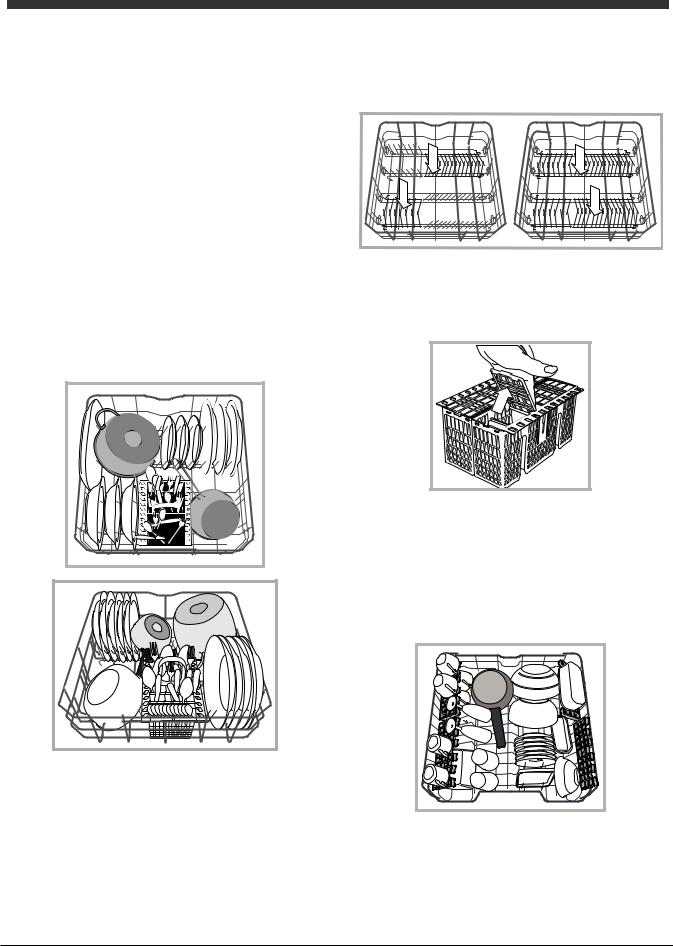
Loading the racks
|
EN |
Tips |
|
Before loading the racks, remove all food residues from the |
|
|
crockery and empty liquids from glasses and containers. No |
|
|
preventive rinsing is needed under running water. |
|
|
Arrange the crockery so that it is held in place firmly and does |
|
|
not tip over; and arrange the containers with the openings facing |
|
|
downwards and the concave/convex parts placed obliquely, |
|
|
thus allowing the water to reach every surface and flow freely. |
|
|
Make sure that the lids, handles, trays and frying pans do not |
|
|
prevent the sprayer arms from rotating. Place any small items |
|
|
in the cutlery basket. |
|
|
Since plastic dishes and non-stick frying pans usually retain more |
|
|
water drops, their drying will be not so good as that of ceramic |
|
|
or stainless-steel dishes. |
|
|
Lightweight items such as plastic containers should be placed |
|
|
in the upper rack and arranged so that they cannot move. |
|
|
After loading the appliance, make sure that the sprayer arms |
|
|
can rotate freely. |
Lower rack
The lower rack can hold pans, lids, dishes, salad bowls, cutlery etc. Large plates and lids should ideally be placed at the sides.
Several dishwasher models are fitted with tip-up sectors*. They can be used in a vertical position when arranging dishes or in a horizontal position (lower) to load pans and salad bowls easily.
Cutlery basket
The modular basket is equipped with top grilles for improved cutlery arrangement. The cutlery basket should be positioned only at the front of the lower rack
 Knives and other utensils with sharp edges must be placed in the cutlery basket with the points facing downwards or they must be positioned horizontally in the tip-up compartments on the upper rack
Very soiled dishes and pans should be placed in the lower rack because in this sector the water sprays are stronger and allow a higher washing performance.
*Only available in selected models with different numbers and positions.
Upper rack
Load this rack with delicate and lightweight crockery such as glasses, cups, saucers and shallow salad bowls.
Several dishwasher models are fitted with tip-up sectors*. They can be used in a vertical position when arranging tea/ dessert saucers or in a lower position to load bowls and food containers.
18

Tip-up compartments with adjustable position
The side tip-up compartments can be positioned at three different heights to optimize the arrangement of crockery inside the rack.
Wine glasses can be placed safely in the tip-up compartments by inserting the stem of each glass into the corresponding slots.
For optimum drying results incline
the tip-up compartments more. To
change the inclination, pull up the
tip-up compartment, slide it slightly and position it as you wish.
Cutlery tray*
Some dishwasher models are fitted with a sliding tray which can be used to hold serving utensils or small cups. For optimum washing performance avoid positioning bulky crockery directly below the tray. The cutlery tray can be removed (see Figure).
The upper rack can be adjusted for height based on requirements:
high position to place bulky crockery in the lower rack and low EN position to make the most of the tip-up compartments/sectors
by creating more space upwards.
Adjusting the height of the upper rack
In order to make it easier to arrange the crockery, the upper rack may be moved to a higher or lower position.
The height of the upper rack should be adjusted WHEN THE RACK IS EMPTY.
NEVER raise or lower the rack on one side only.
If the rack is equipped with a Lift-Up device* (see figure), lift it up by holding its sides. To restore the lower position, press the levers (A) at the sides of the rack and follow the rack down.
Unsuitable crockery
•Wooden crockery and cutlery.
•Delicate decorated glasses, artistic handicraft and antique crockery. Their decorations are not resistant.
•Parts in synthetic material which do not withstand high temperatures.
•Copper and tin crockery.
•Crockery soiled with ash, wax, lubricating grease or ink.
The colours of glass decorations and aluminium/silver pieces can change and fade during the washing process. Some types of glass (e.g. crystal objects) can become opaque after a number
of wash cycles too.
Damage to glass and crockery
Caused by:
•Type of glass and glass production process.
•Chemical composition of detergent.
•Water temperature of rinse cycle.
Tips:
•Only use glasses and porcelain guaranteed by the manufacturer as dishwasher safe.
•Use a delicate detergent suitable for crockery.
•Collect glasses and cutlery from the dishwasher as soon as the wash cycle is over.
*Only available in selected models.
19

|
Detergent and |
||||
|
dishwasher use |
||||
|
Starting the dishwasher |
||||
|
EN |
||||
|
1. Turn the water tap on. |
||||
|
2. Press the ON/OFF button. |
||||
|
3. Open the door and pour in a suitable amount of detergent |
||||
|
(see below). |
||||
|
4. Load the racks (see Loading the racks) and shut the door. |
||||
|
5. Select the wash cycle in accordance with the type of crockery |
||||
|
and its soil level (see Table of wash cycles) by pressing the P |
||||
|
button. |
||||
|
6. Select the wash options* (see Special wash cycles and |
||||
|
options.) |
||||
|
7. Start the cycle by pressing the Start/Pause button: The wash |
||||
|
indicator light goes on and the time left to the end of the cycle |
||||
|
appears on the display together with the wash-cycle number. |
||||
|
8. At the end of the cycle, the display shows END. Switch off the |
||||
|
appliance by pressing the ON/OFF button, shut off the water tap |
||||
|
and unplug the appliance from the electricity socket. |
||||
|
9. Wait a few minutes before removing the crockery to avoid |
||||
|
getting burnt. Unload the racks, beginning with the lower level. |
||||
|
— The machine will switch off automatically during long |
||||
|
periods of inactivity in order to minimise electricity |
||||
|
consumption. |
||||
|
AUTO WASH CYCLES*: some models of dishwasher are |
||||
|
equipped with a special sensor which can be used to assess |
||||
|
the level of soiling and automatically select the most efficient |
||||
|
and economic wash cycle accordingly. The duration of the auto |
||||
|
wash cycles may vary due to the operation of the sensor. |
||||
|
Changing a wash cycle in progress |
||||
|
If a mistake was made in the wash-cycle selection process, it is |
||||
|
possible to change the cycle provided that it has only just begun: |
||||
|
Once the wash cycle has started, in order to change the wash |
||||
|
cycle switch off the machine by pressing and holding the ON/ |
||||
|
OFF/Reset button. Switch it back on using the same button and |
||||
|
select the desired wash cycle and options. |
||||
|
Adding extra crockery |
||||
|
Press the Start/Pause button and open the door, taking care to |
||||
|
avoid the escaping steam. Then place the crockery inside the |
||||
|
dishwasher. Press the Start/Pause button: The cycle will start |
||||
|
again after a long beep has been emitted. |
||||
|
If the delayed start has been set, at the end of the countdown |
||||
|
the wash cycle will not start. It will stay in Pause mode. |
||||
|
Press the Start/Pause button to pause the machine; the wash |
||||
|
cycle is stopped. |
||||
|
At this stage the wash cycle cannot be changed. |
||||
|
Accidental interruptions |
||||
|
If the door is opened during the wash cycle or there is a power |
||||
|
cut, the cycle stops. It starts again from the point at which it |
||||
|
was interrupted once the door has been shut or the electricity |
||||
|
supply restored. |
||||
|
* Only available in selected models. |
Measuring out the detergent
A good wash result also depends on the correct amount of detergent being used. Exceeding the stated amount does not result in a more effective wash and increases environmental pollution.
Based on how soiled the items are, the amount can be adjusted to individual cases using powder or liquid detergent.
In the case of normally soiled items, use approximately either 35 gr (powder detergent) or 35 ml (liquid detergent). If tablets are used, one tablet will be enough.
If the crockery is only lightly soiled or if it has been rinsed with water before being placed in the dishwasher, reduce the amount of detergent used accordingly.
For good washing results also follow the instructions shown on the detergent box.
For further questions please ask the detergent producers. To open the detergent dispenser use the opening device “A”.
Introduce the detergent into the dry dispenser “B” only. Place the amount of detergent for pre-washing directly inside the tub.
1.When measuring out the detergent refer to the Table of wash cycles to add the proper quantity. Compartment B comprises a level showing the maximum quantity of liquid or powder detergent that can be added to each cycle.
2.Remove detergent residues from the edges of the dispenser and close the cover until it clicks.
3.Close the lid of the detergent dispenser by pulling it up until the closing device is secured in place.
The detergent dispenser automatically opens up at the right time according to the wash cycle.
If all-in-one detergents are used, we recommend using the TABS option, because it adjusts the cycle so that the best washing and drying results are always achieved.
 Only use detergent which has been specifically designed for dishwashers.
DO NOT USE washing up liquid.
Using excessive detergent may result in foam residues remaining in the machine after the cycle has ended.
To achieve the best washing and drying results, the combined use of detergent, rinse aid liquid and refined salt is required.
We recommend using detergents that do not contain phosphates or chlorine, as these products are harmful to the environment.
20

Wash cycles
|
Wash-cycle data is measured under laboratory conditions according to European Standard EN 50242. |
||
|
EN |
||
|
Based on the different conditions of use, the wash-cycle duration and data can change. |
||
 The number and type of wash cycles and options may vary depending on the dishwasher model.
|
Wash Cycle |
Water |
Energy |
|||||||||
|
Wash Cycle |
Drying |
Options |
Consumption |
Consumption |
|||||||
|
Duration |
|||||||||||
|
(l/cycle) |
(kWh/cycle) |
||||||||||
|
1. |
Eco |
Yes |
Delayed start – Tabs – |
03:10’ |
9,0 |
0,93 |
|||||
|
Half Load |
|||||||||||
|
2. |
Intensive |
Yes |
Delayed start – Tabs – |
02:00’ — 03:10’ |
14,0 — 15,5 |
1,50 — 1,80 |
|||||
|
Half Load |
|||||||||||
|
3. |
Normal |
Yes |
Delayed start – Tabs – |
01:30’ — 02:30’ |
14,5 — 16,0 |
1,20 — 1,35 |
|||||
|
Half Load |
|||||||||||
|
4. |
Delicates |
Yes |
Delayed start – Tabs – |
01:40’ |
11,0 |
1,10 |
|||||
|
Half Load |
|||||||||||
|
5. |
Rapid |
No |
Delayed start – Tabs |
00:30’ |
9,0 |
0,50 |
|||||
|
6. |
Prewash |
No |
Delayed start – Half Load |
00:12’ |
4,5 |
0,01 |
|||||
|
7. |
Hygiene |
Yes |
Delayed start |
01:20’ |
10,0 |
1,25 |
|||||
|
8. |
Extra |
No |
Delayed start — Extra Light (Half Load) |
01:00’ |
11,0 |
n.a. |
|||||
Instructions on wash-cycle selection and detergent dosage
1. The ECO wash cycle is the standard cycle to which the energy label data refers. It can be used to wash crockery with a normal soil level and is the most efficient cycle in terms of energy and water consumption for this type of crockery.
29 gr/ml + 6 gr/ml** – 1 Tab (**Quantity of pre-washing detergent)
2.Heavily soiled dishes and pans (not to be used for delicate items). 35 gr/ml – 1 Tab
3.Normally soiled pans and dishes. 29 gr/ml + 6 gr/ml** – 1 Tab
4.Cycle for delicate items, which are more sensitive to high temperatures 35 gr/ml – 1 Tab
5.Fast cycle to be used for slightly dirty dishes (ideal for 2 place settings) 25 gr/ml – 1 Tab
6.Pre-wash while awaiting completion of the load with the dishes from the next meal. No detergent.
7.High-temperature disinfecting cycle. Ideal to clean crockery and feeding bottles. 30 gr/ml – 1 Tab
8 Large crockery. (Do not use on delicate items) 35 gr/ml – 1 Tab
Standby consumption: Left-on mode consumption: 5,0 W — Off mode consumption: 0.5 W n.a. non applicable
Notes:
Optimum performance levels when using the “Rapid” cycle can be achieved by respecting the specified number of place settings.
To reduce consumption even further, only run the dishwasher when it is full.
Note for Test Laboratories: for information on comparative EN testing conditions, please send an email to the following address: assistenza_en_lvs@indesitcompany.com
21

Special wash cycles and Options
Wash cycle EXTRA
EN EXTRA makes it possible to carry out a heavy-duty wash cycle of large crockery up to a max height of 53cm: baking pans, oven grids, dripping pans, hob grids, large saucepans, serving dishes, pizza dishes, stainless-steel hood filters.
Remove the upper rack to load bulky crockery.
Release the two locks (right and left) and pull out the rack.
When the upper rack is fitted, the locks must be always closed.
In order for the water to reach the crockery everywhere, arrange it as shown in the Figure.
The cycle can also be used on large delicate crockery using the option Extra Light (see Wash Options).
Do not start the dishwasher without the upper rack using wash cycles other than EXTRA.
To carry out the wash cycle Extra and Extra with the Light* option pour the detergent directly into the tub and not into the dispenser.
Wash options*
The OPTIONS may only be set, changed or reset after the wash cycle has been selected and before the Start/Pause button has been pressed.
Only the options which are compatible with the type of wash cycle set may be selected. If an option is not compatible with the selected wash cycle (see Table of wash cycles), the corresponding symbol flashes rapidly 3 times.
If an option is selected which is not compatible with another (previously selected) option, it will flash 3 times and switch off, while the most recently selected option will remain active.
To deselect an option which has been set by mistake, press the corresponding button again.
* Only available in selected models.
Half load/Extra light
The button has two functions: HALF LOAD and
EXTRA LIGHT.
Select the wash cycle and press the HALF LOAD/ EXTRA LIGHT button; the indicator light will go on.
Press the HALF LOAD/EXTRA LIGHT button again to deselect this option.
Half Load
If there are not many dishes to be washed, a half load cycle may be used in order to save water, electricity and detergent.
The amount of detergent can be halved.
Extra Light
Compatible with the wash cycle EXTRA only.
This option makes EXTRA suitable to large delicate crockery and items. This option includes no drying phase.
 Make sure the crockery and items are dishwasher-safe.
Multi-functional tablets (Tabs)
This option optimises washing and drying results.
When using multi-functional tablets, press the MULTIFUNCTIONAL TABLETS button; the corresponding symbol will light up. If the button is pressed again, the option will be deselected.
 The “Multi-functional tablets” option results in a longer wash cycle.
 The use of tablets is only recommended for models having this option and it is not recommended with wash cycles which do not specify the use of multi-functional tablets.
Delayed start
It is possible to delay the start time of the cycle by a period of time between 1 and 24 hours:
1.Select the desired wash cycle and any other options required; press the DELAYED START button. The indicator light will go on. Use the same button to select when the wash cycle will start
(h01, h02 etc.)
2.Confirm the selection using the START/PAUSE button to start the countdown.
3.Once this time has elapsed, the DELAYED START indicator light goes off and the wash cycle begins.
To deselect the DELAYED START option, press the DELAYED START button until the text OFF appears.
The Delayed Start function cannot be set once a wash cycle has started.
22

Care and maintenance
|
Shutting off the water and electricity |
|
|
supplies |
|
|
• |
Turn off the water tap after every wash cycle to avoid leaks. |
|
• |
Always unplug the appliance when cleaning it and when |
|
performing maintenance work. |
|
|
Cleaning the dishwasher |
|
|
• |
The external surfaces of the machine and the control panel |
|
can be cleaned using a non-abrasive cloth which has been |
|
|
dampened with water. Do not use solvents or abrasive |
|
|
products. |
|
|
• |
Any marks on the inside of the appliance may be removed |
|
using a cloth dampened with water and a little vinegar. |
|
|
Preventing unpleasant odours |
|
|
• |
Always keep the door of the appliance ajar in order to avoid |
|
moisture from forming and being trapped inside the machine. |
|
|
• |
Clean the seals around the door and detergent dispensers |
|
regularly using a damp sponge. This will avoid food becoming |
|
|
trapped in the seals, which is the main cause behind the |
|
|
formation of unpleasant odours. |
|
|
Cleaning the sprayer arms |
|
|
Food residue may become encrusted onto the sprayer arms |
|
|
and block the holes used to spray the water. It is therefore |
|
|
recommended that you check the arms from time to time and |
|
|
clean them with a small non-metallic brush. |
|
|
The two sprayer arms may both be removed. |
|
|
To remove the upper sprayer arm, |
|
|
turn the plastic locking ring in an |
|
|
anti-clockwise direction. The upper |
|
|
sprayer arm should be replaced |
|
|
so that the side with the greater |
|
|
number of holes is facing upwards. |
|
The lower sprayer arm can be |
|
removed by pressing on the side |
|
tabs and pulling it upwards. |
|
Cleaning the water inlet filter* |
If the water hoses are new or have not been used for an extended period of time, let the water run to make sure it is clear and free of impurities before performing the necessary connections. If this precaution is not taken, the water inlet could become blocked and damage the dishwasher.
Clean the water inlet filter at the tap outlet regularly.
—Turn off the water tap.
—Unscrew the end of the water inlet hose, remove the filter and clean it carefully under running water.
—Re-place the filter and screw the water hose back into position.
|
Cleaning the filters |
|||
|
EN |
|||
|
The filter assembly consists of three filters which remove food |
|||
|
residues from the washing water and then recirculate the water. |
|||
|
They should be cleaned if you wish to achieve the best results |
|||
|
in every wash. |
|||
|
Clean the filters regularly. |
|||
|
The dishwasher should not be used without filters or if the |
|||
|
filter is loose. |
• After several washes, check the filter assembly and if necessary clean it thoroughly under running water, using a non-metallic brush and following the instructions below:
1.Turn the cylindrical filter C in an anti-clockwise direction and pull it out (fig. 1).
2.Remove the cup filter B by exerting a slight pressure on the side flaps (fig. 2);
3.Slide out the stainless-steel plate filter A. (fig. 3).
4.Inspect the trap and remove any food residues. NEVER
REMOVE the wash-cycle pump protection (black detail) (fig.4).
After cleaning the filters, re-place the filter assembly and fix it in position correctly; this is essential for maintaining the efficient operation of the dishwasher.
Leaving the machine unused for extended periods
•Disconnect the appliance from the electricity supply and shut off the water tap.
•Leave the door of the appliance ajar.
•When you return, run a wash cycle when the dishwasher is empty.
*Only available in selected models.
23

Troubleshooting
|
Whenever the appliance fails to work, check for a solution from the following list before calling for Assistance. |
||||
|
EN |
||||
|
Problem: |
Possible causes / Solutions: |
|||
|
The dishwasher does not start or |
• Switch off the appliance by pressing the ON/OFF button, switch it back on after |
|||
|
approximately one minute and reset the program. |
||||
|
cannot be controlled. |
• The appliance has not been plugged in properly. |
|||
|
• The dishwasher door has not been shut properly. |
||||
|
The door won’t close. |
• The lock was released. Strongly push the door until a “clacking” noise is heard. |
|||
|
No water drains out from the |
• The dishwasher cycle has not yet finished. |
|||
|
• The water inlet hose is bent (see Installation). |
||||
|
dishwasher. |
• The drain duct is blocked. |
|||
|
• The filter is clogged up with food residues. |
||||
|
The dishwasher makes excessive |
• The dishes are rattling against each other or against the sprayer arms. |
|||
|
noise. |
• Excessive foam presence: the detergent has not been measured out correctly or it is not |
|||
|
suitable for use in dishwashers. (see Start-up and use). |
||||
|
The dishes and glasses are |
• The level of the refined salt is low or the dosage setting is not suited to the hardness of |
|||
|
the water (see Rinse aid and salt). |
||||
|
covered in a white film or |
||||
|
• The lid on the salt dispenser is not closed properly. |
||||
|
limescale deposits. |
||||
|
• The rinse aid has been used up or the dosage is too low. |
||||
|
The dishes and glasses are |
• The rinse aid dosage is too high. |
|||
|
streaked or have a bluish tinge. |
||||
|
The crockery has not been dried |
• A wash cycle without a drying programme has been selected. |
|||
|
• The rinse aid has been used up or the dosage is too low (see Rinse aid and salt). |
||||
|
properly. |
• The rinse aid dispenser setting is not high enough. |
|||
|
• The crockery is made from non-stick material or plastic. |
||||
|
• The racks are overloaded (see Loading the racks). |
||||
|
• The crockery has not been arranged well. |
||||
|
• The sprayer arms cannot move freely. |
||||
|
The dishes are not clean. |
• The wash cycle is too gentle (see Wash cycles). |
|||
|
• Excessive foam presence: the detergent has not been measured out correctly or it is not |
||||
|
suitable for use in dishwashers. (see Start-up and use). |
||||
|
• The lid on the rinse aid compartment has not been shut correctly. |
||||
|
• The filter is dirty or blocked (see Care and maintenance). |
||||
|
• The refined salt level is low (see Rinse aid and salt). |
||||
|
The dishwasher does not take any |
• There is no water in the mains supply. |
|||
|
water in — Tap shut-off alarm. |
• The water inlet hose is bent (see Installation.) |
|||
|
• Turn on the tap and the appliance will start after a few minutes. |
||||
|
(indicator light ON/OFF flashing; |
• The appliance stopped because no action was taken when the beep sounded*. |
|||
|
H2O displayed; F 6 appears after a |
Switch off the machine using the ON/OFF button, turn on the tap and switch the machine |
|||
|
few seconds). |
back on after a few seconds by pressing the same button. Re-program the appliance and |
|||
|
restart the wash cycle. |
* Only available in selected models.
24
 Loading…
Перейти к контенту

Русские электронные инструкции по эксплуатации
Постоянно обновляемый большой каталог документации по эксплуатации и использованию современных устройств и оборудования на русском языке. Бесплатное скачивание файлов.
Поиск:
Главная
Просмотр инструкции в pdf


Инструкция по эксплуатации посудомоечной машины Indesit DFP 58T94 CA NX EU.
Скачать инструкцию к посудомоечной машине Indesit DFP 58T94 CA NX EU (3,09 МБ)

Инструкции по эксплуатации посудомоечных машин Indesit
« Инструкция к посудомоечной машине Maunfeld MWF08S
» Инструкция к посудомоечной машине Electrolux ESF2400OH
Вам также может быть интересно
.jpg)
Инструкция к стиральной машине Indesit IWB 6105 (CIS)

Инструкция к стиральной машине Indesit TMIL 585 CIS
.L.jpg)
Инструкция к стиральной машине Indesit IWE 7105 B (CIS).L

Инструкция к стиральной машине Indesit BWSE 61251 1

Инструкция к стиральной машине Indesit BTW E71253P
-RU.jpg)
Инструкция к электрической плите Indesit MVI5V22(W)-RU

Инструкция к газовой плите Indesit IS5G4KHX-RU
.jpg)
Инструкция к стиральной машине Indesit IWD 71051 (CIS)
Добавить комментарий
Имя *
Email *
Сайт
Комментарий


Сохранить моё имя, email и адрес сайта в этом браузере для последующих моих комментариев.
- Добавить инструкцию
- Заказать инструкцию
- Политика конфиденциальности

2
RU
Меры предосторожности
и рекомендации
Изделие спроектировано и изготовлено
в соответствии с международными
нормативами по безопасности. Настоящие
инструкции составлены в целях вашей
безопасности и должны быть внимательно
прочитаны.
Важно сохранить данное руководство
для его последующих консультации. В
случае продажи, передачи или переезда
проверьте, чтобы данное техническое
руководство сопровождало изделие.
Необходимо внимательно прочитать
настоящие инструкции: в них содержатся
важные сведения об установке изделия,
его эксплуатации и безопасности.
Данное изделие предназначено для
бытового или другого аналогичного
использования, например:
— в агротуристических усадьбах;
— для использования проживающими в
гостинице, мотеле и в других временных
местах проживания;
— в гостиницах типа «номер с завтраком».
Снимите упаковку с изделия и проверьте,
чтобы на нем не было повреждений,
нанесенных при транспортировке.
При обнаружении повреждений не
подсоединяйте машину, а обратиться к
продавцу.
Общие требования к безопасности
• Данный бытовой электроприбор может
быть использован детьми не младше
8 лет и лицами с ограниченными
физическими сенсорными или
умственными способностями или не
обладающими достаточным опытом или
знанием о работе подобного прибора,
под наблюдением или после обучения
безопасному пользованию прибором и
усвоения связанных с ним опасностей.
• Не разрешайте детям играть с прибором.
• Чистка и уход за прибором должны
выполняться пользователем. Не поручать
чистку и уход детям без контроля.
• Данное изделие предназначается для
непрофессионального использования в
домашних условиях.
• Изделие предназначено для мытья
посуды в домашних условиях, может
быть использовано только в соответствии
с инструкциями, приведенными в данном
техническом руководстве.
• Запрещается устанавливать изделие
на улице, даже под навесом, так как
воздействие на него дождя и грозы
является чрезвычайно опасным.
• Не прикасайтесь к посудомоечной
машине с босыми ногами.
• Не тяните за сетевой кабель для
отсоединения вилки изделия из сетевой
розетки, возьмитесь за штепсельную
вилку рукой.
• Необходимо перекрыть водопроводный
кран и вынуть штепсельную вилку из
сетевой розетки в конце каждого цикла
и перед началом чистки и технического
обслуживания.
• Максимальное количество столовых
приборов указывается в технической
спецификации изделия.
• В случае неисправности категорически
запрещается открывать внутренние
механизмы изделия с целью их
самостоятельного ремонта.
• Не опирайтесь и не садитесь на открытую
дверцу машины: машина может
опрокинуться.
• Не держите дверцу открытой, так как об
нее можно случайно споткнуться.
• Храните моющие средства и
ополаскиватель вдали от детей.
• Не разрешайте детям играть с
упаковочными материалами.
• Ножи и кухонные принадлежность с
заостренными краями необходимо
укладывать острым концом/лезвием вниз
в корзине для столовых приборов или в
горизонтальном положении на откидных
полках или в лоток/третью корзину в
моделях, где предусмотрен.
Утилизация
• Утилизация упаковочных материалов:
соблюдайте местные нормативы по
утилизации упаковочных материалов.
• Согласно Европейской Директиве 2012/19/
СЕ касательно утилизации электронных
и электрических электроприборов
(RAEE), электроприборы не могут
утилизироваться вместе с обычным
городским мусором. Выведенные из
строя приборы должны собираться
отдельно для оптимизации их утилизации
и рекуперации составляющих их
материалов, а также для безопасности
окружающей среды и здоровья человека.
Символ зачеркнутая мусорная корзинка,
Руководство пользователя INDESIT DFP 58T94 CA NX EU. Основные функции, характеристики и условия эксплуатации изложены на 72 страницах документа в pdf формате.
Просмотр
Доступно к просмотру 68 страниц. Рекомендуем вам скачать файл инструкции, поскольку онлайн просмотр документа может сильно отличаться от оригинала.
-
DFP 58T94
RU   Русский                                                                       ??????? AR
Руководство по эксплуатации                                                   ??????? ???????
ПОСУДОМОЕЧНАЯ МАШИНА - Оглавление                                        ????????? - ??????? ??? ??????
Руководство по эксплуатации, 1
Меры предосторожности и рекомендации, 2-3                                          1 ,??????? ???????
Установка, 10-11                                                               5-6 ??????? ????????
Техническая спецификация изделия, 12
Описание изделия, 13                                                                   9 ?????????
Регенерирующая соль и Ополаскиватель, 14                                            48-49 ????????
Загрузка корзин, 15-16                                                             50 ??????? ???
Моющее средство и использование посудомоечной машины, 17             51 ????????? ????? ????? ??????? ???
Программы, 18                                                                   52-53 ??????? ?????
Специальные программы и Допольнительные функции, 19
Техническое обслуживание и уход, 20                             54 ???????? ??? ?????? ???????? ??????? ????
Неисправности и методы их устранения, 21                                           55 ??????? ?????
Сервисное обслуживание, 22                                             56 ?????????? ?????? ????? ?????
57 ????????? ???????
UA     Українська                                                          58 ?????? ??????? ???????
Довідник користувача
ПОСУДОМИЙНА МАШИНА - Зміст                                                          ?????  FA
Довідник користувача,1
Запобіжні заходи та поради, 3-4                                        ?????? ?????????????
Допомога, 9
Встановлення, 23-24
Опис приладу, 25                                                        ????? ????? – ??????? ?????
Регенераційна сіль і ополіскувач, 26                                           1 ??????? ?????????????
Як завантажити короби, 27-28                                             6-7-8 ????????? ? ??????? ????
Миючий засіб і використання посудомийної машини, 29
Програми, 30                                                                         9 ?????? ???
Спеціальні програми й опції, 31                                                       60-61 ????
Догляд та очищення, 32                                                             62 ??????? ?????
Несправності та засоби їх усунення, 33                               63 ?????? ??? ???? ? ??? ????? ???
64-65 ??? ???? ?? ???? ???? ????
KZ   ?аза?ша                                                      66 ???????? ????? ?? ??????? ? ?????? ????
67 ?????? ??? ??????
Пайдалану н?с?аулы?ы                                                 68 ??? ????? ? ???? ?????? ??? ??????
69 ??????? ? ???????
ЫДЫС ЖУУ МАШИНАСЫ - Мазм?ны                                                           70 ????? ???
Пайдалану н?с?аулы?ы, 1
Са?ты? шаралары мен ке?ес, 4-5
К?мек, 9
Орнату, 35-36
?нім пара?шасы, 37
??рыл?ы сипаттамасы, 38
Тазалан?ан т?з ж?не шаю?а к?мекші зат, 39
Тартпалар?а ж?ктеу, 40-41
Жу?ыш зат пен ыдыс жуу машинасын ?олдану, 42
Жуу циклдары, 43
Арнайы жуу циклдары мен опциялары, 44
К?тім ж?не техникалы? ?ызмет к?рсету, 45
А?аулы?тарды жою, 46
-
Меры предосторожности                         с инструкциями, приведенными в данном
техническом руководстве.
RU
и рекомендации                              •  Запрещается устанавливать изделие
Изделие спроектировано и изготовлено               на улице, даже под навесом, так как
в  соответствии  с  международными                    воздействие на него дождя и грозы
является чрезвычайно опасным.
нормативами по безопасности. Настоящие              •  Не  прикасайтесь  к  посудомоечной
инструкции составлены в целях вашей                   машине с босыми ногами.
безопасности и должны быть внимательно              •  Не  тяните  за  сетевой  кабель  для
прочитаны.                                            отсоединения вилки изделия из сетевой
Важно сохранить данное руководство                    розетки, возьмитесь за штепсельную
для его последующих консультации. В                   вилку рукой.
случае продажи, передачи или переезда               •  Необходимо перекрыть водопроводный
проверьте, чтобы данное техническое                   кран и вынуть штепсельную вилку из
руководство сопровождало изделие.                     сетевой розетки в конце каждого цикла
Необходимо  внимательно  прочитать                    и перед началом чистки и технического
настоящие инструкции: в них содержатся                обслуживания.
важные сведения об установке изделия,               •  Максимальное количество столовых
его эксплуатации и безопасности.                      приборов указывается в технической
спецификации изделия.
Данное  изделие  предназначено  для                 •  В случае неисправности категорически
бытового  или  другого  аналогичного                  запрещается  открывать внутренние
использования, например:                              механизмы  изделия  с  целью  их
- в агротуристических усадьбах;                       самостоятельного ремонта.
- для использования проживающими в                  •  Не опирайтесь и не садитесь на открытую
гостинице, мотеле и в других временных                дверцу  машины:  машина  может
местах проживания;                                    опрокинуться.
- в гостиницах типа «номер с завтраком».            •  Не держите дверцу открытой, так как об
Снимите упаковку с изделия и проверьте,               нее можно случайно споткнуться.
чтобы на нем  не  было повреждений,                 •  Храните  моющие  средства  и
нанесенных  при  транспортировке.                     ополаскиватель вдали от детей.
При  обнаружении  повреждений  не                   •  Не  разрешайте  детям  играть  с
подсоединяйте машину, а обратиться к                  упаковочными материалами.
продавцу.                                           • Ножи и кухонные принадлежность с
заостренными  краями  необходимо
Общие требования к безопасности                       укладывать острым концом/лезвием вниз
•  Данный бытовой электроприбор может                 в корзине для столовых приборов или в
быть использован детьми не младше                   горизонтальном положении на откидных
8  лет  и  лицами  с  ограниченными                 полках или в лоток/третью корзину в
физическими  сенсорными  или                        моделях, где предусмотрен.
умственными способностями или не                  •  Прибор должен быть подсоединен к
обладающими достаточным опытом или                  водопроводу посредством новой трубы
знанием о работе подобного прибора,                 подачи, не использовать старую трубу
под наблюдением или после обучения                  для подачи.
безопасному пользованию прибором и                •  Если  посудомоечная  машина  не
усвоения связанных с ним опасностей.                встраивается в мебельный элемент, ее
•  Не разрешайте детям играть с прибором.             задняя панель должна быть обращена к
•  Чистка и уход за прибором должны                   стене.
выполняться пользователем. Не поручать
чистку и уход детям без контроля.                 Утилизация
•  Данное изделие предназначается для               •  Утилизация упаковочных материалов:
непрофессионального использования в                 соблюдайте местные нормативы по
домашних условиях.                                  утилизации упаковочных материалов.
•  Изделие  предназначено  для  мытья               •  Согласно Европейской Директиве 2012/19/
посуды в домашних условиях, может                   СЕ касательно утилизации электронных
быть использовано только в соответствии             и  электрических  электроприборов
2
-
(RAEE),  электроприборы  не  могут                стандартів безпеки. Це попередження
утилизироваться вместе с обычным                  надаються задля вашої безпеки: уважно
городским мусором. Выведенные из                  ознайомтеся з ними.
строя  приборы  должны  собираться
отдельно для оптимизации их утилизации            Збережіть цю брошуру, щоб мати нагоду
и  рекуперации  составляющих  их                  звернутися до неї у будь-який момент.
материалов, а также для безопасности              У разі продажу, передачi iншiй особi або
окружающей среды и здоровья человека.             переїзду переконайтеся в тому, що вона
Символ зачеркнутая мусорная корзинка,             залишається разом з виробом.
имеющийся на всех приборах, служит                Уважно вивчіть інструкції: в них міститься
напоминанием  об  их  отдельной                   важлива інформація щодо встановлення,
утилизации.                                       використання та безпеки.
За  более  подробной  информацией
о  правильной  утилизации  бытовых                Цей прилад призначений для побутового
электроприборов  пользователи                     або аналогічного призначення, наприклад:
могут  обратиться  в  специальную                 - у великих сільських будівлях;
государственную организацию или в                 - використання з боку клієнтів у готелях,
магазин.                                          мотелях і інших готельних структурах;
- у пансіонах зі сніданками.
Энергосбережение и охрана
окружающей среды                                    Звільніть  прилад  від  упаковки  і
переконайтеся у відсутності пошкоджень
Экономия воды и электроэнергии                      внаслідок  перевезення.  За  наявностi
•  Используйте посудомоечную машину                 пошкоджень  не  виконуйте  нiяких
только с полной загрузкой. В ожидании             пiдключень  та  негайно  зверніться  до
полного заполнения машины избежать                постачальника.
образования неприятных запахов можно
с помощью цикла Ополаскивание  (где               Загальна безпека
доступен - см.Программы).                         •  Цей електропобутовий прилад може
•  Выбирайте  программу  мойки,                       використовуватися  дітьми  віком
подходящую для данного типа посуды                  старше 8 років і особами з обмеженими
и степени загрязнения в соответствии с              фізичними, сенсорними чи розумовими
Таблицей программ:                                  можливостями або з браком досвіду та
-  для  нормально  грязной  посуды                  необхідних знань, коли користування
используйте  программу  Есо,                        відбувається під уважним наглядом
обеспечивающую  низкий  расход                      або за вказівками щодо безпечного
электроэнергии и воды.                              використання  приладу  від  осіб,
- если машина загружена не полностью,               відповідальних за їхню безпеку.
включите дополнительную функцию                   •  Діти   не  п ови нні  г ра ти ся   з
Половина  загрузки  (где  доступна,  см.            електропобутовим приладом.
Специальные  программы  и  Дополнительные         •  Очищення  і  догляд  за  приладом
функции).                                           поглядається на користувача. Ці операції
•  Если  ваш  контракт  с  поставщиком                не повинні виконуватися дітьми без
электроэнергии  предусматривает                     нагляду.
разные часовые тарифы для экономии                •  Прилад призначений для непрофесійного
электроэнергии, пользуйтесь машиной                 використання  всередині  житлових
во  время  с  льготным  тарифом.                    приміщень.
Дополнительная  функция  Запуск  с                •  Прилад має використовуватися для
задержкой  поможет  оптимально                      миття посуду та столових приборiв, згідно
организовать  мойку  (где  доступна,                інструкціям, вказаним у цій брошурі.
см.Специальные программы и Дополнительные         •  Забороняється встановлювати прилад
функции).                                           поза приміщенням, навіть в захищених
мiсцях,  тому  що  дуже  небезпечно
UA  Запобіжні заходи та поради                       піддавати його впливу дощу і грози.
•  Не торкайтеся посудомийної машини
Посудомийна машина розроблена і                    голими ногами.
вироблена відповідно до міжнародних                 •  Не виймайте вилку з розетки, потягнувши
3
Português, 30
Operating instructions
English, 1
EN
DFP 58T94
DISHWASHER
Contents
Product Fiche, 2
Precautions and advice, 3
General safety
Disposal
Saving energy and respecting the environment
Installation and Assistance, 4-5
Positioning and levelling
Connecting the water and electricity supplies
Advice regarding the first wash cycle
Technical data
Description of the appliance, 6
Overall view
Control panel
Loading the racks, 7-8
Lower rack
Cutlery basket
Upper rack
Adjusting the upper rack
Unsuitable crockery
Start-up and use, 9
Starting the dishwasher
Measuring out the detergent
Wash cycles, 10
Table of wash cycles
Special wash cycles and Options, 11
Rinse aid and refined salt, 12
Measuring out the rinse aid
Measuring out the refined salt
Care and maintenance, 13
Shutting off the water and electricity supplies
Cleaning the dishwasher
Preventing unpleasant odours
Cleaning the sprayer arms
Cleaning the water inlet filter
Cleaning the filters
Leaving the machine unused for extended periods
Troubleshooting, 14
TR
RU
Türkçe,
44
PT
Русский, 58
FR
Français, 15