
Table of Contents: Beurer medical PO 30 Medical Equipment Owner’s Manual
-
Beurer medical PO 30 − on fingers that have nail varnish on, are dirty or have a plaster or other dressing on them. − on large fingers that do not fit into the device easily (fingertip: width approx. > 20 mm, thickness >15 mm). − on fingers with anatomical changes, oedemas, scars or burns. − on fingers that are too small, as with small children for example (width approx. < 10 mm, thickness < 5 mm). − on patients who are not steady at the site of application (e.g. trembling). − near flammable or explosive gas
-
Beurer medical PO 30 PO 30 BEURER GmbH • Söflinger Str. 218 • 89077 Ulm (Germany) Tel.: +49 (0) 731 / 39 89-144 • Fax: +49 (0) 731 / 39 89-255 www.beurer.com • Mail: [email protected] Pulsoximeter DEUTSCH Sehr geehrte Kundin, sehr geehrter Kunde, wir freuen uns, dass Sie sich für ein Produkt unseres Sortimentes entschieden haben. Unser Name steht für hochwertige und eingehend geprüfte Qualitätsprodukte aus den Bereichen Wärme, Gewicht, Blutdruck, Körpertemperatur, Puls, Sanfte Therapie, Massage, Beauty, Baby und Luft. Bitte lesen Sie diese Gebrauchsanweisung aufmerksam durch, bewahren Sie s
-
Beurer medical PO 30 PO 30 BEURER GmbH • Söflinger Str. 218 • 89077 Ulm (Germany) Tel.: +49 (0) 731 / 39 89-144 • Fax: +49 (0) 731 / 39 89-255 www.beurer.com • Mail: [email protected] Pulsoximeter DEUTSCH Sehr geehrte Kundin, sehr geehrter Kunde, wir freuen uns, dass Sie sich für ein Produkt unseres Sortimentes entschieden haben. Unser Name steht für hochwertige und eingehend geprüfte Qualitätsprodukte aus den Bereichen Wärme, Gewicht, Blutdruck, Körpertemperatur, Puls, Sanfte Therapie, Massage, Beauty, Baby und Luft. Bitte lesen Sie diese Gebrauchsanweisung aufmerksam durch, bewahren Sie sie für späteren Gebrauch auf, mache
-
Beurer medical PO 30 − on fingers that have nail varnish on, are dirty or have a plaster or other dressing on them. − on large fingers that do not fit into the device easily (fingertip: width approx. > 20 mm, thickness >15 mm). − on fingers with anatomical changes, oedemas, scars or burns. − on fingers that are too small, as with small children for example (width approx. < 10 mm, thickness < 5 mm). − on patients who are not steady at the site of application (e.g. trembling). − near flammable or exp
-
Beurer medical PO 30 − on fingers that have nail varnish on, are dirty or have a plaster or other dressing on them. − on large fingers that do not fit into the device easily (fingertip: width approx. > 20 mm, thickness >15 mm). − on fingers with anatomical changes, oedemas, scars or burns. − on fingers that are too small, as with small children for example (width approx. < 10 mm, thickness < 5 mm). − on patients who are not steady at the site of application (e.g. trembling). − near flamma
-
Beurer medical PO 30 PO 30 BEURER GmbH • Söflinger Str. 218 • 89077 Ulm (Germany) Tel.: +49 (0) 731 / 39 89-144 • Fax: +49 (0) 731 / 39 89-255 www.beurer.com • Mail: [email protected] Pulsoximeter DEUTSCH Sehr geehrte Kundin, sehr geehrter Kunde, wir freuen uns, dass Sie sich für ein Produkt unseres Sortimentes entschieden haben. Unser Name steht für hochwertige und eingehend geprüfte Qualitätsprodukte aus den Bereichen Wärme, Gewicht, Blutdruck, Körpertemperatur, Puls, Sanfte Therapie, Massage, Beauty, Baby und Luft. Bitte lesen Sie diese Gebrauchsanweisung aufme
-
▶ xxkdhrt//§bneülld7653…hge Art.Nr.: 27008 zum Produkt … Blutdruck & Tens zur Kategorie… Bedienungsanleitung BEURER Fingerpulsoximeter PO 30
-
PO 30 BEURER GmbH • Söflinger Str. 218 • 89077 Ulm (Germany) Tel.: +49 (0) 731 / 39 89-144 • Fax: +49 (0) 731 / 39 89-255 www.beurer.com • Mail: [email protected] Pulsoximeter DEUTSCH Sehr geehrte Kundin, sehr geehrter Kunde, wir freuen uns, dass Sie sich für ein Produkt unseres Sortimentes entschieden haben. Unser Name steht für hochwertige und eingehend geprüfte Qualitätsprodukte aus den Bereichen Wärme, Gewicht, Blutdruck, Körpertemperatur, Puls, Sanfte Therapie, Massage, Beauty, Baby und Luft. Bit
-
Beurer medical PO 30 − on fingers that have nail varnish on, are dirty or have a plaster or other dressing on them. − on large fingers that do not fit into the device easily (fingertip: width approx. > 20 mm, thickness >15 mm). − on fingers with anatomical changes, oedemas, scars or burns. − on fingers that are too small, as with small children for example (width approx. < 10 mm, thickness < 5 mm). − on patients who are not steady at the site of application (e.g. trembling). − near flammable or explosive gas mixtures. • Using the device for long periods may cause pain for people with circulatory dis
-
PO 30 BEURER GmbH • Söflinger Str. 218 • 89077 Ulm (Germany) Tel.: +49 (0) 731 / 39 89-144 • Fax: +49 (0) 731 / 39 89-255 www.beurer.com • Mail: [email protected] Pulsoximeter DEUTSCH Sehr geehrte Kundin, sehr geehrter Kunde, wir freuen uns, dass Sie sich für ein Produkt unseres Sortimentes entschieden haben. Unser Name steht für hochwertige und eingehend geprüfte Qualitätsprodukte aus den Bereichen Wärme, Gewicht, Blutdruck, Körpertemper
-
Sport-Tec Physio & Fitness Lemberger Straße 255 D-66955 Pirmasens Tel.: 0 63 31/14 80-0 Fax: 0 63 31/14 80-220 [email protected] www.sport-tec.de
-
Beurer medical PO 30 PO 30 BEURER GmbH • Söflinger Str. 218 • 89077 Ulm (Germany) Tel.: +49 (0) 731 / 39 89-144 • Fax: +49 (0) 731 / 39 89-255 www.beurer.com • Mail: [email protected] Pulsoximeter DEUTSCH Sehr geehrte Kundin, sehr geehrter Kunde, wir freuen uns, dass Sie sich für ein Produkt unseres Sortimentes entschieden haben. Unser Name steht für hochwertige und eingehend geprüfte Qualitätsprodukte aus den Bereichen Wärme, Gewicht, Blutdruck, Körpertemperatur, Puls, Sanfte Therapie, Massage, Beauty, Baby und Luft. Bitte lesen Sie diese Gebrauchsanweisung aufmerksam durch
Questions, Opinions and Exploitation Impressions:
You can ask a question, express your opinion or share our experience of Beurer medical PO 30 device using right now.
Sehr geehrte Kundin, sehr geehrter Kunde, wir freuen uns, dass Sie sich fr ein Produkt unseres Sortimentes entschieden haben. Unser Name steht fr hochwertige und eingehend geprfte Qualittsprodukte aus den Bereichen Wrme, Gewicht, Blutdruck, Krpertemperatur, Puls, Sanfte Therapie, Massage, Beauty, Baby und Luft. Bitte lesen Sie diese Gebrauchsanweisung aufmerksam durch, bewahren Sie sie fr spteren Gebrauch auf, machen Sie sie anderen Benutzern zugnglich und beachten Sie die Hinweise.
Mit freundlicher Empfehlung Ihr Beurer-Team
1. Lieferumfang 1x PO 30 Pulsoximeter, 2x 1,5 V AAA Batterien LR03, 1x Umhngeband, 1x Grteltasche, 1x Diese Gebrauchsanweisung
2. Bestimmungsgeme Verwendung Verwenden Sie das Beurer Pulsoximeter PO 30 ausschlielich am Menschen zur Messung der arteriellen Sauerstoffsttigung (SpO) des Hmoglobins und der Herzfrequenz (Pulsfrequenz). Das Pulsoximeter eignet sich sowohl zur Verwendung im privaten Umfeld (zu Hause) als auch im medzinischen Bereich (Krankenhusern, medizinischen Einrichtungen).
3. Zum Kennenlernen Das Beurer Pulsoximeter PO 30 dient der nichtinvasiven Messung der arteriellen Sauerstoffst- tigung (SpO2) und der Herzfrequenz (Pulsfrequenz). Die Sauerstoffsttigung gibt an, wie viel Prozent des Hmoglobins im arteriellen Blut mit Sauerstoff beladen sind. Daher ist sie ein wich- tiger Parameter fr die Beurteilung der Atemfunktion. Das Pulsoximeter verwendet zur Messung zwei Lichtstrahlen unterschiedlicher Wellenlnge, die im Gehuseinneren auf den eingelegten Finger auftreffen. Einem niedrigen Sauerstoffsttigungswert liegen berwiegend Erkrankungen (Atemwegserkrankungen, Asthma, Herzinsuffizienz etc.) zu Grunde. Bei Menschen mit einem niedrigen Sauerstoffsttigungswert kommt es vermehrt zu folgenden Symptomen: Atemnot, Herzfrequenzerhhung, Leistungsabfall, Nervositt und Schweiausbr- che. Eine chronische und bekannte erniedrigte Sauerstoffsttigung bentigt eine berwachung durch Ihr Pulsoximeter unter rztlicher Kontrolle. Eine akut erniedrigte Sauerstoffsttigung, mit oder ohne Begleitsymptome, ist sofort rztlich abzuklren, es kann sich dabei um eine lebens- bedrohliche Situation handeln. Das Pulsoximeter eignet sich daher insbesondere fr Riskopa- tienten wie Personen mit Herzerkrankungen, Asthmatiker, aber auch fr Sportler und gesunde Personen, die sich in groen Hhen bewegen (z.B. Bergsteiger, Skifahrer oder Sportflieger).
4. Zeichenerklrung In der Gebrauchsanweisung, auf der Verpackung und auf dem Typschild des Gerts werden folgende Symbole verwendet:
WARNUNG Warnhinweis auf Verletzungs- gefahren oder Gefahren fr Ihre Gesundheit
Storage Zulssige Lagerungstemperatur und -luftfeuchtigkeit
ACHTUNG Sicherheitshinweis auf mgliche Schden an Gert/Zubehr
Operating Zulssige Betriebstemperatur und -luftfeuchtigkeit
Hinweis Hinweis auf wichtige Informa- tionen
Anwendungsteil Typ BF
Gebrauchsanweisung beachten Seriennummer
%SpO Arterielle Sauerstoffsttigung des Hmoglobins (in Prozent)
CE-Kennzeichnung Dieses Produkt erfllt die Anforde- rungen der geltenden europischen und nationalen Richtlinien.
PR bpm Pulsfrequenz (Pulsschlge pro Minute) Hersteller
Entsorgung gem Elektro- und Elektronik-Altgerte EG-Richtli- nie WEEE (Waste Electrical and Electronic Equipment)
Alarmunterdrckung
Schadstoffhaltige Batterien nicht im Hausmll entsorgen IP 22
Gert geschtzt gegen Fremdkr- per 12,5 mm und gegen schrges Tropfwasser
5. Warn- und Sicherheitshinweise Lesen Sie diese Gebrauchsanweisung sorgfltig! Ein Nichtbeachten der nachfolgenden Hinweise kann Personen- oder Sachschden verursachen. Bewahren Sie die Gebrauchsan- weisung auf und machen Sie diese auch anderen Anwendern zugnglich. bergeben Sie diese Gebrauchsanweisung bei Weitergabe des Gerts.
WARNUNG berprfen Sie, ob alle im Lieferumfang angegebenen Teile enthalten sind. berprfen Sie das Pulsoximeter regelmig, um sicherzustellen, dass das Gert vor dem
Gebrauch keine sichtbaren Schden aufweist und die Batterien noch ausreichend geladen sind. Benutzen Sie es im Zweifelsfall nicht und wenden Sie sich an den Beurer-Kundendienst oder an einen autorisierten Hndler.
Benutzen Sie keine Zusatzteile, die nicht vom Hersteller empfohlen bzw. als Zubehr angebo- ten werden.
Sie drfen das Gert keinesfalls ffnen oder reparieren, da sonst eine einwandfreie Funktion nicht gewhrleistet werden kann. Bei Nichtbeachten erlischt die Garantie. Wenden Sie sich bei Reparaturen an den Beurer-Kundendienst oder an einen autorisierten Hndler.
Verwenden Sie das Pulsoximeter NICHT, wenn Sie allergisch auf Gummiprodukte reagieren. NICHT, wenn das Gert oder der Anwendungsfinger feucht ist. NICHT an Kleinkindern oder Suglingen. NICHT whrend einer MRT- oder CT-Untersuchung. NICHT whrend einer Blutdruckmessung auf der Armseite mit Manschettenanwendung. NICHT an Fingern mit Nagellack, Beschmutzungen oder Pflasterverbnden. NICHT an Fingern mit groer Fingerdicke, die nicht zwanglos in das Gert einfhrbar sind
(Fingerspitze: Breite ca. > 20 mm, Dicke ca. >15 mm). NICHT an Fingern mit anatomischen Vernderungen, demen, Narben oder Verbrennun-
gen. NICHT an Fingern mit zu geringer Dicke und Breite, wie sie zum Beispiel bei Kleinkindern
vorkommen (Breite ca. < 10 mm, Dicke ca. < 5 mm). NICHT an Patienten, die am Anwendungsort unruhig sind (z.B. Zittern). NICHT in der Nhe von brennbaren oder explosiven Gasgemischen. Bei Personen mit Durchblutungsstrungen kann eine lngere Benutzung des Pulsoximeters
zu Schmerzen fhren. Verwenden Sie daher das Pulsoximeter nicht lnger als ca. 2 Stunden an einem Finger.
Das Pulsoximeter zeigt jeweils einen momentanen Messwert, kann aber nicht fr eine konti- nuierliche berwachung verwendet werden.
Das Pulsoximeter verfgt ber keine Alarmfunktion und eignet sich daher nicht zur Bewertung medizinischer Ergebnisse.
Fhren Sie aufgrund der Messergebnisse keine Selbstdiagnose oder -behandlung ohne Rcksprache mit Ihrem behandelnden Arzt durch. Setzen Sie insbesondere nicht eigenmch- tig eine neue Medikation an und fhren Sie keine nderungen in Art und / oder Dosierung einer bestehenden Medikation durch.
Schauen Sie whrend des Messvorgangs nicht direkt in das Gehuseinnere. Das Rotlicht und das unsichtbare Infrarot-Licht des Pulsoximeters sind schdlich fr die Augen.
Dieses Gert ist nicht dafr bestimmt, durch Personen (einschlielich Kinder) mit eing- schrnkten physischen, sensorischen oder geistigen Fhigkeiten oder mangels Erfahrung und/oder mangels Wissen benutzt zu werden, es sei denn, sie werden durch eine fr Ihre Sicherheit zustndige Person beaufsichtigt oder erhielten von ihr Anweisungen, wie das Gert zu benutzen ist. Kinder sollten beaufsichtigt werden, damit sie nicht mit dem Gert spielen.
Die Anzeige der Pulswelle sowie der Pulssule, erlauben keine Abschtzung ber die Puls- oder Durchblutungsstrke am Messort, sondern dienen ausschlielich der Darstellung der aktuellen optischen Signalvariation am Messort, sie ermgliechen jedoch nicht eine sichere Pulsdiagnos- tik.
Bei Nichtbeachtung der nachfolgenden Anweisungen kann es zu fehlerhaften Messungen oder Messversagen kommen. Auf dem Messfinger darf sich kein Nagellack, Kunstnagel oder andere Kosmetika befinden. Achten Sie beim Messfinger darauf, dass der Fingernagel so kurz ist, dass die Fingerbeere
die Sensorelemente im Gehuse bedeckt. Halten Sie Hand, Finger und Krper whrend des Messvorgangs ruhig. Bei Personen mit Herzrythmusstrungen knnen die Messwerte von SpO und der Herzfre-
quenz verflscht sein oder die Messung ist gar nicht erst mglich. Das Pulsoximeter zeigt im Falle von Kohlenmonoxidvergiftungen zu hohe Messwerte an. Um das Messergebnis nicht zu verflschen, sollte sich in der unmittelbaren Umgebung des
Pulsoximeters keine starke Lichtquelle (z.B. Leuchtstofflampe oder direkte Sonneneinstrah- lung) befinden.
Bei Personen, die einen niedrigen Blutdruck haben, unter Gelbsucht leiden oder Medikamen- te zur Gefkontraktion einnehmen, kann es zu fehlerhaften oder verflschten Messungen kommen.
Bei Patienten, denen in der Vergangenheit klinische Farbstoffe verabreicht wurden und bei Patienten mit abnormalem Hmoglobinvorkommen ist mit einer Messverflschung zu rech- nen. Dies gilt insbesondere bei Kohlenmonoxidvergiftungen und Methmoglobinvergiftungen, welche z.B. durch die Zugabe von Lokalansthetika oder bei vorliegendem Methmoglobin- reduktase-Mangel entstehen.
Schtzen Sie das Pulsoximeter vor Staub, Erschtterungen, Nsse, extremen Temperaturen und explosiven Stoffen.
Hinweise zum Umgang mit Batterien Wenn Flssigkeit aus einer Batteriezelle mit Haut oder Augen in Kontakt kommt, die betroffe-
ne Stelle mit Wasser auswaschen und rztliche Hilfe aufsuchen. Verschluckungsgefahr! Kleinkinder knnten Batterien verschlucken und daran ersticken.
Daher Batterien fr Kleinkinder unerreichbar aufbewahren! Auf Polarittskennzeichen Plus (+) und Minus (-) achten. Wenn eine Batterie ausgelaufen ist, Schutzhandschuhe anziehen und das Batteriefach mit
einem trockenen Tuch reinigen. Schtzen Sie Batterien vor bermiger Wrme. Explosionsgefahr! Keine Batterien ins Feuer werfen. Batterien drfen nicht geladen oder kurzgeschlossen werden. Bei lngerer Nichtbenutzung des Gerts die Batterien aus dem Batteriefach nehmen. Verwenden Sie nur denselben oder einen gleichwertigen Batterietyp. Immer alle Batterien gleichzeitig auswechseln. Keine Akkus verwenden! Keine Batterien zerlegen, ffnen oder zerkleinern.
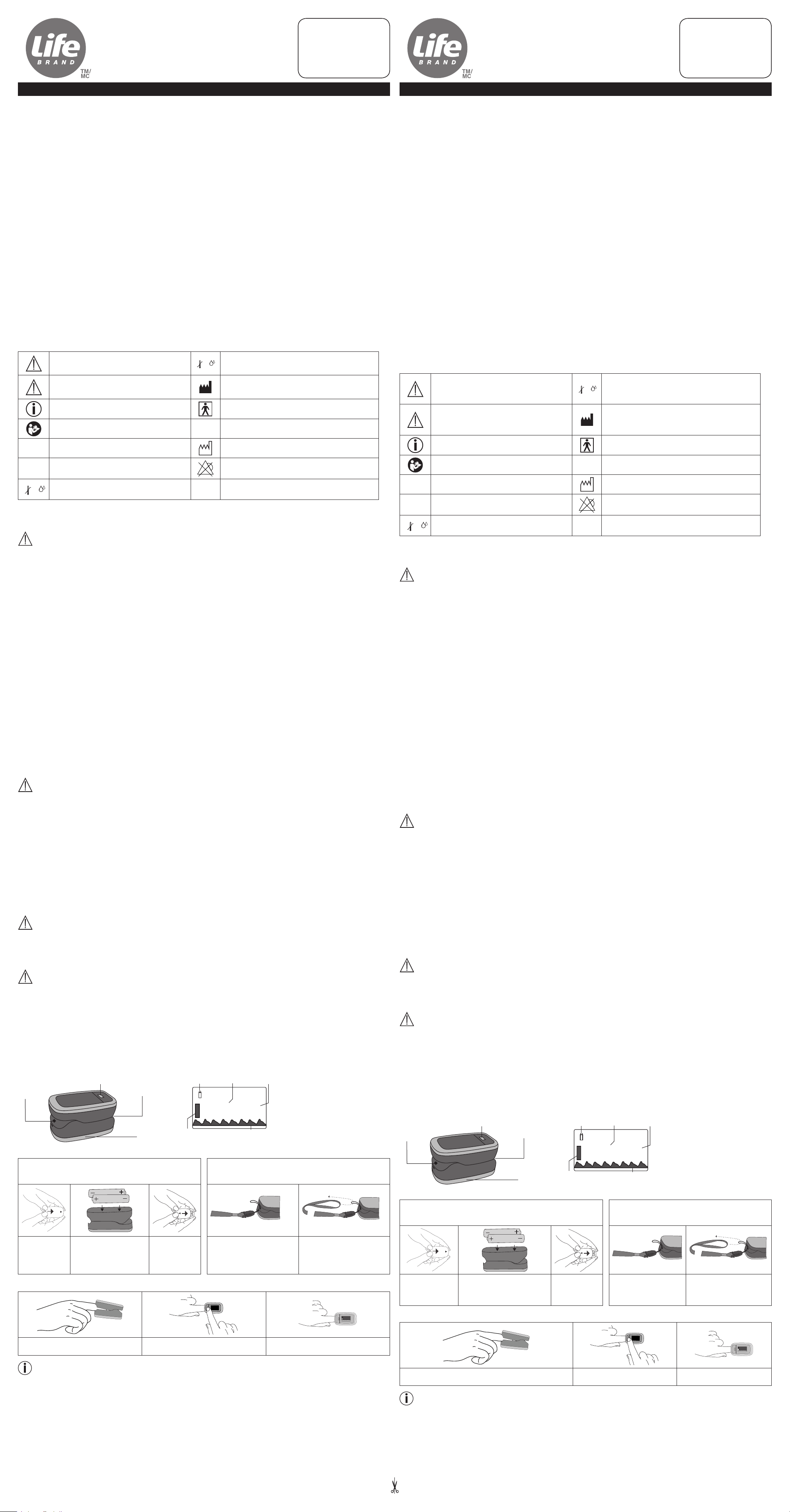
6. Gertebeschreibung
Displaybeschreibung
1 2
34
5
98 65 %SpO2 PRbpm
1. Sauerstoffsttigung (Wert in Prozent) 2. Pulsfrequenz (Wert in Pulsschlge pro Minute) 3. Pulswelle (Plethysmografische Welle) 4. Pulssule 5. Batterieanzeige
7. Inbetriebnahme 7.1 Batterien einlegen
1. Schieben Sie die Abde- ckung des Batteriefachs auf.
2. Legen Sie die zwei mitgelieferten Batterien wie abgebildet (mit der korrekten Polung) in das Pulsoximeter.
3. Schlieen Sie die Abde- ckung des Batteriefachs wieder.
7.2 Umhngeband befestigen Sie knnen zum einfacheren Transport des Pulsoximeters ein Umhngeband am Gert befestigen.
1. Schieben Sie das schmale Ende des Umhngebands wie abgebildet durch die Halterung.
2. Ziehen Sie das andere Ende des Umhn- gebands durch die Schlaufe des schmalen Endes fest an.
8. Bedienung
98 65 %SpO2 PRbpm
1. Schieben Sie einen Finger wie abgebildet in die Fin- gerffnung des Pulsoxime- ters. Halten Sie den Finger ruhig.
2. Drcken Sie auf die Funk- tionstaste. Das Pulsoxi- meter beginnt zu messen. Bewegen Sie sich whrend des Messvorgangs nicht.
3. Auf dem Bildschirm erscheinen nach wenigen Sekunden Ihre Messwerte.
Hinweis Wenn Sie Ihren Finger aus dem Pulsoximeter herausziehen, schaltet sich das Gert nach ca. 5 Sekunden automatisch aus.
Funktionstaste Die Funktionstaste des Pulsoximeters hat insgesamt zwei Funktionen: Einschalt-Funktion: Wenn das Pulsoximeter ausgeschaltet ist, knnen Sie es durch kurzes
Gedrckthalten der Funktionstaste einschalten. Helligkeits-Funktion: Um Ihre gewnschte Display-Helligkeit einzustellen, halten Sie wh-
rend des Betriebs die Funktionstaste lnger gedrckt.
Hinweis: Die Ausrichtung der Display-Anzeige (Hochformat, Querformat) erfolgt automatisch. Dadurch knnen Sie die Werte auf dem Display jederzeit gut ablesen, egal wie Sie das Pulsoximeter halten.
9. Messergebnisse beurteilen
WARNUNG Die nachfolgende Tabelle zur Beurteilung Ihres Messergebnisses gilt NICHT fr Personen mit bestimmten Vorerkrankungen (z.B. Asthma, Herzinsuffizienz, Atemwegserkrankungen) und bei Aufenthalten in Hhenlagen ber 1500 Metern. Wenn Sie unter Vorerkrankungen leiden, wenden Sie sich zur Beurteilung Ihrer Messwerte immer an Ihren Arzt.
Messergebnis SpO (Sauerstoff sttigung) in % Einstufung / Zu treffende Manahmen
99-94 Normalbereich
93-90 Erniedrigter Bereich: Arztbesuch empfohlen
< 90 Kritischer Bereich: Dringend Arzt aufsuchen
Hhenabhngiger Sauerstoffsttigungabfall
Hinweis Die nachfolgende Tabelle informiert Sie ber die Auswirkungen unterschiedlicher Hhenlagen auf den Sauerstoffsttigungswert sowie deren Folgen fr den menschlichen Organismus. Die nachfolgende Tabelle gilt NICHT fr Personen mit bestimmten Vorerkrankungen (z.B. Asthma, Herzinsuffizienz, Atemwegserkrankungen etc.). Bei Personen mit Vorerkrankungen knnen Krankheitssymptome (z.B. Hypoxie) bereits in niedrigeren Hhenlagen auftreten.
Hhenlage Zu erwartender SpO-Wert (Sauerstoffsttigung) in % Folgen fr den Menschen
1500-2500 m > 90 Keine Hhenkrankheit (in der Regel)
2500-3500 m ~90 Hhenkrankheit, Anpassung empfohlen
3500-5800 m <90 Sehr hufiges Auftreten einer Hhen- krankheit, Anpassung zwingend erforderlich
5800-7500 m <80 Schwere Hypoxie, nur zeitlich begrenz- ter Aufenthalt mglich
7500-8850 m <70 Sofortige akute Lebensgefahr
Quelle: Hackett PH, Roach RC: High-Altitude Medicine. In: Auerbach PS (ed): Wilderness Medicine, 3rd edition; Mosby, St.Louis, MO 1995; 1-37.
10. Reinigung / Instandhaltung
ACHTUNG: Wenden Sie am Pulsoximeter keine Hochdruck-Sterilisation an! Halten Sie das Pulsoximeter auf keinen Fall unter Wasser, da sonst Flssigkeit eindringen kann und das Pulsoximeter beschdigt wird. Reinigen Sie nach jeder Anwendung das Gehuse und die gummierte Innenflche des Pulso-
ximeters mit einem weichen, mit medizinischem Alkohol angefeuchteten Tuch. Wenn auf dem Display des Pulsoximeters ein niedriger Batteriestand angezeigt wird, tau-
schen Sie die Batterien aus. Wenn Sie das Pulsoximeter lnger als einen Monat nicht benutzen, entnehmen Sie beide
Batterien aus dem Gert, um ein eventuelles Auslaufen der Batterien zu verhindern.
11. Aufbewahrung
ACHTUNG: Bewahren Sie das Pulsoximeter in einer trockenen Umgebung auf (relative Luftfeuchtigkeit 95 %). Zu hohe Luftfeuchtigkeit kann die Lebensdauer des Pulsoximeters verkrzen oder es beschdigen. Bewahren Sie das Pulsoximeter an einem Ort auf, an dem die Umgebungstempe- ratur zwischen -40C und 60C liegt.
12. Entsorgung Im Interesse des Umweltschutzes darf das Gert am Ende seiner Lebensdauer nicht mit dem Hausmll entsorgt werden. Die Entsorgung kann ber entsprechende Sammelstellen in Ihrem Land erfolgen. Entsor- gen Sie das Gert gem der Elektro- und Elektronik Altgerte EG-Richtlinie WEEE (Waste Electrical and Electronic Equipment). Bei Rckfragen wenden Sie sich an die fr die Entsorgung zustndige kommunale Behrde. Die verbrauchten, vollkommen entladenen Batterien mssen Sie ber speziell gekennzeichnete Sammelbehlter, Sondermllannahmestellen oder ber den Elektrohndler entsorgen. Sie sind gesetzlich dazu verpflichtet, die Batterien zu entsorgen. Diese Zeichen finden Sie auf schadstoffhaltigen Batterien: Pb = Batterie enthlt Blei, Cd = Batterie enthlt Cadmium, Hg = Batterie enthlt Quecksilber.
Funktionstaste Umhngeband- Halterung Fingerffnung
13. Was tun bei Problemen?
Problem Mgliche Ursache Behebung
Das Puls oxi meter zeigt keine Mess- werte.
Die Batterien im Pulsoxime- ter sind leer. Tauschen Sie die Batterien aus.
Batterien nicht korrekt eingelegt.
Batterien erneut einlegen. Falls nach korrekter Einlegung der Batterien immer noch keine Messwerte angezeigt werden, wenden Sie sich an den Kundendienst.
Pulsoximeter zeigt Mess unter- brechungen oder hohe Mess wert- sprnge.
Unzureichende Durchblu- tung des Messfingers.
Warn- und Sicherheitshinsweise in Kapi- tel 5 beachten.
Messfinger ist zu gro oder zu klein.
Fingerspitze muss folgende Mae haben: Breite zwischen 10 — 20 mm Dicke zwischen 5 — 15 mm
Finger, Hand oder Krper befindet sich in Bewegung.
Finger, Hand und Krper whrend der Messung ruhig halten.
Herzrythmusstrungen Einen Arzt aufsuchen.
14. Technische Daten Modell-Nr. PO 30 Messmethode Nicht invasive Messung der arteriellen Sauerstoffsttigung des
Hmoglobins und Pulsfrequenz am Finger Messbereich SpO 0 100%,
Puls 30 250 Schlge /Minute Genauigkeit SpO 70 100%, 2%,
Puls 30 250 bpm, 2 Schlge /Minute Abmessungen L 61 mm x B 36 mm x H 32 mm Gewicht Ca. 58 g (einschlielich Batterien) Sensorik zur Messung von SpO Rotlicht (Wellenlnge 660 nm); Infrarot (Wellenlnge 880 nm);
Silizium-Empfangsdiode Zulssige Betriebs bedingungen +10 C bis +40 C, < 75 % relative Luftfeuchte,
700 1060 hPa Umgebungsdruck Zulssige Aufbewahrungsbe- dingungen
-40 C bis +60 C, 95 % relative Luftfeuchte, 500 1060 hPa Umgebungsdruck
Stromversorgung 2 x 1,5 V AAA Batterien Batterie-Lebensdauer 2 AAA Batterien ermglichen ca. 2 Jahre Betrieb bei 3 Messungen
pro Tag (je 60 Sekunden) Klassifikation IP22, Anwendungsteil Typ BF
Die Seriennummer befindet sich auf dem Gert oder im Batteriefach.
nderungen der technischen Angaben ohne Benachrichtigung sind aus Aktualisierungsgrnden vorbehalten. Dieses Gert entspricht den europischen Normen EN60601-1 und EN60601-1-2 (ber-
einstimmung mit CISPR 11, IEC 61000-4-2, IEC 61000-4-3, IEC 61000-4-8) und unterliegt besonderen Vorsichtsmanahmen hinsichtlich der elektromagnetischen Vertrglichkeit. Bitte beachten Sie dabei, dass tragbare und mobile HF-Kommunikationseinrichtungen dieses Ge- rt beeinflussen knnen. Genauere Angaben knnen Sie unter der angegebenen Kundenser- viceAdresse anfordern.
Das Gert entspricht der EU-Richtlinie fr Medizinprodukte 93/42/EEC, dem Medizinproduk- tegesetz und der Norm DIN EN ISO 80601-2-61 (Medizinisch elektrische Gerte Besondere Festlegungen fr die grundlegende Sicherheit und die wesentlichen Leistungsmerkmale von Pulsoximetern fr den medizinischen Gebrauch).
Hinweise zu Elektromagnetischer Vertrglichkeit Das Gert ist fr den Betrieb in allen Umgebungen geeignet, die in dieser Gebrauchsanwei-
sung aufgefhrt sind, einschlielich der huslichen Umgebung. Das Gert kann in der Gegenwart von elektromagnetischen Strgren unter Umstnden nur
in eingeschrnktem Mae nutzbar sein. Infolgedessen knnen z.B. Fehlermeldungen oder ein Ausfall des Displays/Gertes auftreten.
Die Verwendung dieses Gertes unmittelbar neben anderen Gerten oder mit anderen Ger- ten in gestapelter Form sollte vermieden werden, dadies eine fehlerhafte Betriebsweise zur Folge haben knnte. Wenn eine Verwendung in der vorgeschriebenen Art dennoch notwendig ist, sollten dieses Gert und die anderen Gerte beobachtet werden, um sich davon zu ber- zeugen, dass sie ordnungsgem arbeiten.
Die Verwendung von anderem Zubehr, als jenem, welches der Hersteller dieses Gertes festgelegt oder bereitgestellt hat, kann erhhte elektromagnetische Straussendungen oder eine geminderte elektromagnetische Strfestigkeit des Gertes zur Folge haben und zu einer fehlerhaften Betriebsweise fhren.
Halten Sie tragbare RF-Kommunikationsgerte (einschlielich Peripherie wie Antennenkabel oder externe Antennen) mindestens 30cm fern von allen Gerteteilen, inklusive allen im Lie- ferumfang enthaltenen Kabeln. Eine Nichtbeachtung kann zu einer Minderung der Leistungs- merkmale des Gertes fhren.
Eine Nichtbeachtung kann zu einer Minderung der Leistungsmerkmale des Gertes fhren.
15. Garantie / Service Die Beurer GmbH, Sflinger Strae 218, D-89077 Ulm (nachfolgend Beurer genannt) gewhrt unter den nachstehenden Voraussetzungen und in dem nachfolgend beschriebenen Umfang eine Garantie fr dieses Produkt.
Die nachstehenden Garantiebedingungen lassen die gesetzlichen Gewhrleistungsver- pflichtungen des Verkufers aus dem Kaufvertrag mit dem Kufer unberhrt. Die Garantie gilt auerdem unbeschadet zwingender gesetzlicher Haftungsvorschriften.
Beurer garantiert die mangelfreie Funktionstchtigkeit und die Vollstndigkeit dieses Produktes.
Die weltweite Garantiezeit betrgt 5 Jahre ab Beginn des Kaufes des neuen, ungebrauchten Produktes durch den Kufer.
Diese Garantie gilt nur fr Produkte, die der Kufer als Verbraucher erworben hat und aus- schlielich zu persnlichen Zwecken im Rahmen des huslichen Gebrauchs verwendet. Es gilt deutsches Recht.
Falls sich dieses Produkt whrend der Garantiezeit als unvollstndig oder in der Funktionstch- tigkeit als mangelhaft gem der nachfolgenden Bestimmungen erweist, wird Beurer gem diesen Garantiebedingungen eine kostenfreie Ersatzlieferung oder Reparatur durchfhren.
Wenn der Kufer einen Garantiefall melden mchte, wendet er sich zunchst an den Beurer Kundenservice: Beurer GmbH, Servicecenter Tel: +49 731 3989-144 Fr eine zgige Bearbeitung nutzen Sie bitte unser Kontaktformular auf der Homepage www. beurer.com unter der Rubrik Service.
Der Kufer erhlt dann nhere Informationen zur Abwicklung des Garantiefalls, z.B. wohin er das Produkt kostenfrei senden kann und welche Unterlagen erforderlich sind.
Eine Inanspruchnahme der Garantie kommt nur in Betracht, wenn der Kufer — eine Rechnungskopie/Kaufquittung und — das Original-Produkt Beurer oder einem autorisierten Beurer Partner vorlegen kann.
Ausdrcklich ausgenommen von dieser Garantie sind — Verschlei, der auf normalem Gebrauch oder Verbrauch des Produktes beruht; — zu diesem Produkt mitgelieferte Zubehrteile, die sich bei sachgemen Gebrauch abnutzen
bzw. verbraucht werden (z.B. Batterien, Akkus, Manschetten, Dichtungen, Elektroden, Leucht- mittel, Aufstze, Inhalatorzubehr);
— Produkte, die unsachgem und/oder entgegen der Bestimmungen der Bedienungsanleitung verwendet, gereinigt, gelagert oder gewartet wurden sowie Produkte, die vom Kufer oder einem nicht von Beurer autorisierten Servicecenter geffnet, repariert oder umgebaut wurden;
— Schden, die auf dem Transportweg zwischen Hersteller und Kunde bzw. zwischen Service- center und Kunde entstehen
— Produkte, die als 2.Wahl-Artikel oder als gebrauchte Artikel gekauft wurden; — Folgeschden, welche auf einem Mangel dieses Produktes beruhen (es knnen fr diesen Fall
jedoch Ansprche aus Produkthaftung oder aus anderen zwingenden gesetzlichen Haftungs- bestimmungen bestehen).
Reparaturen oder ein Komplettaustausch verlngern in keinem Fall die Garantiezeit.
Irrtum und nderungen vorbehalten
PO 30 Pulsoximeter
Beurer GmbH Sflinger Strae 218 89077 Ulm, Germany www.beurer.com www.beurer-gesundheitsratgeber.com www.beurer-healthguide.com
DEUTSCH
Dear customer, Thank you for choosing one of our products. Our name stands for high-quality, thoroughly tested products for applications in the areas of heat, weight, blood pressure, body tempera- ture, pulse, gentle therapy, massage, beauty, baby and air. Please read these instructions for use carefully and keep them for later use, be sure to make them accessible to other users and observe the information they contain.
With kind regards, Your Beurer team
1. Included in delivery 1x PO 30 pulse oximeter, 2x 1.5 V LR03 AAA batteries, 1x Lanyard, 1x Belt bag, 1x These instructions for use
2. Intended use Only use the Beurer PO 30 pulse oximeter on humans to measure the arterial oxygen saturation (SpO) of haemoglobin and the heart rate (pulse rate). The pulse oximeter is suitable for private use (at home) as well as for use in the medical sector (hospitals, medical establishments).
3. Getting to know your device The Beurer PO 30 pulse oximeter provides a non-invasive measurement of the arterial oxygen saturation (SpO2) and the heart rate (pulse rate). Oxygen saturation indicates the percentage of haemoglobin in arterial blood that is loaded with oxygen. Therefore it is an important parameter for assessing the respiratory function. To take a measurement, the pulse oximeter uses two rays of light with differing wavelengths, which strike the finger inserted inside the housing. A low oxygen saturation value generally indicates underlying illnesses (respiratory diseases, asthma, heart failure etc.). People with a low oxygen saturation value are more likely to experience the following symptoms: shortness of breath, increased heart rate, weakness, nervousness and outbreaks of sweating. If oxygen saturation is known to be chronically diminished, it requires monitoring using the pulse oximeter under medical supervision. If you have acutely diminished oxygen saturation, with or without the accompanying symptoms, you must consult a doctor immediately as it could lead to a life-threatening situation. The pulse oximeter is particularly suitable for patients at risk such as people with heart disease or asthma, but also for athletes and healthy people who exercise at high altitude (e.g. mountaineers, skiers or amateur pilots).
4. Signs and symbols The following symbols are used in these instructions for use, on the packaging and on the type plate for the device:
WARNING Warning instruction indicating a risk of injury or damage to health
Storage Permissible storage temperature and humidity
IMPORTANT Safety note regarding potential for damage to the device/accessories
Operating Permissible operating tempera- ture and humidity
Note Note on important information Application part, type BF
Observe the instructions for use Serial number
%SpO Arterial oxygen saturation of haemoglobin (in percent)
CE labelling This product satisfies the require- ments of the applicable Euro- pean and national directives.
PR bpm Pulse rate (beats per minute) Manufacturer
Disposal in accordance with EC Directive WEEE (Waste Electrical and Electronic Equipment)
Alarm suppression
Do not dispose of batteries con- taining hazardous substances with household waste.
IP 22 Device protected against foreign objects 12.5 mm and against falling drops of water
5. Warnings and safety notes Read these instructions for use carefully. Non-observance of the following information may result in personal injury or material damage. Store these instructions for use and make them accessible to other users. Make sure you include these instructions for use when handing over the device to third parties.
WARNING Check to ensure that the package contains all the parts that should be included in the deliv-
ery. Check the pulse oximeter regularly before use to ensure that there is no visible damage to the
device and the batteries are still sufficiently charged. In case of doubt, do not use the device and contact Beurer customer services or an authorised retailer.
Do not use any additional parts that are not recommended by the manufacturer or offered as equipment.
Under no circumstances should you open or repair the device yourself, as faultless function- ality could no longer be guaranteed thereafter. Failure to comply will result in voiding of the warranty. For repairs, please contact Beurer customer services or an authorised retailer.
Do NOT use the pulse oximeter if you are allergic to rubber products. if the device or the finger you are using is damp. on small children or babies. during an MRI or CT scan. whilst taking a blood pressure measurement on the same arm using a cuff. on fingers that have nail varnish on, are dirty or have a plaster or other dressing on them. on large fingers that do not fit into the device easily (fingertip: width approx. > 20 mm,
thickness >15 mm). on fingers with anatomical changes, oedemas, scars or burns. on fingers that are too small, as with small children for example (width approx. < 10 mm,
thickness < 5 mm). on patients who are not steady at the site of application (e.g. trembling). near flammable or explosive gas mixtures.
Using the device for long periods may cause pain for people with circulatory disorders. Therefore do not use the pulse oximeter for longer than approx. 2 hours on one finger.
The pulse oximeter displays a current measurement but cannot be used for continuous monitoring.
The pulse oximeter does not have an alarm function and is therefore not suitable for evaluat- ing medical results.
Do not self-diagnose or self-medicate on the basis of the measurements without consulting your doctor. In particular, do not start taking any new medication or change the type and/or dosage of any existing medication without prior approval.
Do not look directly inside the housing during the measurement. The red light and the invis- ible infra-red light in the pulse oximeter are harmful to your eyes.
This device is not intended for use by people (including children) with restricted physical, sensory or mental skills or a lack of experience and/or a lack of knowledge, unless they are supervised by a person who has responsibility for their safety or they receive instructions from this person on how to use the device. Children should be supervised around the device to ensure they do not play with it.
Neither of the displays for the pulse wave and pulse bar allows the strength of the pulse or circulation to be evaluated at the measurement site. Rather, they are exclusively used to display the current visual signal variation at the measurement site and do not enable reliable diagnos- tics for the pulse.
Non-observance of the following instructions can lead to incorrect or failed measurements. There must not be any nail varnish, artificial nails or other cosmetics on the finger to be
measured. Ensure that the finger nail on the finger to be measured is short enough that the fingertip
covers the sensor element in the housing. Keep your hand, finger and body steady during the measurement. For people with cardiac arrhythmia, the measurement values of SpO and the heart rate may
be incorrect or the measurement may not be possible at all. In cases of carbon monoxide poisoning, the pulse oximeter displays a measurement value
that is too high. To avoid falsifying the measuring result, there should not be any strong light sources (e.g.
fluorescent lamps or direct sunlight) in the immediate vicinity of the pulse oximeter. People with low blood pressure, who suffer from jaundice or take medication for vascular
contraction, may experience incorrect or falsified measurements. Incorrect measurements are likely for patients who have been administered medical dye in
the past or for those who have abnormal haemoglobin levels. This applies in particular for cases of carbon monoxide poisoning and methaemoglobin poisoning, which can occur for example from the administration of local anaesthetics or from an existing methaemoglobin reductase deficiency.
Protect the pulse oximeter from dust, shocks, moisture, extreme temperatures and explosive materials.
Notes on handling batteries If your skin or eyes come into contact with battery fluid, flush out the affected areas with
water and seek medical assistance. Choking hazard! Small children may swallow and choke on batteries. Store the batteries
out of the reach of small children. Observe the plus (+) and minus (-) polarity signs. If a battery has leaked, put on protective gloves and clean the battery compartment with a
dry cloth. Protect the batteries from excessive heat. Risk of explosion! Never throw batteries into a fire. Do not charge or short-circuit batteries. If the device is not to be used for a long period, take the batteries out of the battery compart-
ment. Use identical or equivalent battery types only. Always replace all batteries at the same time. Do not use rechargeable batteries. Do not disassemble, split or crush the batteries.
6. Unit description
Display description
1 2
34
5
98 65 %SpO2 PRbpm
1. Oxygen saturation (value in percent) 2. Pulse rate (value in beats per minute) 3. Pulse wave (plethysmographic wave) 4. Pulse bar 5. Battery level indicator
7. Initial use 7.1 Inserting the batteries
1. Slide the battery compart- ment lid open.
2. Place the two batter- ies supplied in the pulse oximeter as shown. Ensure that the correct battery polarity is observed.
3. Close the battery compart- ment lid again.
7.2 Attaching the lanyard To transport the pulse oximeter more easily you can attach a lanyard to the device.
1. Insert the narrow end of the lanyard through the holder as shown.
2. Draw the other end of the lanyard through the loop at the narrow end and tighten.
8. Operation
98 65 %SpO2 PRbpm
1. Insert one finger into the finger opening of the pulse oximeter as shown and hold it steady.
2. Press the function button. The pulse oximeter begins its measurement. Do not move during the measure- ment.
3. Your measurement values will appear on the screen after a few seconds.
Note When you remove your finger from the pulse oximeter, the device will automatically switch off after approx. five seconds.
Function button The function button on the pulse oximeter has two functions in total: Switch-on function: When the pulse oximeter is switched off you can hold down the func-
tion button briefly to switch it on. Brightness function: To select your desired display brightness, hold down the function but-
ton for slightly longer during operation.
Note: The display orients automatically (vertical format, horizontal format). This ensures that the valu- es are easy to read on the display at all times, regardless of how you hold the pulse oximeter.
9. Evaluating measurement results
WARNING The following table for evaluating your measurements does NOT apply to people with certain pre-existing conditions (e.g. asthma, heart failure, respiratory diseases) or whilst staying at altitudes above 1500 metres. If you have a pre-existing condition, always consult your doctor to evaluate your measurements.
SpO measurement (oxygen saturation) in % Classification/measures to be taken
99-94 Normal range
93-90 Decreased range: visit to the doctor recommended
< 90 Critical range Seek medical attention urgently
Decline in oxygen saturation depending on altitude
Note The following table informs you of the effects of various altitudes on oxygen saturation value and its impact on the human body. The following table does NOT apply to people with certain pre-existing conditions (e.g. asthma, heart failure, respiratory diseases etc.). People with pre- existing conditions can show signs of illness (e.g. hypoxia) at lower altitudes.
Altitude Expected SpO value (oxygen saturation) in % Impact on human body
1500-2500 m > 90 No altitude sickness (normally)
2500-3500 m ~90 Altitude sickness, acclimatisation recom- mended
3500-5800 m <90 Very frequent altitude sickness, acclimatisa- tion absolutely essential
5800-7500 m <80 Severe hypoxia, only limited length of stay possible
7500-8850 m <70 Immediate, acute danger to life Source: Hackett PH, Roach RC: High-Altitude Medicine. In: Auerbach PS (ed): Wilderness Medicine, 3rd edition; Mosby, St.Louis, MO 1995; 1-37.
10. Maintenance/cleaning
IMPORTANT: Do not use high-pressure sterilisation on the pulse oximeter! Under no circumstances should you hold the pulse oximeter under water, as this can cause liquid to enter and damage the pulse oximeter. Clean the housing and the interior rubber surface with a soft cloth dampened with medical
alcohol after each use. If a low battery status appears on the display of the pulse oximeter, change the batteries. If you are not going to use the pulse oximeter for more than one month, remove both batter-
ies from the device to avoid possible leaking.
11. Storage
IMPORTANT: Store the pulse oximeter in a dry place (relative humidity 95 %). If the humidity is too high it may shorten the service life of the pulse oximeter or damage it. Store the pulse oximeter in a place where the ambient temperature is between -40C and 60C.
12. Disposal For environmental reasons, do not dispose of the device in the household waste at the end of its useful life. Dispose of the unit at a suitable local collection or recycling point. Dispose of the device in accordance with EC Directive WEEE (Waste Electrical and Electronic Equipment). If you have any questions, please contact the local authorities respon- sible for waste disposal. The empty, completely flat batteries must be disposed of through specially designated collection boxes, recycling points or electronics retailers. You are legally required to dispose of the batteries. The codes below are printed on batteries containing harmful substances: Pb = Battery contains lead, Cd = Battery contains cadmium, Hg = Battery contains mercury.
13. What if there are problems?
Problem Possible cause Solution
The pulse oximeter is not displaying measurement values.
The batteries in the pulse oximeter are empty. Replace the batteries.
Batteries not inserted correctly.
Reinsert the batteries. If after reinserting the batteries correctly there are still no measurement values displayed, contact customer services.
Function button
Lanyard holder
Finger opening
45 4.
30 _P
O 30
_2 02
0- 01
-0 8_
04 _I
M 1a
_B EU
_D E-
EN
PO 30 Pulse oximeter
Beurer GmbH Sflinger Strae 218 89077 Ulm, Germany www.beurer.com www.beurer-healthguide.com
ENGLISH
Problem Possible cause Solution
The pulse oximeter is displaying measurement interruptions or high measurement value jumps.
Insufficient circulation in the measurement finger.
Observe the warnings and safety notes in chapter 5.
Measurement finger is too large or too small.
Fingertip must have the following meas- urements: Width between 10 and 22 mm Thickness between 5 and 15 mm
Finger, hand or body is moving.
Keep your finger, hand and body still during the measurement.
Cardiac arrhythmia Seek medical attention.
14. Technical Data Model no. PO 30 Measurement method Non-invasive measurement of arterial oxygen saturation of haemo-
globin and pulse rate in finger Measurement range SpO 0 100%,
Pulse 30 250 beats /minute Accuracy SpO 70 100%, 2%,
Pulse 30 250 bpm, 2 beats /minute Dimensions L 61 mm x W 36 mm x H 32 mm Weight Approx. 58 g (including batteries) Sensor to measure SpO Red light (wave length 660 nm); infra-red (wave length 880 nm);
silicon receiver diode Permissible operating conditions +10 C to +40 C, < 75 % relative humidity,
700 1060 hPa ambient pressure Permissible storage conditions -40 C to +60 C, 95 % relative humidity,
500 1060 hPa ambient pressure Power supply 2 x 1.5 V AAA batteries Battery life 2 AAA batteries last for approx. 2 years of operation at 3 measure-
ments per day (each of 60 seconds). Classification IP22, application part type BF
The serial number is located on the device or in the battery compartment.
Technical information is subject to change without notification to allow for updates. This device conforms with the European standards EN60601-1 and EN60601-1-2 (in ac-
cordance with CISPR 11, IEC 61000-4-2, IEC 61000-4-3, IEC 61000-4-8) and is subject to particular precautions with regard to electromagnetic compatibility. Please note that portable and mobile HF communication systems may interfere with this device. For more details, please contact our Customer Services at the address indicated.
This device complies with the EU Directive 93/42/EEC concerning medical devices, the Medizinproduktegesetz (German Medical Devices Act) and the DIN EN ISO 80601-2-61 standard (Medical electrical equipment Particular requirements for the basic safety and essential performance of pulse oximeter equipment for medical use)
Notes on electromagnetic compatibility The device is suitable for use in all environments listed in these instructions for use, including
domestic environments. The use of the device may be limited in the presence of electromagnetic disturbances. This
could result in issues such as error messages or the failure of the display/device. Avoid using this device directly next to other devices or stacked on top of other devices, as
this could lead to faulty operation. If, however, it is necessary to use the device in the manner stated, this device as well as the other devices must be monitored to ensure they are working properly.
The use of accessories other than those specifed or provided by the manufacturer of this device can lead to an increase in electromagnetic emissions or a decrease in the devices electromagnetic immunity; this can result in faulty operation.
Keep portable RF communication devices (including peripheral equipment, such as antenna cables or external antennas) at least 30 cm away from all device parts, including all cables in- cluded in delivery. Failure to comply with the above can impair the performance of the device.
Failure to comply with the above can impair the performance of the device.
15. Warranty/service Beurer GmbH, Sflinger Strae 218, 89077 Ulm, Germany (hereinafter referred to as Beu- rer) provides a warranty for this product, subject to the requirements below and to the extent described as follows.
The warranty conditions below shall not affect the sellers statutory warranty obligations which ensue from the sales agreement with the buyer. The warranty shall apply without prejudice to any mandatory statutory provisions on liability.
Beurer guarantees the perfect functionality and completeness of this product.
The worldwide warranty period is 5 years, commencing from the purchase of the new, unused product from the seller.
The warranty only applies to products purchased by the buyer as a consumer and used exclusi- vely for personal purposes in the context of domestic use. German law shall apply.
During the warranty period, should this product prove to be incomplete or defective in functio- nality in accordance with the following provisions, Beurer shall carry out a repair or a replace- ment delivery free of charge, in accordance with these warranty conditions.
If the buyer wishes to make a warranty claim, they should approach their local retailer in the first instance: see the attached International Service list of service addresses.
The buyer will then receive further information about the processing of the warranty claim, e.g. where they can send the product and what documentation is required.
A warranty claim shall only be considered if the buyer can provide Beurer, or an authorised Beurer partner, with — a copy of the invoice/purchase receipt, and — the original product.
The following are explicitly excluded from this warranty: — deterioration due to normal use or consumption of the product; — accessories supplied with this product which are worn out or used up through proper use
(e.g. batteries, rechargeable batteries, cuffs, seals, electrodes, light sources, attachments and nebuliser accessories);
— products that are used, cleaned, stored or maintained improperly and/or contrary to the provisions of the instructions for use, as well as products that have been opened, repaired or modified by the buyer or by a service centre not authorised by Beurer;
— damage that arises during transport between manufacturer and customer, or between service centre and customer;
— products purchased as seconds or
PO 30 PO 30
Pulse Oximeter
Instruction manual
Oxymètre de pouls
Mode d’emploi
Content
1. Package Contents
Pulse oximeter, 2x 1.5V AAA alkaline batteries, Lanyard, Carrying Case, Instruction Manual
2. Intended use
Only use the PO 30 pulse oximeter on humans to measure the arterial oxygen saturation (SpO₂) of hemoglobin and the heart rate (pulse rate).
3. Getting to know your device
The PO 30 pulse oximeter provides a non-invasive measurement of the arterial oxygen saturation (SpO
2
) and the heart rate (pulse rate). Oxygen
saturation indicates the percentage of hemoglobin in arterial blood that is loaded with oxygen. Therefore it is an important parameter for assess-
ing the respiratory function. To take a measurement, the pulse oximeter uses two rays of light with diering wavelengths, which strike the finger
inserted inside the housing. A low oxygen saturation value generally indicates underlying illnesses (respiratory diseases, asthma, heart failure
etc.).
People with a low oxygen saturation value are more likely to experience the following symptoms: shortness of breath, increased heart rate, weak-
ness, nervousness and outbreaks of sweating. If oxygen saturation is known to be chronically diminished, it requires monitoring using the pulse
oximeter under medical supervision. If you have acutely diminished oxygen saturation, with or without the accompanying symptoms, you must
consult a doctor immediately as it could lead to a life-threatening situation. The pulse oximeter is particularly suitable for patients at risk such as
people with heart disease or asthma, but also for athletes and healthy people who exercise at high altitude (e.g. mountaineers, skiers or pilots).
4. Signs and symbols
The following symbols are used in these instructions for use, on the packaging and on the type plate for the device:
WARNING
indicates a hazardous situation which, if not avoided,
could result in death or serious injury.
10°C
(50°F)
(104°F)
40°C
RH <= 75%
Operating conditions
CAUTION
indicates a hazardous situation which, if not avoided,
may result in minor or moderate injury.
Manufacturer
Note
Note on important information
Application part, type BF
Observe the instructions for use
SN
Serial number
%SpO₂ Arterial oxygen saturation of haemoglobin (in percent) Date of manufacture
PR bpm Pulse rate (beats per minute)
Alarm suppression
RH <= 95
-40°C
(-40°F)
(104°F)
60°C
Storage and transport conditions
IP 22
Device protected against foreign objects ≥ 12.5 mm and against
falling drops of water
5. Warnings and safety notes
Read these instructions for use carefully. Non-observance of the following information may result in death, personal injury or other serious
adverse reactions or product/property damage. Store these instructions for use and make them accessible to other users. Make sure you include
these instructions for use when handing over the device to third parties.
WARNING
•
Check the pulse oximeter before use to ensure that there is no visible damage to the device and the batteries are still suciently charged. In
case of doubt, do not use the device and contact customer services or an authorized retailer.
•
Do not use any additional parts that are not recommended by the manufacturer.
•
Under no circumstances should you open or repair the device yourself. Failure to comply will result in voiding of the warranty. For repairs,
please contact customer services or an authorized retailer.
•
Do NOT use the pulse oximeter
−
if you are allergic to rubber products.
−
if the device or the finger you are using is damp.
−
on small children or babies.
−
during an MRI or CT scan.
−
while taking a blood pressure measurement on the same arm.
−
on fingers that have nail polish, are dirty or have a plaster or other dressing on them.
−
on large fingers that do not fit into the device easily (fingertip: width approx. > 0.8 «, thickness >0.6 «).
−
on fingers with anatomical changes, oedemas, scars or burns.
−
on fingers that are too small, as with small children for example (width approx. < 0.4 «, thickness < 0.2 «).
−
on patients who are not steady at the site of application (e.g. trembling).
−
near flammable or explosive gas mixtures.
•
Using the device for long periods may cause pain for people with circulatory disorders. Do not use the pulse oximeter for longer than approx.
two hours on one finger.
•
The pulse oximeter displays a current measurement but cannot be used for continuous monitoring.
•
The pulse oximeter does not have an alarm function and is therefore not suitable for evaluating medical results.
•
Do not self-diagnose or self-medicate on the basis of the measurements without consulting your doctor. In particular, do not start taking any
new medication or change the type and/or dosage of any existing medication without prior approval.
•
Do not look directly inside the housing during the measurement. The red light and the invisible infra-red light in the pulse oximeter are harmful
to your eyes.
•
This device is not intended for use by people (including children) with restricted physical, sensory or mental skills or a lack of experience and/or
a lack of knowledge, unless they are supervised by a person who has responsibility for their safety or they receive instructions from this person
on how to use the device. Children should be supervised around the device to ensure they do not play with it.
•
Neither of the displays for the pulse wave and pulse bar allows the strength of the pulse or circulation to be evaluated at the measurement site.
Rather, they are exclusively used to display the current visual signal variation at the measurement site and do not enable reliable diagnostics for
the pulse.
•
Keep batteries away from children and pets. Batteries may be harmful if swallowed. Should a child or pet swallow a battery, seek medical as-
sistance immediately.
CAUTION
•
This product contains natural latex rubber which may cause allergic reactions.
Non-observance of the following instructions can lead to incorrect or failed measurements.
•
There must not be any nail polish, artificial nails or other cosmetics on the finger to be measured.
•
Ensure that the finger nail on the finger to be measured is short enough that the fingertip covers the sensor element in the housing.
•
Keep your hand, finger and body steady during the measurement.
•
For people with cardiac arrhythmia, the measurement values of SpO₂ and the heart rate may be incorrect or the measurement may not be pos-
sible at all.
•
In cases of carbon monoxide poisoning, the pulse oximeter will display a measurement value that is too high.
•
To avoid incorrect results, there should not be any strong light sources (e.g. fluorescent lamps or direct sunlight) in the immediate vicinity of the
pulse oximeter.
•
People with low blood pressure, who suer from jaundice or take medication for vascular contraction, may experience incorrect measurements.
•
Incorrect measurements are likely for patients who have been administered medical dye in the past or for those who have abnormal hemoglo-
bin levels. This applies in particular for cases of carbon monoxide poisoning and methemoglobin poisoning, which can occur for example from
the administration of local anaesthetics or from an existing methemoglobin reductase deficiency.
•
Protect the pulse oximeter from dust, shocks, moisture, extreme temperatures and explosive materials.
Battery Handling and Usage:
WARNING
To reduce the risk of serious personal injury:
•
Keep batteries away from children. Only adults should handle batteries.
•
Do not try to recharge batteries not intended to be recharged; they can overheat and rupture.
Follow the battery manufacturer’s safety and usage instructions.
•
Never throw batteries into a fire. Dispose or recycle spent/discharged batteries in compliance with all applicable laws.
CAUTION
To reduce the risk of personal injury:
•
Always use the size and type of battery indicated.
•
Do not mix a used battery with a new battery, or mix alkaline, standard (carbonzinc), or rechargeable (nickel‐cadmium) batteries.
Always replace batteries as a simultaneous set.
•
Insert the batteries observing the proper polarity (+/−) as indicated.
NOTICE
To reduce the risk of product and/or property damage:
•
Clean the battery contacts and those of the device prior to installation.
•
Remove spent or discharged batteries from the product.
•
Remove the batteries when not using the product for an extended period.
6. Unit description Display description
Function button
Wrist Strap
Post
Finger opening
1
2
3
4
5
98
65
%SpO
2
PRbpm
1. Oxygen saturation (value in percent)
2. Pulse rate (value in beats per minute)
3. Pulse wave (plethysmographic wave)
4. Pulse bar
5. Battery level indicator
7. Initial use
7.1 Inserting the batteries
7.2 Attaching the wrist strap
To transport the pulse oximeter more easily attach the wrist strap as
follows:
1
. Slide the bat-
tery compart-
ment lid open.
2
. Place two “AAA” alkaline
batteries (included) into
the battery compartment
observing the correct
polarity as indicated.
3
. Reattach the
battery com-
partment lid.
1
. Insert the narrow end of the
lanyard through the holes as
shown.
2
. Route the other end through
the loop at the narrow end and
tighten.
8. Operation
98
65
%SpO
2
PRbpm
1
. Insert one finger into the opening as shown
and hold it steady.
2
. Press the function button. Do not move
during the measurement.
3
. Your measurement values will appear on
the screen after a few seconds.
Note
When you remove your finger from the pulse oximeter, the device will switch o after approx. five seconds.
Function button
The function button performs three functions:
•
Power: When the pulse oximeter is o, press the function button to switch it on.
•
Display: To choose among the various display formats (vertical, horizontal etc.), press the function button briefly during operation.
•
Brightness: To select your desired display brightness, press and hold the function button during operation until the brightness level changes.
Battery compartment
Table des matières
1. Contenu de l’emballage
Oxymètre de pouls, 2 piles alcalines AAA de 1,5 V, lanière, pochette de rangement, mode d’emploi
2. Utilisation conforme aux recommandations
Utilisez l’oxymètre de pouls PO 30 exclusivement sur des personnes pour la mesure de la saturation artérielle pulsée en oxygène (SpO₂) de l’hémo-
globine et de la fréquence cardiaque (pouls).
3. Familiarisation avec l’appareil
L’oxymètre de pouls PO 30 est conçu pour la mesure non invasive de la saturation artérielle pulsée en oxygène (SpO₂) et de la fréquence car-
diaque (pouls). La saturation pulsée en oxygène indique le pourcentage d’hémoglobine chargé d’oxygène dans le sang artériel. Il s’agit donc d’un
paramètre important pour l’évaluation de la fonction respiratoire. Pour la mesure, l’oxymètre de pouls utilise deux rayons lumineux de longueurs
d’onde diérentes qui apparaissent sur le doigt inséré dans le boîtier. Une valeur faible de saturation pulsée en oxygène est principalement due à
des maladies (maladies des voies respiratoires, asthme, insusance cardiaque, etc.).
Chez les personnes ayant une valeur faible de saturation pulsée en oxygène, les symptômes suivants sont fréquents: détresse respiratoire,
augmentation de la fréquence cardiaque, faiblesse, nervosité et suées. Une saturation pulsée en oxygène faible chronique et connue nécessite
une surveillance à travers l’oxymètre de pouls sous contrôle médical. Une saturation pulsée en oxygène faible aiguë avec ou sans symptômes
doit être immédiatement signalée à un médecin, il peut s’agir d’une situation vitale. L’oxymètre de pouls est donc particulièrement adapté aux
patients à risques tels que les personnes atteintes de maladies cardiaques, d’asthme, mais aussi les sportifs et personnes en bonne santé qui se
déplacent à des altitudes élevées (par ex. alpinistes, skieurs, pilotes).
4. Icônes et symboles
Les symboles suivants sont utilisés sur le mode d’emploi, sur l’emballage et sur la plaque signalétique de l’appareil:
AVERTISSEMENT
indique un
e situation dangereuse qui, si elle n’est
pas évitée, pourrait provoquer la mort ou de graves
blessures.
10°C
(50°F)
(104°F)
40°C
RH <= 75%
Conditions de fonctionnement
ATTENTION
indique une situation dangereuse qui, si elle n’est pas
évitée, pourrait provoquer une blessure mineure ou
modérée.
Fabricant
Remarque
Remarque sur une information importante
Appareil de type BF
Suivez les instructions d’utilisation
SN
Numéro de série
%SpO₂
Saturation artérielle en oxygène de l’hémoglobine (en
pourcentage).
Date de fabrication
FP bpm Fréquence du pouls (battements par minute).
Suppression des alarmes
RH <= 95
-40°C
(-40°F)
(104°F)
60°C
Conditions de stockage et de transport
IP 22
Appareil protégé contre les corps étrangers≥ 12,5mm et contre
le contact de gouttes d’eau.
5. Consignes d’avertissement et de mise en garde
Lisez attentivement ce mode d’emploi. Le non-respect des consignes suivantes peut entraîner la mort, des blessures, d’autres graves consé-
quences ou des dommages matériels. Rangez ces instructions pour qu’elles soient facilement accessibles par les autres utilisateurs. Veillez à
remettre ces instructions lorsque vous confiez l’appareil à des tiers.
AVERTISSEMENT
•
Vérifiez l’oxymètre de pouls avant l’utilisation afin de vous assurer que l’appareil ne présente aucun dommage visible et que les piles sont
encore assez chargées. En cas de doute, ne l’utilisez pas et adressez-vous au service client ou à un détaillant agréé.
•
N’utilisez aucun élément supplémentaire non recommandé par le fabricant.
•
Vous ne devez en aucun cas ouvrir ou réparer l’appareil vous-même. Le non-respect de cette consigne annulerait la garantie. Pour toute répa-
ration, adressez-vous au service client ou à un revendeur agréé.
•
N’utilisez PAS l’oxymètre de pouls
−
si vous faites des réactions allergiques aux produits en caoutchouc;
−
si l’appareil ou le doigt à utiliser est humide;
−
sur de jeunes enfants ou nourrissons;
−
lors d’un examen IRM ou CT;
−
pendant une prise de tension sur le même bras;
−
sur des doigts avec du vernis à ongles, des saletés ou des pansements;
−
sur des doigts très épais qui ne peuvent pas être introduits dans l’appareil sans forcer (bout du doigt: largeur env. >
0,8 po
, épaisseur >
0,6 po
);
−
sur des doigts présentant des modifications anatomiques, œdèmes, cicatrices ou brûlures;
−
sur des doigts trop petits, par exemple chez les jeunes enfants (largeur env. < 0,4 po, épaisseur < 0,2 po);
−
sur des patients agités au point d’utilisation (par ex. tremblement);
−
à proximité de mélanges gazeux inflammables ou explosifs.
•
Chez les personnes sourant de problèmes de circulation sanguine, une utilisation prolongée de l’oxymètre de pouls peut provoquer des dou—
leurs. N’utilisez donc pas l’oxymètre de pouls plus de 2heures environ sur un doigt.
•
L’oxymètre de pouls indique une mesure en temps réel mais ne peut pas être utilisé pour une surveillance continue.
•
L’oxymètre de pouls ne dispose pas d’une fonction d’alarme et n’est donc pas adapté à l’évaluation des résultats médicaux.
•
Vous ne devez pas pratiquer d’auto-diagnostic ni d’auto-médication sur la base des résultats de mesure sans avoir discuté avec votre méde-
cin. Ne prenez pas, de vous-même, un nouveau médicament et ne modifiez ni le type, ni la posologie d’un traitement existant.
•
Au cours de la mesure, ne regardez jamais directement à l’intérieur du boîtier. La lumière rouge et la lumière infrarouge invisible de l’oxymètre
de pouls sont nuisibles pour les yeux.
•
Cet appareil n’est pas conçu pour être utilisé par une personne (y compris des enfants) dont les capacités physiques, sensorielles ou intellec-
tuelles sont limitées, ou n’ayant pas l’expérience et/ou les connaissances nécessaires. Le cas échéant, cette personne doit, pour sa sécurité,
être surveillée par une personne compétente ou doit recevoir vos recommandations sur la manière d’utiliser l’appareil. Surveillez les enfants
afin de les empêcher de jouer avec l’appareil.
•
L’onde et la barre de pouls ne permettent pas d’évaluer l’intensité du pouls et de la circulation sanguine au point de mesure. Elles ne repré-
sentent que les variations en temps réel du signal au point de mesure; elles n’ont pas une valeur diagnostique fiable.
•
Rangez les piles hors de portée des enfants et des animaux. Les piles peuvent être dangereuses si elles sont avalées. Si un enfant ou un animal
avale une pile, consultez immédiatement un médecin ou un vétérinaire.
ATTENTION
•
Ce produit contient du latex de caoutchouc naturel qui peut provoquer des réactions allergiques.
Le non-respect des instructions suivantes peut provoquer des mesures erronées ou un échec de la mesure.
•
Aucun vernis à ongle, faux ongle ou autre cosmétique ne doit se trouver sur le doigt de mesure.
•
Sur le doigt de mesure, assurez-vous que l’ongle est assez court pour que le bout du doigt couvre les éléments du capteur dans le boîtier.
•
Pendant la mesure, gardez la main, le doigt et le corps immobiles.
•
Chez les personnes atteintes de troubles du rythme cardiaque, les mesures de SpO₂ et de la fréquence cardiaque peuvent être faussées ou la
mesure peut ne pas être possible.
•
En cas d’intoxication au monoxyde de carbone, l’oxymètre de pouls indique des valeurs de mesure trop élevées.
•
Pour ne pas fausser le résultat, aucune source de lumière puissante (par ex. lampe fluorescente ou rayons directs du soleil) ne doit se trouver à
proximité immédiate de l’oxymètre de pouls.
•
Les mesures peuvent être faussées chez les personnes ayant une pression sanguine trop faible, sourant de jaunisse ou prenant des médica—
ments pour la contraction vasculaire.
•
Des mesures faussées sont probables chez les patients auxquels des colorants cliniques ont été administrés par le passé et chez ceux ayant
un taux d’hémoglobine anormal. Ceci s’applique en particulier en cas d’intoxications au monoxyde de carbone et à la méthémoglobine, cau-
sées par exemple par l’administration d’anesthésiques locaux ou en cas de déficit en méthémoglobine réductase.
•
Protégez l’oxymètre de pouls contre la poussière, les secousses, l’humidité, les températures extrêmes et les substances explosives.
Manipulation et utilisation des piles:
AVERTISSEMENT
Pour réduire les risques de blessures graves:
•
Conservez les piles hors de portée des enfants. Seuls les adultes doivent manipuler les piles.
•
Ne tentez pas de recharger des piles non rechargeables, elles pourraient surchauer et se rompre.
Respectez les instructions de sécurité et d’utilisation du fabricant de la pile.
•
Ne jetez jamais de pile au feu. Éliminez ou recyclez les piles usagées ou déchargées conformément aux lois applicables.
ATTENTION
Pour réduire les risques de blessures:
•
Utilisez toujours des piles de la taille et du type indiqués.
•
N’associez pas de piles usées à des piles neuves et ne mélangez pas les piles alcalines, standard (zinc-carbone) ou rechargeables (nickel‐cadmium).
Remplacez toujours toutes les piles simultanément.
•
Insérez les piles en respectant leur polarité (+/−), comme indiqué.
REMARQUE
Pour réduire le risque de dommages au produit et/ou dommages matériels:
•
Nettoyez les contacts de la pile et ceux de l’appareil avant de les installer.
•
Retirez les piles usées ou déchargées de l’appareil.
•
Retirez les piles de l’appareil lorsque vous ne l’utilisez pas pendant une période prolongée.
6. Description de l’appareil Description de l’affichage
Touche de fonction
Emplace
—
ment de la
dragonne
Ouverture pour le doigt
1
2
3
4
5
98
65
%SpO
2
PRbpm
1. Saturation pulsée en oxygène (valeur en
pourcentage)
2. Pouls (valeur en pulsations par minute)
3. Onde du pouls (onde pléthysmographique)
4. Colonne de pouls
5. Achage du niveau des piles
7. Mise en service
7.1 Insertion des piles
7.2 Fixation de la lanière
Pour faciliter le transport de l’oxymètre de pouls, fixez la
lanière conformément aux instructions suivantes:
1. Ouvrez le cou—
vercle du compar—
timent à piles en le
faisant glisser.
2. Insérez les deux piles alcalines
AAA
(fournies) dans le comparti—
ment à piles en faisant attention
à respecter la polarité indiquée.
3. Refermez le
couvercle du
compartiment à
piles.
1. Faites glisser l’extrémité
fine de la lanière à travers
les trous comme sur
l’illustration.
2. Passez l’autre extrémité de la
lanière à travers la boucle de
l’extrémité fine et serrez.
8. Fonctionnement
98
65
%SpO
2
PRbpm
1
. Glissez un doigt dans l’ouverture de l’oxymètre de pouls
comme sur l’illustration. Gardez le doigt immobile.
2
. Appuyez sur la touche de fonction.
Ne bougez pas pendant la mesure.
3
. Vos valeurs s’achent à l’écran
après quelques secondes.
Remarque
Lorsque vous sortez votre doigt de l’oxymètre de pouls, l’appareil s’éteint automatiquement après env. 5secondes.
Touche de fonction
La touche de fonction de l’oxymètre de pouls a trois fonctions:
•
Fonction de démarrage: quand l’oxymètre de pouls est éteint, vous pouvez l’allumer en appuyant sur la touche de fonction.
•
Fonction d’achage: pour régler le format d’achage souhaité (vertical, horizontal, etc.), appuyez brièvement sur la touche de fonction pen-
dant l’utilisation.
•
Fonction de luminosité: pour régler la luminosité voulue de l’écran, appuyez de façon continue la touche de fonction pendant le fonctionne-
ment jusqu’à ce que la luminosité change.
Compartiment des piles
ENGLISH FRANÇAIS
READ THIS MANUAL COM—
PLETELY AND CAREFULLY
BEFORE USING THIS PRODUCT
Keep this manual in a safe location
for future reference
LISEZ CE MODE D’EMPLOI
COMPLÈTEMENT ET
ATTENTIVEMENT AVANT
D’UTILISER CE PRODUIT
Conservez cet encart en lieu sûr
pour vous y référer ultérieurement
FULL MONEY BACK GUARANTEE
FOR PRODUCT QUALITY
Manufactured for:
SHOPPERS DRUG MART® / PHARMAPRIXMD
TORONTO, M2J 4W8 TM/MC ®/MD 911979
Alberta Ltd.
Distributed by:
Beurer North America LP, 900 N Federal Hwy,
Ste 300. Hallandale Beach, FL 33009
MADE IN CHINA
GARANTIE DE REMBOURSEMENT TOTAL
SUR LA QUALITÉ DU PRODUIT
Fabriqué pour :
SHOPPERS DRUG MART® / PHARMAPRIXMD
TORONTO, M2J 4W8 TM/MC ®/MD 911979
Alberta Ltd.
Distribué par :
Beurer North America LP, 900 N Federal Hwy,
Ste 300. Hallandale Beach, FL 33009
FABRIQUÉ EN CHINE
1. Package Contents …………………………………………. 1
2. Intended use …………………………………………………. 1
3. Getting to know your device ………………………….. 1
4. Signs and symbols ………………………………………… 1
5. Warnings and safety notes …………………………….. 1
6. Unit description …………………………………………….. 1
7. Initial use ………………………………………………………. 1
8. Operation …………………………………………………….. 1
9. Evaluating measurement results…………………… 2
10. Care and Maintenance …………………………………. 2
11. Troubleshooting? …………………………………………. 2
12. Technical Data …………………………………………….. 2
13. Warranty and Returns Policy ………………………… 2
Electromagnetic Compatibility Information ………… 2
1. Contenu de l’emballage …………………………………. 1
2. Utilisation conforme aux recommandations ……. 1
3. Familiarisation avec l’appareil ………………………… 1
4. Icônes et symboles ……………………………………….. 1
5. Consignes d’avertissement et de mise en garde 1
6. Description de l’appareil ………………………………… 1
7. Mise en service ……………………………………………… 1
8. Fonctionnement …………………………………………… 1
9. Évaluation des résultats de la mesure …………… 2
10. Nettoyage et entretien …………………………………. 2
11. Dépannage ………………………………………………….. 2
12. Données techniques ……………………………………. 2
13. Garantie et politique de retour ……………………… 2
Informations relatives à la compatibilité
électromagnétique ……………………………………………. 2
File type: PDF
File name: 8704743_po30.pdf
File size: 1.53 MB
File Language: English, French
Pages: 2
Author: Beurer
File created: 2015-07-28
3.0
Rated 3.0 out of 5
3.0 out of 5 stars (based on 1 review)
Your overall rating
BEURER PO 30 (02) PDF MANUAL
Click here to download BEURER PO 30 (02) PDF MANUAL
BEURER PO 30 (02) PDF MANUAL
FREE ENGLISH PDF
OPERATING INSTRUCTIONS
USER GUIDE – USER MANUAL
OWNER GUIDE – OWNER MANUAL
REFERENCE GUIDE – REFERENCE MANUAL
INSTRUCTION GUIDE – INSTRUCTION MANUAL
Your overall rating
- YouTube
BEURER PO 30 (02) PDF MANUAL
BEURER PO 30 (02) PDF MANUAL
Хорошее руководство по эксплуатации
Законодательство обязывает продавца передать покупателю, вместе с товаром, руководство по эксплуатации Beurer PO 30. Отсутствие инструкции либо неправильная информация, переданная потребителю, составляют основание для рекламации в связи с несоответствием устройства с договором. В законодательстве допускается предоставлении руководства в другой, чем бумажная форме, что, в последнее время, часто используется, предоставляя графическую или электронную форму инструкции Beurer PO 30 или обучающее видео для пользователей. Условием остается четкая и понятная форма.
Что такое руководство?
Слово происходит от латинского «instructio», тоесть привести в порядок. Следовательно в инструкции Beurer PO 30 можно найти описание этапов поведения. Цель инструкции заключается в облегчении запуска, использования оборудования либо выполнения определенной деятельности. Инструкция является набором информации о предмете/услуге, подсказкой.
К сожалению немного пользователей находит время для чтения инструкций Beurer PO 30, и хорошая инструкция позволяет не только узнать ряд дополнительных функций приобретенного устройства, но и позволяет избежать возникновения большинства поломок.
Из чего должно состоять идеальное руководство по эксплуатации?
Прежде всего в инструкции Beurer PO 30 должна находится:
— информация относительно технических данных устройства Beurer PO 30
— название производителя и год производства оборудования Beurer PO 30
— правила обслуживания, настройки и ухода за оборудованием Beurer PO 30
— знаки безопасности и сертификаты, подтверждающие соответствие стандартам
Почему мы не читаем инструкций?
Как правило из-за нехватки времени и уверенности в отдельных функциональностях приобретенных устройств. К сожалению само подсоединение и запуск Beurer PO 30 это слишком мало. Инструкция заключает ряд отдельных указаний, касающихся функциональности, принципов безопасности, способов ухода (даже то, какие средства стоит использовать), возможных поломок Beurer PO 30 и способов решения проблем, возникающих во время использования. И наконец то, в инструкции можно найти адресные данные сайта Beurer, в случае отсутствия эффективности предлагаемых решений. Сейчас очень большой популярностью пользуются инструкции в форме интересных анимаций или видео материалов, которое лучше, чем брошюра воспринимаются пользователем. Такой вид инструкции позволяет пользователю просмотреть весь фильм, не пропуская спецификацию и сложные технические описания Beurer PO 30, как это часто бывает в случае бумажной версии.
Почему стоит читать инструкции?
Прежде всего здесь мы найдем ответы касательно конструкции, возможностей устройства Beurer PO 30, использования отдельных аксессуаров и ряд информации, позволяющей вполне использовать все функции и упрощения.
После удачной покупки оборудования/устройства стоит посвятить несколько минут для ознакомления с каждой частью инструкции Beurer PO 30. Сейчас их старательно готовят или переводят, чтобы они были не только понятными для пользователя, но и чтобы выполняли свою основную информационно-поддерживающую функцию.