

 WARNING
The engine exhaust from this product contains chemicals known to cause cancer, birth defects or other reproductive harm.
A card containing important ATV safety information should be attached to the owner’s manual on the next page. If you cannot locate this card, or if it has been removed, please call 1-800-342-3764 for assistance.

WELCOME
Thank you for purchasing a Polaris vehicle, and welcome to our world-wide family of Polaris owners. We proudly produce an exciting line of utility and recreational products.
S Snowmobiles
S All-terrain vehicles (ATVs) S RANGER utility vehicles
S Victory motorcycles
We believe Polaris sets a standard of excellence for all utility and recreational vehicles manufactured in the world today. Many years of experience have gone into the engineering, design, and development of your Polaris vehicle, making it the finest machine we’ve ever produced.
For safe and enjoyable operation of your vehicle, be sure to follow the instructions and recommendations in this owner’s manual. Your manual contains instructions for minor maintenance, but information about major repairs is outlined in the Polaris Service Manual and should be performed only by a Factory Certified Master Service Dealer (MSD) Technician.
Your Polaris dealer knows your vehicle best and is interested in your total satisfaction. Be sure to return to your dealership for all of your service needs during, and after, the warranty period.
We also take great pride in our complete line of apparel, parts and accessories, available through our online store at www.purepolaris.com. Have your accessories and clothing delivered right to your door!
1
Copyright 2005 Polaris Sales Inc. All information contained within this publication is based on the latest product information at the time of publication. Due to constant improvements in the design and quality of production components, some minor discrepancies may result between the actual vehicle and the information presented in this publication. Depictions and/or procedures in this publication are intended for reference use only. No liability can be accepted for omissions or inaccuracies. Any reprinting or reuse of the depictions and/or procedures contained within, whether whole or in part, is expressly prohibited.
Printed in U.S.A.
2006 Sportsman 500 EFI Owner’s Manual P/N 9920012
2
TABLE OF CONTENTS
VEHICLE IDENTIFICATION NUMBERS . . . . . . . 5 SAFETY . . . . . . . . . . . . . . . . . . . . . . . . . . . . . . . . . . . 6 CONTROLS . . . . . . . . . . . . . . . . . . . . . . . . . . . . . . . 31 FEATURES . . . . . . . . . . . . . . . . . . . . . . . . . . . . . . . 39 OPERATION . . . . . . . . . . . . . . . . . . . . . . . . . . . . . . 46 EMISSION CONTROL SYSTEMS . . . . . . . . . . . . 63 MAINTENANCE AND LUBRICATION . . . . . . . . 64 ADJUSTMENTS . . . . . . . . . . . . . . . . . . . . . . . . . . 105 POLARIS PRODUCTS . . . . . . . . . . . . . . . . . . . . 107 TROUBLESHOOTING . . . . . . . . . . . . . . . . . . . . . 108 SPECIFICATIONS . . . . . . . . . . . . . . . . . . . . . . . . 112 WARRANTY . . . . . . . . . . . . . . . . . . . . . . . . . . . . . 114 MAINTENANCE LOG . . . . . . . . . . . . . . . . . . . . . 120 INDEX . . . . . . . . . . . . . . . . . . . . . . . . . . . . . . . . . . . 122
3
4
VEHICLE IDENTIFICATION NUMBERS
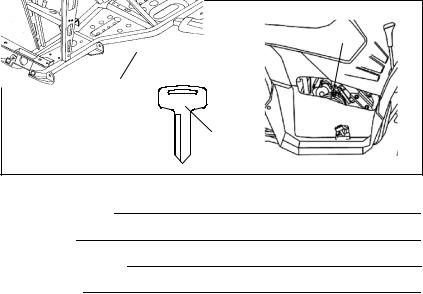
Record your ATV’s identification numbers and key number in the spaces provided. Remove the spare key and store it in a safe place. Your key can be duplicated only by mating a Polaris key blank with one of your existing keys, so if both keys are lost, the ignition switch must be replaced.
2
31XX
3
Vehicle Model Number:
Frame VIN (1):
Engine Serial Number (2):
Key Number (3):
5
SAFETY
Safety Decals and Locations
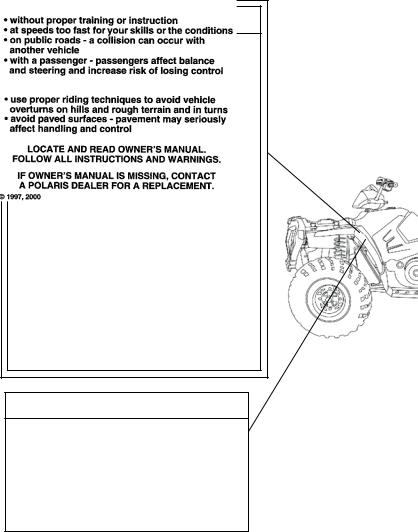
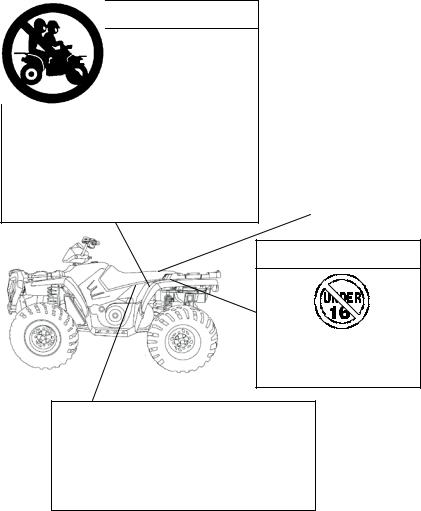
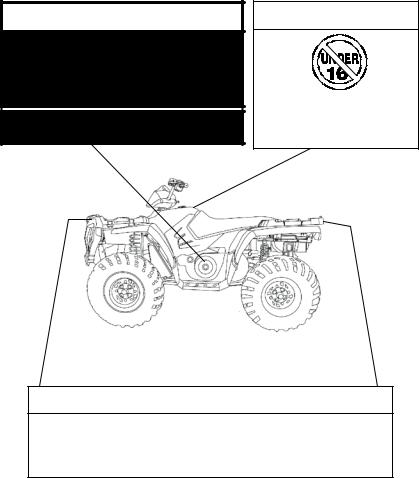
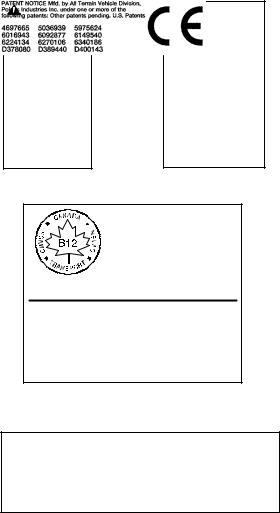
Warning decals have been placed on the ATV for your protection. Read and follow the instructions of the decals on the ATV carefully. If any of the decals depicted in this manual differ from the decals on your ATV, always read and follow the instructions of the decals on the ATV.
If any decal becomes illegible or comes off, contact your Polaris dealer to purchase a replacement. Replacement safety decals are provided by Polaris at no charge. The part number is printed on the decal.
 WARNING
Improper ATV use can result in SEVERE INJURY or DEATH
|
ALWAYS USE |
NEVER USE |
NEVER CARRY |
NEVER USE |
|
AN APPROVED |
ON PUBLIC |
PASSENGERS |
WITH DRUGS |
|
HELMET AND |
ROADS |
OR ALCOHOL |
|
|
PROTECTIVE |
|||
|
GEAR |
NEVER operate:
ALWAYS:
7172560
 WARNING
7172561
6
SAFETY
Safety Decals and Locations
 WARNING
IMPROPER TIRE PRESSURE OR OVERLOADING can cause loss of control resulting in SEVERE INJURY OR DEATH.
TIRE PRESSURE IN PSI (KPa): FRONT 5 (34,5) REAR 5 (34,5)
MAXIMUM WEIGHT CAPACITY (Gross Vehicle Weight)
INCLUDING MACHINE, DRIVER AND CARGO IS 1200 LBS. (545 kg).
Reduce speed and allow greater distance for braking when carrying cargo. Overloading or carrying tall, off-center, or unsecured loads will increase your risk of losing control. Loads should be centered, carried as low as possible, and firmly secured to the racks. With dual racks, load distribution 1/3 front 2/3 rear is best. For stability on rough or hilly terrain, reduce speed and cargo. Do not block headlight. Be careful if load extends over the side of the rack.
Read Owner’s Manual for more detailed loading information
7172748
 WARNING
Operating this ATV if you are under the age of 16 increases your chance of severe injury or death.
NEVER operate this ATV if you are
under age 16.
7172559
ATTENTION
SOperation of this vehicle without the air filter element will severely damage the engine.
SClean pre-filter element often, more frequent cleaning required in dusty conditions. Do not operate vehicle without pre-filter.
7172921
7
SAFETY
Safety Decals and Locations
 WARNING
SMoving parts hazard under belt-clutch guard. To prevent serious injury, do not operate vehicle with guard removed.
SDo not modify engine or clutch. Doing so can cause part failure, possible imbalance, and excessive engine RPM, which can result in serious injury or death.
NO STEP 7172563
 WARNING
Operating this ATV if you are under the age of 16 increases your chance of severe injury or death.
NEVER operate this ATV if you are
under age 16.
7172559
 WARNING
SDO NOT TOW FROM RACK OR BUMPER.
Vehicle damage or tipover may result causing severe injury or death. Tow only from tow hooks or hitch.
S Max Rack Loads: Front 90 lbs. (41 kg) Rear 180 lbs. (82 kg) 7172572
8
SAFETY
Safety Decals and Locations
|
WARNING |
ALL WHEEL |
||
|
Pushing reverse |
DRIVE |
||
|
override button |
SWITCH |
||
|
may cause |
|||
|
sudden increases |
Do not push switch to |
||
|
in power and |
|||
|
engage AWD if the rear |
|||
|
traction if too |
|||
|
wheels are spinning. |
|||
|
much throttle is |
|||
|
This may cause severe |
|||
|
applied. Loss of |
|||
|
drive shaft |
and clutch |
||
|
control or forward |
|||
|
damage. |
|||
|
flipover may |
|||
|
See your |
Owner’s |
||
|
result, especially |
|||
|
Manual. |
|||
|
in AWD. See |
|||
|
Owner’s Manual. |
|||
|
7172564 |
7079780 |
||
|
MANUFACTURED |
|||
|
BY: POLARIS IND. INC. |
|||
|
DATE: |
|||
|
VIN: |
THIS VEHICLE IS AN ALL TERRAIN VEHICLE AND IS NOT
INTENDED FOR USE ON PUBLIC ROADS.
CE VÉHICULE EST UN VÉHICULE TOUT TERRAIN QUI NiEST
PAS DESTINÉ À ÊTRE UTILISÉ SUR LES CHEMINS PUBLICS.
Canadian Certification Decal
TRAILER MAX WEIGHT:
1225 LBS. (557 KG) ON LEVEL GROUND
850 LBS. (386 KG) UP TO 15° GRADE
HITCH MAX. VERTICAL WEIGHT: 120 LBS. (55KG)
7170911
9
SAFETY
Safe Riding Gear
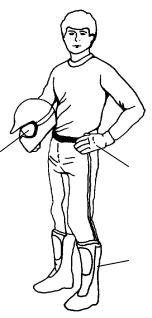
Always wear clothing suited to the type of riding. ATV riding requires special protective clothing for comfort and to reduce the chance of injury.
|
1. Helmet |
||
|
Your helmet is the most important piece |
||
|
of protective gear for safe riding. A |
||
|
helmet can prevent a severe head injury. |
||
|
Select an approved helmet that meets |
||
|
or exceeds your state’s safety standards |
||
|
and bears either the Department of |
||
|
Transportation (DOT) label, the |
||
|
American National Standards |
||
|
Institute label (ANSI z90.1), or the |
2 |
|
|
Snell Memorial Foundation label. |
||
|
2. Eye Protection |
||
|
Do not depend on sunglasses for |
||
|
proper eye protection. A pair of |
||
|
goggles or a helmet face shield offer |
||
|
the best protection for your eyes. They |
||
|
should be kept clean and be of |
||
|
shatterproof design (bearing the |
||
|
markings Z2.1 or VESC 8). |
3. Gloves
Off-road style gloves with knuckle pads are the best for comfort and protection.
4. Boots
The best footwear is a pair of strong over-the-calf boots with heels, like moto-cross boots.
5. Clothing
Always wear long sleeves and long pants to protect arms and legs. Riding pants with kneepads and a jersey with shoulder pads provide the best protection.
10
SAFETY
Operator Safety
 WARNING
Failure to follow the warnings contained in this manual can result in serious injury or death.
A Polaris ATV is not a toy and can be hazardous to operate. This vehicle handles differently than other vehicles, such as motorcycles and cars. A collision or rollover can occur quickly, even during routine maneuvers like turning, or driving on hills or over obstacles, if you fail to take proper precautions.
Read and understand your owner’s manual and all warnings before operating a Polaris ATV.
Age Restrictions
This vehicle is an ADULT VEHICLE ONLY. Operation is prohibited for anyone under 16 years of age.
Know Your Vehicle
As the operator of the vehicle, you are responsible for your personal safety, the safety of others, and the protection of our environment. Read and understand your owner’s manual, which includes valuable information about all aspects of your vehicle, including safe operating procedures.
Safety Training
When you purchased your new ATV, your dealer offered a hands-on safety training course that covers all aspects of vehicle safety. You were also provided with printed materials that explain safe operating procedures. You should review this information on a regular basis.
If you purchased a used Polaris ATV from a party other than a Polaris dealer, you can request this free safety training from any authorized Polaris dealer.
A Polaris ATV is an off-road vehicle. Familiarize yourself with all laws and regulations concerning the operation of the ATV in your area.
We strongly advise you to strictly follow the recommended maintenance program outlined in your owner’s manual. This preventive maintenance program is designed to ensure that all critical components on your vehicle are thoroughly inspected at specific intervals.
11

SAFETY
Operator Safety
The following two pages identify signal words and symbols that appear in this manual. Your safety is involved when these words and symbols are used. Become familiar with their meanings before reading the manual.
The safety alert symbol, on your vehicle or in this manual, alerts you to the potential for personal injury.
 WARNING
The safety alert warning indicates a potential hazard that may result in serious injury or death.
 CAUTION
The safety alert caution indicates a potential hazard that may result in minor personal injury or damage to the vehicle.
CAUTION
A caution indicates a situation that may result in damage to the vehicle.
NOTE:
A note will alert you to important information or instructions.
12
SAFETY
Operator Safety
 WARNING
Serious injury or death can result if you do not follow these instructions and procedures, which are outlined in further detail within your owner’s manual.
SRead this manual and all labels carefully, and follow the operating procedures described.
SNever operate an ATV without proper instruction. Take a training course. Beginners should receive training from a certified instructor. Contact an authorized Polaris ATV dealer or call Polaris at 1-800-342-3764 to find out about the training courses nearest you.
S Never allow anyone under 16 years of age to operate this ATV.
SNever permit a guest to operate the ATV unless the guest has read this manual and all product labels and has completed a certified safety training course.
SAlways avoid operating an ATV on paved surfaces, including sidewalks, driveways, parking lots, and streets.
SNever operate an ATV on a public street, road or highway, including a dirt or gravel road.
SNever operate an ATV without wearing an approved helmet that fits properly. Always wear eye protection (goggles or face shield), gloves, boots, a long-sleeved shirt or jacket, and long pants.
S Never consume alcohol or drugs before or while operating an ATV.
SNever operate at excessive speeds. Travel at speeds appropriate for the terrain, visibility and operating conditions, and your experience.
S Never attempt wheelies, jumps or other stunts.
SAlways inspect your ATV before each use to make sure it’s in safe operating condition. Always follow the inspection and maintenance procedures and schedules outlined in your owner’s manual.
SAlways keep both hands on the handlebars and both feet on the footrests of the ATV during operation.
SAlways travel slowly and use extra caution when operating on unfamiliar terrain. Be alert to changing terrain conditions.
S Never operate on excessively rough, slippery, or loose terrain.
SAlways follow proper turning procedures as described in this manual. Practice turning at low speeds before attempting to turn at faster speeds. Do not turn at excessive speeds.
13
SAFETY
Operator Safety
SAlways have the ATV inspected by an authorized Polaris dealer if it’s been involved in an accident.
SNever operate on hills too steep for the ATV or for your abilities. Practice on smaller hills before attempting larger hills.
SAlways follow proper procedures for climbing hills. Check the terrain carefully before ascending a hill. Never climb hills with excessively slippery or loose surfaces. Shift your weight forward. Never open the throttle suddenly or make sudden gear changes. Never go over the top of a hill at high speed.
SAlways follow proper procedures for going downhill and for braking on hills. Check the terrain carefully before you start down a hill. Shift your weight backward. Never go down a hill at high speed. Avoid going down a hill at an angle, which would cause the vehicle to lean sharply to one side. Travel straight down the hill when possible.
SAlways follow proper procedures for crossing the side of a hill. Avoid hills with excessively slippery or loose surfaces. Shift your weight to the uphill side of the ATV. Never attempt to turn the ATV around on any hill until you’ve mastered (on level ground) the turning technique outlined in this manual. Avoid crossing the side of a steep hill when possible.
SAlways use proper procedures if you stall or roll backwards while climbing a hill. To avoid stalling, maintain a steady speed when climbing a hill. If you stall or roll backwards, follow the special procedure for braking described in this manual. Always dismount on the uphill side, or to either side if the ATV is pointed straight uphill. Turn the ATV around and remount following the procedure described in this manual.
SAlways check for obstacles before operating in a new area. Never attempt to operate over large obstacles, such as rocks or fallen trees. Always follow proper procedures when operating over obstacles as described in this manual.
SAlways be careful of skidding or sliding. On slippery surfaces like ice, travel slowly and use extra caution to reduce the chance of skidding or sliding out of control.
SAvoid operating the ATV through deep or fast-flowing water. If it’s unavoidable, travel slowly, balance your weight carefully, avoid sudden movements, and maintain a slow and steady forward motion. Do not make sudden turns or stops, and do not make sudden throttle changes.
14
SAFETY
Operator Safety
SWet brakes may have reduced stopping ability. Test the brakes after leaving water. If necessary, apply them lightly several times to allow friction to dry out the pads.
SAlways check for obstacles or people behind the ATV before operating in reverse. When it’s safe to proceed in reverse, move slowly and avoid turning at sharp angles.
SAlways use the size and type of tires specified for your ATV, and always maintain proper tire pressure.
SNever modify an ATV through improper installation or use of accessories.
SNever exceed the stated load capacity for your ATV. Cargo must be properly distributed and securely attached. Reduce speed and follow the instructions in this manual for carrying cargo or towing. Allow a greater distance for braking.
FOR MORE INFORMATION ABOUT ATV SAFETY, call the Consumer Product Safety Commission at 1-800-638-2772, or call Polaris at 1-800-342-3764.
Equipment Modifications
We are concerned for the safety of our customers and for the general public. Therefore, we strongly recommend that consumers do not install on a Polaris ATV any equipment that may increase the speed or power of the vehicle, or make any other modifications to the vehicle for these purposes. Any modifications to the original equipment of the vehicle create a substantial safety hazard and increase the risk of bodily injury.
The warranty on your Polaris ATV is terminated if any equipment has been added to the vehicle, or if any modifications have been made to the vehicle, that increase its speed or power.
NOTE: The addition of certain accessories, including (but not limited to) mowers, blades, tires, sprayers, or large racks, may change the handling characteristics of the vehicle. Use only Polaris-approved accessories, and familiarize yourself with their function and effect on the vehicle.
15
SAFETY
Operator Safety
 WARNING
POTENTIAL HAZARD
Operating this ATV without proper instruction. WHAT CAN HAPPEN
The risk of an accident is greatly increased if the operator does not know how to operate the ATV properly in different situations and on different types of terrain.
HOW TO AVOID THE HAZARD
Beginning and inexperienced operators should complete the certified training course offered by Polaris. Operators should regularly practice the skills learned in the course and the operating techniques described in the owner’s manual.
For more information about the training course, contact an authorized ATV dealer or call Polaris at 1-800-342-3764.
 WARNING
POTENTIAL HAZARD
Failure to follow the age recommendations for this ATV. WHAT CAN HAPPEN
Severe injury and/or death could occur if a child under the minimum age recommendation operates an ATV.
Even though a child may be within the recommended age group for operating some ATVs, he/she may not have the skills, abilities, or judgment needed to operate an ATV safely and could be susceptible to accident or injury.
HOW TO AVOID THE HAZARD
No one under the age of 16 should operate a Polaris ATV.
16
SAFETY
Operator Safety
 WARNING
POTENTIAL HAZARD
Carrying a passenger on an ATV.
WHAT CAN HAPPEN
Carrying a passenger greatly reduces the operator’s ability to balance and control the ATV, which could cause an accident and injury to the
operator and/or passenger. HOW TO AVOID THE HAZARD
Never carry a passenger. The purpose of the long seat is to allow the operator to shift position as needed during operation. It is not intended for carrying passengers.
 WARNING
POTENTIAL HAZARD
Operating an ATV on paved surfaces, including sidewalks, paths, parking lots, and driveways.
WHAT CAN HAPPEN
ATV tires are designed for off-road use. Operating on paved surfaces may
seriously affect the handling and
control of the ATV and could result in loss of control, accident, and/or injury.
HOW TO AVOID THE HAZARD
Avoid operating the ATV on pavement. If it’s unavoidable, travel slowly and avoid sudden turns or stops.
17
SAFETY
Operator Safety
 WARNING
POTENTIAL HAZARD
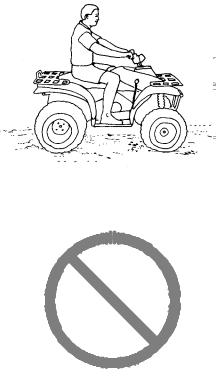
Operating this ATV on public streets, roads or highways.
WHAT CAN HAPPEN
The ATV could collide with another vehicle.
HOW TO AVOID THE HAZARD
Never operate the ATV on any public street, road or highway,
including dirt and gravel roads. In many states
it’s illegal to operate ATVs on public streets, roads and highways.
 WARNING
POTENTIAL HAZARD
Operating this ATV without wearing an approved helmet, eye protection and protective clothing.
WHAT CAN HAPPEN
Operating an ATV without an approved helmet increases the risk of a severe head injury or death in the event of an accident.
Operating without eye protection could result in an accident and could increase the chance of a severe injury in the event of an accident.
HOW TO AVOID THE HAZARD
Always wear an approved helmet that fits properly.
Always wear eye protection (goggles or face shield), gloves, boots, long-sleeved shirt or jacket, and long pants.
18
SAFETY
Operator Safety
 WARNING
POTENTIAL HAZARD
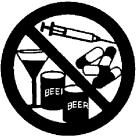
Operating the ATV after consuming alcohol or drugs.
WHAT CAN HAPPEN
Consumption of alcohol and/or drugs could seriously affect operator judgment. Reaction time may be slower and operator balance and perception could be affected.
Consuming alcohol and/or drugs before or while operating an ATV could result in
an accident causing severe injury or death. HOW TO AVOID THE HAZARD
Never consume alcohol or drugs before or while operating an ATV.
 WARNING
POTENTIAL HAZARD
Operating the ATV at excessive speeds. WHAT CAN HAPPEN
Excessive speed increases the operator’s chance of losing control of the ATV, which can result in an accident.
HOW TO AVOID THE HAZARD
Always operate the ATV at a speed that’s proper for the terrain, visibility and operating conditions, and your experience.
19
SAFETY
Operator Safety
 WARNING
POTENTIAL HAZARD
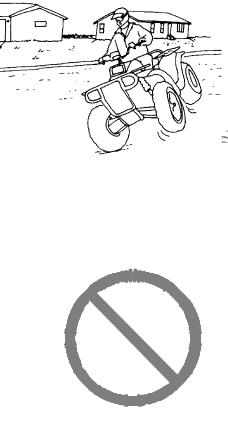
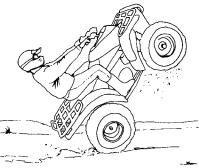
Attempting wheelies, jumps and other stunts.
WHAT CAN HAPPEN
Attempting stunts increases the chance of an accident, including an overturn.
HOW TO AVOID THE HAZARD
Never attempt wheelies, jumps, or other stunts. Avoid exhibition driving.
 WARNING
POTENTIAL HAZARD
Failure to inspect the ATV before operating. Failure to properly maintain the ATV. WHAT CAN HAPPEN
Poor maintenance increases the possibility of an accident or equipment damage.
HOW TO AVOID THE HAZARD
Always inspect your ATV before each use to make sure it’s in safe operating condition.
Always follow the inspection and maintenance procedures and schedules described in the owner’s manual.
20
SAFETY
Operator Safety
 WARNING
POTENTIAL HAZARD
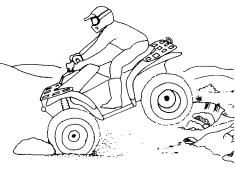
Removing hands from the handlebars or feet from the footrests during operation.
WHAT CAN HAPPEN
Removing even one hand or foot can reduce ability to control the vehicle or could cause loss of balance and ejection from the ATV.
If the operator’s foot is not firmly planted on the footrest, it could come into contact with the rear wheels and lead to accident or injury.
HOW TO AVOID THE HAZARD
Always keep both hands on the handlebars and both feet on the footrests of the ATV during operation.
 WARNING
POTENTIAL HAZARD
Failure to use extra caution when operating the ATV on unfamiliar terrain.
WHAT CAN HAPPEN
Unfamiliar terrain may contain hidden rocks, bumps, or holes that could cause loss of control or overturn.
HOW TO AVOID THE HAZARD
Travel slowly and use extra caution when operating on unfamiliar terrain. Always be alert to changing terrain conditions.
21
SAFETY
Operator Safety
 WARNING
POTENTIAL HAZARD
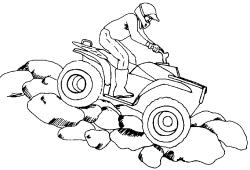
Failure to use extra caution when operating excessively rough, slippery or loose terrain
WHAT CAN HAPPEN
Operating on excessively rough, slippery or loose terrain could cause loss traction or loss of control, which could result in an accident or overturn.
HOW TO AVOID THE HAZARD
Do not operate on excessively rough, slippery or loose terrain until you’ve learned and practiced the skills necessary to control the ATV on such terrain.
Always use extra caution on rough, slippery or loose terrain.
 WARNING
POTENTIAL HAZARD Turning improperly. WHAT CAN HAPPEN
Improper turns could cause loss of control and lead to a collision or overturn.
HOW TO AVOID THE HAZARD
Always follow proper procedures for turning as described in the owner’s manual.
Practice turning at slow speeds before attempting to turn at faster speeds.
Never turn at excessive speed.
22
SAFETY
Operator Safety
 WARNING
POTENTIAL HAZARD
Operating on excessively steep hills. WHAT CAN HAPPEN
The vehicle may overturn. HOW TO AVOID THE HAZARD
Never operate on hills too steep for the ATV or for your abilities. Never operate the ATV on hills steeper than 25_.
Practice on smaller hills before attempting large hills.
 WARNING
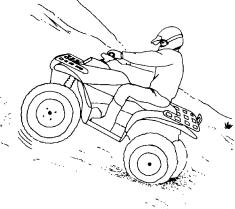
POTENTIAL HAZARD Climbing hills improperly. WHAT CAN HAPPEN
Improper hill climbing could cause loss of control or overturn.
HOW TO AVOID THE HAZARD
Always follow proper procedures for climbing hills as described in the owner’s manual.
Always check the terrain carefully before ascending any hill.
Never operate the ATV on hills steeper than 25_.
Never climb hills with excessively slippery or loose surfaces. Shift your weight forward.
Never open the throttle suddenly while traveling uphill. The ATV could flip over backwards.
Never go over the top of any hill at high speed. An obstacle, a sharp drop, or another vehicle or person could be on the other side of the hill.
23
SAFETY
Operator Safety
 WARNING
POTENTIAL HAZARD
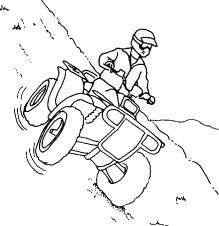
Traveling downhill improperly.
WHAT CAN HAPPEN
Improperly descending a hill could cause loss of control or overturn.
HOW TO AVOID THE HAZARD
Always follow proper procedures for traveling down hills as described in the owner’s manual. NOTE: A special technique is required when braking while
traveling downhill. See page 57.
Always check the terrain carefully before descending a hill. Shift your weight backward.
Never travel down a hill at high speed.
Avoid traveling down a hill at an angle, which would cause the vehicle to lean sharply to one side. Travel straight down the hill when possible.
24
SAFETY
Operator Safety
 WARNING
POTENTIAL HAZARD
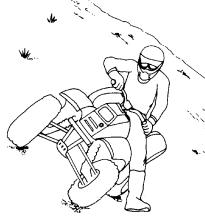
Improperly crossing hills and turning on hills.
WHAT CAN HAPPEN
Improperly crossing or turning as hills could cause loss of control or overturn.
HOW TO AVOID THE HAZARD
Never attempt to turn the ATV around on any hill until you’ve mastered the turning technique (on level ground) as described in the owner’s manual. See page 58. Use extra caution when turning on any hill.
Avoid crossing the side of a steep hill. When crossing the side of a hill:
Always follow proper procedures as described in the owner’s manual.
Avoid hills with excessively slippery or loose surfaces. Shift your weight to the uphill side of the ATV.
25
SAFETY
Operator Safety
 WARNING
POTENTIAL HAZARD
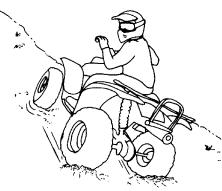
Stalling, rolling backwards or improperly dismounting while climbing a hill.
WHAT CAN HAPPEN
The vehicle could overturn.
HOW TO AVOID THE HAZARD
Maintain steady speed when climbing a hill.
If all forward speed is lost: Keep your weight uphill. Apply the brakes.
Lock the parking brake when fully stopped. If the ATV begins rolling backwards:
Keep weight uphill.
Never apply engine power.
Never apply the rear brake while rolling backwards. Apply the single-lever brake gradually.
When fully stopped, apply the rear brake as well, and then lock the parking brake.
Dismount on uphill side, or to either side if ATV is pointed straight uphill.
Turn the ATV around and remount, following the procedure described in the owner’s manual. See page 58.
26
SAFETY
Operator Safety
 WARNING
POTENTIAL HAZARD
Improperly operating over obstacles. WHAT CAN HAPPEN
Operating over obstacles could cause loss of control or overturn. HOW TO AVOID THE HAZARD
Before operating in a new area, check for obstacles.
Avoid operating over large obstacles such as rocks and fallen trees when possible. If unavoidable, use extreme caution and always follow proper procedures as outlined in the owner’s manual.
 WARNING
POTENTIAL HAZARD Skidding or sliding. WHAT CAN HAPPEN
Skidding or sliding can cause loss of control.
If the tires regain traction unexpectedly, the ATV could overturn. HOW TO AVOID THE HAZARD
On slippery surfaces such as ice, travel slowly and use extra caution to reduce the chance of skidding or sliding out of control.
 WARNING
POTENTIAL HAZARD Improperly operating in reverse. WHAT CAN HAPPEN
The ATV could collide with an obstacle or person, resulting in severe injury.
HOW TO AVOID THE HAZARD
Before shifting into reverse gear, always check for obstacles or people behind the ATV. When it’s safe to proceed, back slowly.
27
SAFETY
Operator Safety
 WARNING
POTENTIAL HAZARD
Operating the ATV through deep or fast-flowing water. WHAT CAN HAPPEN
Tires may float, causing loss of traction and loss of control, which could lead to an accident or overturn.
HOW TO AVOID THE HAZARD
Avoid operating the ATV through deep or fast-flowing water. If it’s unavoidable to enter water that exceeds the recommended maximum depth (see page 59), travel slowly, balance your weight carefully, avoid sudden movements, and maintain a slow and steady forward motion. Do not make sudden turns or stops, and do not make sudden throttle changes.
Wet brakes may have reduced stopping ability. Always test the brakes after leaving water. If necessary, apply them several times to let friction dry out the pads.
 WARNING
POTENTIAL HAZARD
Operating this ATV with improper tires, or with improper or uneven tire pressure.
WHAT CAN HAPPEN
Use of improper tires, or operation of the ATV with improper or uneven tire pressure, could cause loss of control or accident.
HOW TO AVOID THE HAZARD
Always use the size and type of tires specified for the ATV. Always maintain proper tire pressure as specified.
28
SAFETY
Operator Safety
 WARNING
POTENTIAL HAZARD
Operating the ATV with improper modifications. WHAT CAN HAPPEN
Improper installation of accessories or modification of the ATV may cause changes in handling which could lead to an accident.
HOW TO AVOID THE HAZARD
Never modify the ATV through improper installation or use of accessories. All parts and accessories added to the vehicle must be genuine Polaris Industries Inc. or equivalent components designed for use on this ATV and should be installed and used according to approved instructions. See your authorized Polaris ATV dealer for more information.
 WARNING
POTENTIAL HAZARD
Overloading the ATV or carrying/towing cargo improperly. WHAT CAN HAPPEN
Overloading and towing can cause changes in vehicle handling, which could lead to loss of control or an accident.
HOW TO AVOID THE HAZARD
Never exceed the stated load capacity for this ATV.
Cargo should be properly distributed and securely attached.
Reduce speed when carrying cargo or pulling a trailer. Allow a greater distance for braking.
Always follow the instructions in the owner’s manual for carrying cargo or pulling a trailer. See page 50.
 WARNING
POTENTIAL HAZARD
Operating on frozen bodies of water. WHAT CAN HAPPEN
Severe injury or death can result if the ATV and/or the operator fall through the ice.
HOW TO AVOID THE HAZARD
Never operate the ATV on a frozen body of water.
29
SAFETY
Operator Safety
 WARNING
Leaving the keys in the ignition can lead to unauthorized use of the vehicle resulting in serious injury or death. Always remove the ignition key when the vehicle is not in use.
 WARNING
After any overturn or accident, have a qualified service dealer inspect the entire vehicle for possible damage, including (but not limited to) brakes, throttle and steering systems.
 WARNING
Safe operation of this rider-active vehicle requires good judgement and physical skills. Persons with cognitive or physical disabilities who operate this vehicle have an increased risk of overturn and loss of control, which could result in severe injury or death.
 CAUTION
Exhaust system components are very hot during and after use of the vehicle. Hot components can cause serious burns and fire. Do not touch hot exhaust system components. Always keep combustible materials away from the exhaust system. Use caution when traveling through tall grass, especially dry grass.
30

CONTROLS
Engine Electrical Switches
 WARNING
Activating the override switch while the throttle is open can cause loss of control, resulting in severe injury or death. Do not activate the override switch while the throttle is open.
4
2
Mode/Reverse Override Switch (1) — This vehicle is equipped with a reverse speed limiter system. To gain additional power while backing, depress the override switch.
NOTE: The override switch also allows activation of AWD in reverse, if the AWD switch is on. This switch is also used to toggle through the different modes of the rider information center. See page 40.
Engine Stop Switch (2) — The engine will not start or run when the switch is in the OFF position. Its purpose is to provide the operator with a quick means of engine shutdown in case of an emergency.
Main Switch (3) — To start the engine, slide
the stop switch to the center RUN position and turn the main key switch clockwise past the ON position. Release the key when the engine starts.
NOTE: Both the main switch and the emergency engine stop switch will shut off all electrical power to the vehicle, including lights. To stop the engine, slide the stop switch either right or left to the OFF position.
Worklight Switch (4) — The worklight switch controls a light located at the rear of the vehicle. Use the rear light when additional light is needed for loading and unloading the vehicle. Turn the rear worklight off when driving the ATV.
31

CONTROLS
 WARNING
Operating an ATV with sticking or improperly operating throttle controls could cause an accident and lead to severe injury or death.
Never start or operate an ATV with a sticking or improperly operating throttle. Always contact your dealer for service if throttle problems arise.
Failure to check or maintain proper operation of the throttle system can result in an accident if the throttle lever sticks during operation. Always check the lever for free movement and return before starting the engine. Also check occasionally during operation.
Throttle Lever
|
Engine speed and vehicle movement |
|
|
are controlled by pressing the |
|
|
throttle lever (1). The throttle lever |
|
|
is spring loaded. Engine speed |
|
|
returns to idle when the lever is |
1 |
|
released. |
This ATV is equipped with Polaris Electronic Throttle Control (ETC), which is designed to reduce the risk of a frozen or stuck throttle. If the throttle cable should stick in an open position when the operator releases the throttle lever, the engine will stop, and power to the rear wheels will cease.
 WARNING
The Electronic Throttle Control (ETC) stops the engine in the event of a throttle system malfunction and is provided for your safety. Do not attempt to modify the ETC system or replace it with any after market throttle mechanisms.
32

CONTROLS
Light Switches
The light switch is located on the left handlebar. It’s used to turn the lights on and off and to switch the lights from HI to LO.
NOTE: The lights won’t work unless the key is in the ON position and the shut-off switch is in the RUN position.
 WARNING
Operating the ATV on streets or roads, especially in darkness, could result in an accident and serious injury or death.
Your ATV is not equipped with highway-approved lights. It’s designed for and must be used for off-road use only. Use caution and drive at reduced speeds in conditions of reduced visibility such as fog, rain and darkness.
Brake Lever
|
The front and rear brakes are applied |
1 |
by squeezing the brake lever (1) toward the handlebar. The front and rear brakes are hydraulically activated disc type brakes that are activated by only one lever.
Always test brake lever travel and master cylinder fluid level before riding.
When squeezed, the lever should feel firm. Any sponginess would indicate a possible fluid leak or low master cylinder fluid level, which must be corrected before riding. Contact your dealer for proper diagnosis and repairs.
 WARNING
Operating the ATV with a spongy brake lever can result in loss of braking, which could cause an accident.
Never operate the ATV with a spongy-feeling brake lever.
33

CONTROLS
Master Cylinder
|
The brake fluid in the master |
1 |
2 |
|
cylinder (1), which is located on the |
||
left handlebar, should be checked before each ride. The fluid level can be seen through an indicator window (2) on the top of the master cylinder. This eye will appear dark when the fluid level is full. When
fluid needs to be added, the eye will be clear.
NOTE: When checking the fluid level, the ATV must be on level ground with the handlebars straight. If the fluid level is low add DOT 3 brake fluid only. See page 107 for the part numbers of Polaris products.
 WARNING
After opening a bottle of brake fluid, always discard any unused portion. Never store or use a partial bottle. Brake fluid is hygroscopic, meaning it rapidly absorbs moisture from the air. The moisture causes the boiling temperature of the brake fluid to drop, which can lead to early brake fade and the possibility of accident or severe injury.
34

CONTROLS
Parking Brake
 WARNING
Operating the ATV while the parking brake is engaged could result in an accident and serious injury or death. Always check to be sure the parking brake is disengaged before operating.
Setting the Parking Brake
|
1. Place the transmission in PARK. |
1 |
2 |
2.Squeeze and release the brake lever (1) two or three times, then squeeze and hold.
3.Push the park brake lock (2) forward to engage the brake. Release the brake lever.
4.To release the parking brake
lock, squeeze and release the brake
lever. It will return to its unlocked position.
Important Safeguards
SThe parking brake may relax if left on for a long period of time. Always block the wheels to prevent rolling.
SAlways block the wheels on the downhill side of the ATV if leaving it parked on a hill. Another option is to park the ATV in a sidehill position.
SNever depend on the parking brake alone if the ATV is parked on a hill. Always block the wheels to prevent rolling.
35
 Loading…
На этой странице вы можете совершенно бесплатно скачать Руководство по эксплуатации Polaris Sportsman 500 EFI.
У документа PDF Руководство по эксплуатации 126 страниц, а его размер составляет 9.94 Mb.
Читать онлайн Вездеходы Polaris Sportsman 500 EFI Руководство по эксплуатации

Скачать файл PDF «Polaris Sportsman 500 EFI Руководство по эксплуатации» (9.94 Mb)
Популярность:
1588 просмотры
Подсчет страниц:
126 страницы
Тип файла:
Размер файла:
9.94 Mb
Прочие инструкции Polaris Sportsman 500 EFI

Прочие инструкции Polaris Вездеходы






Прочие инструкции Polaris






Page 2
7SAFETYSafety Decals and LocationsIMPROPER TIRE PRESSURE OR OVERLOADING can cause loss ofcontrol resulting in SEVERE INJURY OR DEATH.TIRE PRESSURE IN
Page 3 — The engine exhaust from this
97MAINTENANCE AND LUBRICATIONBatteryBattery Removal1. Disconnect the hold-down strap holding the battery in position, andremove battery cover.2. On co
Page 4
98MAINTENANCE AND LUBRICATIONBatteryBattery StorageWhen the vehicle is placed in storage for three months or more, thebattery should be removed, store
Page 5
99MAINTENANCE AND LUBRICATIONBatteryBattery Charging (Sealed Battery)For a refresh charge, follow all instructions carefully.1. Check the battery volt
Page 6 — TABLE OF CONTENTS
100MAINTENANCE AND LUBRICATIONAccessoriesAuxiliary power outlets provide 12V power for operating accessoriessuch as hand held spot lights. Accessory o
Page 7
101MAINTENANCE AND LUBRICATIONCleaning and StorageStorage TipsCAUTIONStarting the engine during the storage period will disturb theprotective film cre
Page 8 — Key Number (3):
102MAINTENANCE AND LUBRICATIONCleaning and StorageStorage TipsFog the Engine1. Treat the fuel system with Polaris Carbon Clean, following theinstructi
Page 9
103MAINTENANCE AND LUBRICATIONCleaning and StorageStorage TipsInspect and LubricateInspect all cables and lubricate. Follow lubrication guidelines in
Page 10 — Safety Decals and Locations
104MAINTENANCE AND LUBRICATIONTransporting the ATVFollow these procedures whentransporting the vehicle.1. Turn off the engine andremove the key to pre
Page 11
105ADJUSTMENTSCamber and CasterThe camber and caster are non-adjustable.Rear SpringThe rear shock absorber spring isadjusted by rotating the adjuster
Page 12
106ADJUSTMENTSThrottle Body/Idle RPMIdle RPM is preset by the manufacturer. If the engine idle speed is notsatisfactory, please see your Polaris deale
Page 13 — Safe Riding Gear
8SAFETYSafety Decals and LocationsS Moving parts haz ar d under belt-clutc h guard. Toprev ent ser ious injury, do not operate vehiclewith guard remov
Page 14 — Safety Training
107POLARIS PRODUCTSPart No. DescriptionEngine Lubricant2870791 Fogging Oil (12 oz. Aerosol)2871281 Premium 4 Synthetic 0W-40 (4-Cycle) Engine Oil (qt.
Page 15
108TROUBLESHOOTINGContact your P olaris dealer for service if you’re unable to identifysolutions using the following charts.Drive Belt and Cover Probl
Page 16
109TROUBLESHOOTINGEngine Doesn’t Turn OverPossible Cause SolutionLow battery voltage Recharge battery to 12.5 VDCLoose battery connections Check all c
Page 17
110TROUBLESHOOTINGEngine Pings or KnocksPossible Cause SolutionPoor quality or low octane fuel Replace with recommended fuelIncorrect ignition timing
Page 18
111TROUBLESHOOTINGEngine Stops or Loses PowerPossible Cause SolutionOut of fuel RefuelKinked or plugged fuel vent line Inspect and replaceWater presen
Page 19
112SPECIFICATIONSSPORTSMAN 500 EFIGross Vehicle Weight 1200 lbs./544 kgHitch Towing Rating 1225 lbs./556 kgUnbraked Trailer To
Page 20
113SPECIFICATIONSSPORTSMAN 500 EFIShift Type Side Lever (H/L/N/R/P)Gear Reduction — Low 23.91/1Gear Reduction — Reverse 16.30/1Gear Reduction — Forwar
Page 21
114WARRANTYLIMITED WARRANTYPolaris Sales Inc., 2100 Highway 55, Medina, MN 55340, gives a SIXMONTH LIMITED WARRANTY on all components of the Polaris A
Page 22
115WARRANTYWARRANTY COVERAGE AND EXCLUSIONS:LIMITATIONS OF WARRANTIES AND REMEDIESThe Polaris limited warranty excludes any failures that are not caus
Page 23
116WARRANTYALL IMPLIED WARRANTIES (INCLUDING BUT NOT LIMITEDTO THE IMPLIED WARRANTIES OF MERCHANTABILITY ANDFITNESS FOR A PARTICULAR PURPOSE) ARE LIMI
Page 24
9SAFETYSafety Decals and LocationsALL WHEELDRIVESWITCHDo not push switch toengage AW D if the rearwheels are spinning.This may cause severedrive shaft
Page 25
117WARRANTYExported VehiclesEXCEPT WHERE SPECIFICALLY REQUIRED BY LAW, THEREIS NO WARRANTY OR SERVICE BULLETIN COVERAGE ONTHIS VEHICLE IF IT IS SOLD O
Page 26
118WARRANTYExported VehiclesHow to Get ServiceIf Purchased F rom A Private Party:If you purchase a Polaris product from a private citizen outside of t
Page 27
119WARRANTYU.S.A. EPA Emissions Limited W arrantyThis All Terrain Vehicle (ATV) or Off Road Utility Vehicle (ORUV) emissions limitedwarranty is in add
Page 28
120MAINTENANCE LOGUse the following chart to record periodic maintenance.DATE MILES (KM) TECHNICIAN SERVICE PERFORMED / COMMENTS
Page 29
121MAINTENANCE LOGDATE MILES (KM) TECHNICIAN SERVICE PERFORMED / COMMENTS
Page 30
122INDEXAAccessories 100…Age Restrictions 11…Air Filter Service 86…All Wheel Drive 39…Autom
Page 31
123INDEXNNoise Emission Control System 63…OOdometer 42…Oil Change 72-74…Oil Filter Change 72…Oil Lev
Page 32
10SAFETYSafe Riding GearAlways wear clothing suited to t he type of riding. ATV riding requiresspecial protective clothing for comfort and to reduce t
Page 33
11SAFETYOperator SafetyWARNINGFailure to follow the warnings contained in this manual can resultin serious injury or death.A Polaris ATV is not a toy
Page 34 — CONTROLS
12SAFETYOperator SafetyThe following two pages identify signal words and symbols that appearin this manual. Your safety is involved when these words a
Page 35
13SAFETYOperator SafetyWARNINGSerious injury or death can result if you do not follow theseinstructions and procedures, which are outlined in further
Page 36
14SAFETYOperator SafetyS Always have the ATV inspected by an authorized Polaris dealer ifit’s been involved in an accident.S Never operate on hills to
Page 37
15SAFETYOperator SafetyS Wet brakes may have reduced stopping ability. Test the brakes afterleaving water. If necessary, apply them lightly several ti
Page 38
16SAFETYOperator SafetyWARNINGPOTENTIAL HAZARDOperating this ATV without proper instruction.WHAT CANHAPPENThe risk of an accident is greatly increased
Page 40
17SAFETYOperator SafetyWARNINGPOTENTIAL HAZARDCarrying a passenger on anATV.WHAT CANHAPPENCarrying a passengergreatly reduces theoperator’s ability to
Page 41
18SAFETYOperator SafetyWARNINGPOTENTIAL HAZARDOperating this ATV onpublic streets, roads orhighways.WHAT CANHAPPENThe ATV could collidewith another ve
Page 42 — FEATURES
19SAFETYOperator SafetyWARNINGPOTENTIAL HAZARDOperating the ATV after consumingalcohol or drugs.WHAT CANHAPPENConsumption of alcohol and/or drugscould
Page 43
20SAFETYOperator SafetyWARNINGPOTENTIAL HAZARDAttempting wheelies, jumpsand other stunts.WHAT CANHAPPENAttempting stunts increasesthe chance of an acc
Page 44
21SAFETYOperator SafetyWARNINGPOTENTIAL HAZARDRemoving hands from the handlebars or feet from the footrestsduring operation.WHAT CANHAPPENRemoving eve
Page 45
22SAFETYOperator SafetyWARNINGPOTENTIAL HAZARDFailure to use extracaution when operating onexcessively rough,slippery or loose terrain.WHAT CANHAPPENO
Page 46
23SAFETYOperator SafetyWARNINGPOTENTIAL HAZARDOperating on excessively steep hills.WHAT CANHAPPENThe vehicle may overturn.HOW TO AVOID THEHAZARDNever
Page 47
24SAFETYOperator SafetyWARNINGPOTENTIAL HAZARDT raveling downhillimproperly.WHAT CANHAPPENImproperly descending a hillcould cause loss of controlor ov
Page 48
25SAFETYOperator SafetyWARNINGPOTENTIAL HAZARDImproperly crossing hills andturning on hills.WHAT CANHAPPENImproperly crossing orturning as hills could
Page 49 — OPERATION
26SAFETYOperator SafetyWARNINGPOTENTIAL HAZARDStalling, rolling backwardsor improperly dismountingwhile climbing a hill.WHAT CANHAPPENThe vehicle coul
Page 50
A card containing important ATV safety information should be attachedto the owner’s manual on the next page. If you cannot locate this card,or if it h
Page 51
27SAFETYOperator SafetyWARNINGPOTENTIAL HAZARDImproperly operating over obstacles.WHAT CANHAPPENOperating over obstacles could cause loss of control o
Page 52
28SAFETYOperator SafetyWARNINGPOTENTIAL HAZARDOperating the ATV through deep or fast-flowing water.WHAT CANHAPPENT ires may float, causing loss of tra
Page 53
29SAFETYOperator SafetyWARNINGPOTENTIAL HAZARDOperating the ATV with improper modifications.WHAT CANHAPPENImproper installation of accessories or modi
Page 54
30SAFETYOperator SafetyWARNINGLeaving the keys in the ignition can lead to unauthorized use ofthe vehicle resulting in serious injury or death. Always
Page 55
31CONTROLSEngine Electrical SwitchesWARNINGActivating the override switch while the throttle is open can causeloss of control, resulting in severe inj
Page 56
132CONTROLSWARNINGOperating an ATV with sticking or improperly operating throttlecontrols could cause an accident and lead to severe injury ordeath.Ne
Page 57
33CONTROLSLight SwitchesThe light switch is located on the left handlebar. It’s used to turn thelights on and off and to switch the lights from HI to
Page 58
34CONTROLSMaster CylinderThe brake fluid in the mastercylinder (1), which is located on theleft handlebar, should be checkedbefore each ride. The flui
Page 59
35CONTROLSParking BrakeWARNINGOperating the ATV while the parking brake is engaged couldresult in an accident and serious injury or death. Always chec
Page 60
36CONTROLSAuxiliary BrakeWARNINGAggressively applying the auxiliary brake when backing down ahill may cause rear tipover, which could result in seriou
Page 61
1WELCOMEThank you for purchasing a Polaris vehicle, and welcome to ourworld-wide family of P olaris owners. We proudly produce an excitingline of util
Page 62
37CONTROLSFuel TankThe fuel tank filler cap (1) is locateddirectly below the handlebar. Useeither leaded or unleaded gasolinewith a minimum pump octan
Page 63
38CONTROLSAutomatic Transmission Gear SelectorThe transmission gear selector (1) is located on the right side of thevehicle. Shift patterns vary, depe
Page 64
39FEATURESAll Wheel Drive (AWD) SystemThe All Wheel Drive system isactivated by the AWD switch (1) onthe right handlebar. When t heswitchison2X4,theAT
Page 65
40FEATURESInstrument ClusterYour ATV is equipped with an instrument cluster that senses vehiclespeed from the right front wheel. The instrument cluste
Page 66 — EMISSION CONTROL SYSTEMS
41FEATURESInstrument ClusterRider Information CenterThe rider information center is located in the instrument cluster. Allsegments will light up for 2
Page 67
42FEATURESInstrument ClusterRider Information CenterThe rider information center has 4 standard modes:Mode 1 — OdometerMode 2 — TripmeterMode 3 — Tota
Page 68
43FEATURESInstrument ClusterRider Information CenterDiagnostic ModeThe diagnostic mode is for informational purposes only. P l ease returnyour ATV to
Page 69
44FEATURESInstrument ClusterRider Information CenterDiagnostic ModeScreen 5: P rogrammable service intervalThe purpose of the programmable service int
Page 70
45FEATURESInstrument ClusterRider Information CenterSpecial EFI Diagnostic ModeThe EFI diagnostic mode is for informational purposes only. Pleasesee y
Page 71
46OPERATIONFuel SafetyWARNINGGasoline is highly flammable and explosive under certainconditions.S Always exercise extreme caution whenever handling ga
Page 72
2Copyright 2005 Polaris Sales Inc. All information contained within this publication isbased on the latest product information at the time of publicat
Page 73
47OPERATIONBreak-In PeriodThe break-in period for your new Polaris ATV is the first ten hours ofoperation, or the time it takes to use the first two f
Page 74
48OPERATIONPre-Ride InspectionWARNINGIf a proper inspection is not done before each use, severe injuryor death could result. Always inspect the vehicl
Page 75
49OPERATIONStarting the EngineWARNINGEngine exhaust contains poisonous carbon monoxide and cancause loss of consciousness resulting in severe injury o
Page 76
50OPERATIONDriving SafelyHauling CargoYour ATV has been designed to carry or tow a certain amount of load.Always read and understand the load distribu
Page 77
51OPERATIONDriving SafelyHauling CargoWARNINGHauling cargo improperly can alter vehicle handling and maycause loss of control or brake instability and
Page 78
52OPERATIONDriving SafelyDriving Procedu res1. Sit upright with both feet on the footrests and both hands on thehandlebars.2. Start the engine and all
Page 79
53OPERATIONDriving SafelyMaking Tu rnsYour ATV is equipped with a solidrear axle, which drives both rearwheels equally at all times. Thismeans that th
Page 80
54OPERATIONDriving SafelyDriving on Slippery SurfacesWhenever riding on slipperysurfaces such as wet trails orloose gravel, or duringfreezing weather,
Page 81
55OPERATIONDriving SafelyDriving UphillWhenever traveling uphill, follow these precautions:1. Always travel straight uphill.2. Avoid steep hills (25_
Page 82
56OPERATIONDriving SafelySidehillingWARNINGImproperly crossing hills or turning on hills can result in loss ofcontrol or vehicle overturn, resulting i
Page 83
3TABLE OF CONTENTSVEHICLE IDENTIFICATION NUMBERS 5…SAFETY 6…CONTROLS 31…FEATURES
Page 84
57OPERATIONDriving SafelyDriving DownhillWhenever descending a hill, follow these precautions:1. Proceed directly downhill.2. Transfer your weight to
Page 85
8’ (2.4 m)58OPERATIONDriving SafelyTurning Around on a HillIf the vehicle stalls while climbing a hill, never back it down the hill!Use the K-turn to
Page 86
59OPERATIONDriving SafelyDriving Through WaterYour ATV can operate throughwater with a maximumrecommended depth equal t othe bottom of the footrests (
Page 87
60OPERATIONDriving SafelyDriving Over ObstaclesBe alert! Look ahead and learn to read the terrain you’re traveling on.Be constantly alert for hazards
Page 88
61OPERATIONDriving SafelyDriving in ReverseFollow these precautions when operating in reverse:1. Always avoidbacking downhill.2. Back slowly.3. When i
Page 89
62OPERATIONDriving SafelyParkingonanInclineAvoid parking on an incline if possible. If it’s unavoidable, followthese precautions:1. Turn the engine of
Page 90
63EMISSION CONTROL SYSTEMSNoise Emission Control SystemDo not modify the engine, i ntake or exhaust components, as doing somay affect compliance with
Page 91
64MAINTENANCE AND LUBRICATIONPeriodic Maintenance ChartCareful periodic maintenance will help keep your vehicle in the safest,most reliable condition.
Page 92
65MAINTENANCE AND LUBRICATIONPeriodic Maintenance ChartMaintenance Chart Key» Perform these procedures more frequently for vehicles subjected tos
Page 93
66MAINTENANCE AND LUBRICATIONPeriodic Maintenance ChartPerform all services at whichever maintenance interval is reached first.Item Maintenance Interv
Page 95
67MAINTENANCE AND LUBRICATIONPeriodic Maintenance ChartItem Maintenance Interval(whichever comes first)RemarksHours Calendar Miles(Km)»Generallub
Page 96
68MAINTENANCE AND LUBRICATIONPeriodic Maintenance ChartItem Maintenance Interval(whichever comes first)RemarksHours Calendar Miles(Km)JClutches (drive
Page 97
69MAINTENANCE AND LUBRICATIONLubrication GuideCheck and lubricate all components at the intervals outlined in thePeriodic Maintenance Chart beginning
Page 98
70MAINTENANCE AND LUBRICATIONPremium 4 Synthetic LubricantPolaris Premium 4 All Season synthetic engine oil has been speciallyformulated for use in P
Page 99
1ADD 8 OZ. NORMAL FULL271MAINTENANCE AND LUBRICATIONOil LevelThe oil dipstick and fill tube (1) are located on the left side of the ATV.NOTE: A rising
Page 101
73MAINTENANCE AND LUBRICATIONOil Change9. Place shop towels beneath the oil filter. Using an oil filter wrench,turn the filter (1) counterclockwise an
Page 102
74MAINTENANCE AND LUBRICATIONOil ChangeOil Pump PrimingThis priming procedure must beperformed whenever the oil hoseconnection between the oil tankand
Page 103
75MAINTENANCE AND LUBRICATIONTransmission OilAlways check and change the transmission oil at the intervals outlinedin the Periodic Maintenance Chart b
Page 104
76MAINTENANCE AND LUBRICATIONTransmission OilOil ChangeThe transmission drain plug (2) is located on the right side of thegearcase, on the right side
Page 105
5VEHICLE IDENTIFICATION NUMBERSRecord your ATV’s identification numbers and key number in thespaces provided. Remove the spare key and store it in a s
Page 106
77MAINTENANCE AND LUBRICATIONFront Gearcase OilAlways check and change the front gearcase oil at the intervalsoutlined in the Periodic Maintenance Cha
Page 107
78MAINTENANCE AND LUBRICATIONEngine Cooling SystemRadiator Coolant LevelTo ensure that the coolant maintains its ability to protect the engine, wereco
Page 108 — ADJUSTMENTS
79MAINTENANCE AND LUBRICATIONEngine Cooling SystemCoolant LevelThe recovery bottle (1) is locatedon the left side of the machine. Toaccess the recover
Page 109
80MAINTENANCE AND LUBRICATIONBrakesThe front and rear brakes are hydraulic disc brakes, activated bymoving the single brake lever toward the handlebar
Page 110 — POLARIS PRODUCTS
81MAINTENANCE AND LUBRICATIONBrakes2. Check the brake system for fluid leaks.3. Check the brakes for excessive travel orspongy feel.4. Check the frict
Page 111 — TROUBLESHOOTING
82MAINTENANCE AND LUBRICATIONSteering AssemblyThe steering assembly of the ATV should be checked periodically forloose nuts and bolts. If l oose nuts
Page 112
83MAINTENANCE AND LUBRICATIONSide Panel Removal1. Remove the seat.2. Grasp the rear of the side panel near the rear cab. With a firmmotion, pull the p
Page 113
84MAINTENANCE AND LUBRICATIONWARNINGOperating your ATV with worn tires, improperly inflated tires,non-standard tires or improperly installed tires wil
Page 114
85MAINTENANCE AND LUBRICATIONWheel InstallationWARNINGImproperly installed wheels can adversely affect tire wear andvehicle handling, which can result
Page 115 — SPECIFICATIONS
86MAINTENANCE AND LUBRICATIONFilter SystemsAir Filter Service1. Remove the seat, release theair box cover clips, andremove the air box cover.2. Loosen
Page 116
6SAFETYSafety Decals and LocationsWarning decals have been placed on the ATV for your protection. Readand follow the instructions of the decals on the
Page 117 — WARRANTY
87MAINTENANCE AND LUBRICATIONLightsWhen servicing a halogen lamp, don’t touch the lamp with barefingers. Oil from your skin leaves a residue, causing
Page 118
88MAINTENANCE AND LUBRICATIONLightsHigh Beam AdjustmentThe headlight beam can be adjusted slightly upward or downward.Use the following procedure to m
Page 119
89MAINTENANCE AND LUBRICATIONLightsHeadlight Housin g Replacement1. Remove the two screws on the lower front corners of the headlightpod.2. Lift the p
Page 120
1122190MAINTENANCE AND LUBRICATIONLightsLower Headlamp Removal / Installation1. Turn the back of the headlightharness (1) counterclockwiseand pull the
Page 121
91MAINTENANCE AND LUBRICATIONSpark PlugsAlways use the spark plugs recommended for your ATV. Refer to thespecifications section beginning on page 112
Page 122
92MAINTENANCE AND LUBRICATIONVehicle ImmersionCAUTIONIf your vehicle becomes immersed, major engine damage canresult if the machine is not thoroughly
Page 123 — MAINTENANCE LOG
93MAINTENANCE AND LUBRICATIONSpark ArrestorWARNINGFailure to heed the following warnings while servicing the sparkarrestor could result in serious inj
Page 124
94MAINTENANCE AND LUBRICATIONPVT SystemThe basic operation of the Polaris PVT system is dependent on enginespeed and vehicle torque requirements. As e
Page 125
95MAINTENANCE AND LUBRICATIONPVT SystemWARNINGFailure to comply with the instructions in this warning can result insevere injury or death.Do not modif
Page 126
96MAINTENANCE AND LUBRICATIONBatteryYour ATV may have either a sealed battery, which requires littlemaintenance, or a conventional battery. A sealed b
Description
Make: Polaris
Model: Sportsman 500 EFI
Year: 2006
Document Name: Owner`s manual
Type: PDF
Language: English
Pages: 127
Specifications
- Model. This generation produced from 2006 to 2020.
- Engine. Vehicle equipped with liquid-cooled efi single-cylinder carburetor engine which has 499cm3 displacement.
- Transmission. Automatic PVT gearbox.
- Suspension. Macpherson strut on the front and fully independent, progressive rate with anti-roll bar at the back.
- Brakes. The front brakes type: single-lever hydraulic disc. Rear: hydraulic foot brake.
- Dimensions. Sportsman 500 EFI has 83 in (210.8 cm) length, 48 in (121.9 cm) width and 50.5 in (128.3 cm) wheelbase with 11.25 in (28.6 cm) ground clearance. Total weight is 731 lbs (331.6 kg).
- Fuel Capacity. Polaris equipped with gas tank for 4.1 gallons (15.5 liters).
- Tyres. Recommended models are 26x8R12 for front wheels and 26x11R12 for rear.
Хорошее руководство по эксплуатации
Законодательство обязывает продавца передать покупателю, вместе с товаром, руководство по эксплуатации Polaris Sportsman 500 EFI Touring. Отсутствие инструкции либо неправильная информация, переданная потребителю, составляют основание для рекламации в связи с несоответствием устройства с договором. В законодательстве допускается предоставлении руководства в другой, чем бумажная форме, что, в последнее время, часто используется, предоставляя графическую или электронную форму инструкции Polaris Sportsman 500 EFI Touring или обучающее видео для пользователей. Условием остается четкая и понятная форма.
Что такое руководство?
Слово происходит от латинского «instructio», тоесть привести в порядок. Следовательно в инструкции Polaris Sportsman 500 EFI Touring можно найти описание этапов поведения. Цель инструкции заключается в облегчении запуска, использования оборудования либо выполнения определенной деятельности. Инструкция является набором информации о предмете/услуге, подсказкой.
К сожалению немного пользователей находит время для чтения инструкций Polaris Sportsman 500 EFI Touring, и хорошая инструкция позволяет не только узнать ряд дополнительных функций приобретенного устройства, но и позволяет избежать возникновения большинства поломок.
Из чего должно состоять идеальное руководство по эксплуатации?
Прежде всего в инструкции Polaris Sportsman 500 EFI Touring должна находится:
— информация относительно технических данных устройства Polaris Sportsman 500 EFI Touring
— название производителя и год производства оборудования Polaris Sportsman 500 EFI Touring
— правила обслуживания, настройки и ухода за оборудованием Polaris Sportsman 500 EFI Touring
— знаки безопасности и сертификаты, подтверждающие соответствие стандартам
Почему мы не читаем инструкций?
Как правило из-за нехватки времени и уверенности в отдельных функциональностях приобретенных устройств. К сожалению само подсоединение и запуск Polaris Sportsman 500 EFI Touring это слишком мало. Инструкция заключает ряд отдельных указаний, касающихся функциональности, принципов безопасности, способов ухода (даже то, какие средства стоит использовать), возможных поломок Polaris Sportsman 500 EFI Touring и способов решения проблем, возникающих во время использования. И наконец то, в инструкции можно найти адресные данные сайта Polaris, в случае отсутствия эффективности предлагаемых решений. Сейчас очень большой популярностью пользуются инструкции в форме интересных анимаций или видео материалов, которое лучше, чем брошюра воспринимаются пользователем. Такой вид инструкции позволяет пользователю просмотреть весь фильм, не пропуская спецификацию и сложные технические описания Polaris Sportsman 500 EFI Touring, как это часто бывает в случае бумажной версии.
Почему стоит читать инструкции?
Прежде всего здесь мы найдем ответы касательно конструкции, возможностей устройства Polaris Sportsman 500 EFI Touring, использования отдельных аксессуаров и ряд информации, позволяющей вполне использовать все функции и упрощения.
После удачной покупки оборудования/устройства стоит посвятить несколько минут для ознакомления с каждой частью инструкции Polaris Sportsman 500 EFI Touring. Сейчас их старательно готовят или переводят, чтобы они были не только понятными для пользователя, но и чтобы выполняли свою основную информационно-поддерживающую функцию.