
 DM 2610Z06356 05-14 copy_2000 5/7/14 11:47 AM Page 1
|
IMPORTANT: |
IMPORTANT : |
IMPORTANTE: |
|
Read Before Using |
Lire avant usage |
Leer antes de usar |
Operating/Safety Instructions 
 Consignes de sécurité/d’utilisation
Instrucciones de funcionamiento y seguridad
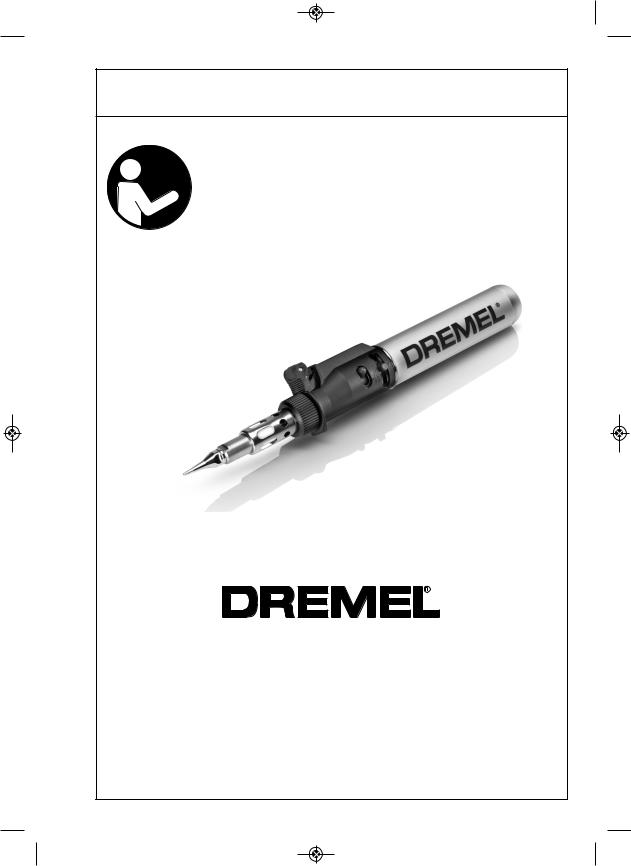
VersaTip 2000
P.O. Box 081126 Racine, WI 53408-1126
|
Call Toll Free for |
Pour obtenir des informations |
Llame gratis para |
|||
|
Consumer Information |
et les adresses de nos centres |
obtener información |
|||
|
& Service Locations |
de service après-vente, |
para el consumidor y |
|||
|
appelez ce numéro gratuit |
ubicaciones de servicio |
||||
|
1-800-4-DREMEL (1-800-437-3635) www.dremel.com |
|||||
|
For English Version |
Version française |
Versión en español |
|||
|
See page 2 |
Voir page 11 |
Ver la página 20 |
|||

 DM 2610Z06356 05-14 copy_2000 5/7/14 11:47 AM Page 2
Safety Warnings
READ ALL INSTRUCTIONS
SAVE ALL WARNINGS AND INSTRUCTIONS FOR FUTURE REFERENCE
|
Read all instructions in |
|||
|
! |
DANGER |
||
|
this manual and familiarize |
|||
yourself with the torch before lighting and using it. Failure to comply with the warnings and instructions may result in fire or an explosion that may result in property damage, serious personal injury or death.
Tank contains extremely flammable gas under pressure.
Keep torch out of reach of children and anyone who has not read these Operating/Safety Instructions.
Do not point the torch flame or torch exhaust port towards your face, other persons, or flammable items.
Take precautions not to heat the fuel tank.
Do not expose the torch or fuel to temperatures exceeding 120°F/49°C or prolonged sunlight.
Never use the torch in or around flammable fumes, liquids, or explosive materials.
Never leave the torch unattended when lit. Make sure the torch is completely extinguished after use.
Never pierce the fuel tank or expose torch to external flame.
Never attempt to repair or heat any containers that held flammable liquid, gas, or any chemical. Heating these containers can result in fire or explosion.
Never use the torch near combustibles (fuels, rags, towels, paper products, etc.). Be careful around motor vehicles or any gasoline-fired products and beware of hidden fuel lines and tanks.
Be sure the torch is not pointed toward objects that may ignite when the torch is set down.
Do not breathe gas, fumes, vapor, or spray. If inhaled, remove affected person to fresh air. Always use torch in a wellventilated area.
Wear a respirator when working on applications where toxic or nauseating vapors may exist. Avoid the fumes from fluxes, lead-based paint, and all metal heating operations. Fumes from cadmium plating and galvanized metal may be present.
Avoid fuel contact with eyes or skin. In case of contact with eyes, rinse immediately with plenty of water and seek medical advice. For skin contact, flush with large amounts of water.
Always protect torch from impact, or dropping onto floor or hard surfaces. Never use the torch if damage is suspected.
Do not modify torch or alter factory settings in any way.
Always use manufacturer recommended replacement parts.
Read refueling instruction before refueling torch.
Do not smoke while filling, refilling, or operating the torch.
-2-

 DM 2610Z06356 05-14 copy_2000 5/7/14 11:47 AM Page 3
Before using, check all ! WARNING parts for proper function
and damage to component parts.
Do not use this torch to heat, mold, or bend plastic sheets, molding or tubing.
Hidden areas such as behind walls, ceilings, floors, soffit boards and other panels may contain flammable materials that could be ignited by the heat gun when working in these locations. The ignition of these materials may not be readily apparent and could result in property damage and injury to persons.
When working in these locations, keep the torch moving in a back-and-forth motion. Lingering or pausing in one spot could ignite the panel or the material behind it.
Extreme care should be taken when stripping paint. The peelings, residue and vapors of paint may contain lead, which is poisonous. Any pre-1977 paint may contain lead and paint applied to homes prior to 1950 is likely to contain lead. Once deposited on surfaces, hand to mouth contact can result in the ingestion of lead. Exposure to even low levels of lead can cause irreversible brain and nervous system damage; young and unborn children are particularly vulnerable. Before beginning any paint removal process you should determine whether the paint you are removing contains lead. This can be done by your local health department or by a professional who uses a paint analyzer to check the lead content of the paint to be removed. LEAD-BASED PAINT SHOULD ONLY BE REMOVED BY A PROFESSIONAL AND SHOULD NOT BE REMOVED USING A TORCH.
Persons removing paint should follow these guidelines:
1)Move the work piece outdoors. If this is not possible, keep the work area well ventilated. Open the windows and put an exhaust fan in one of them. Be sure the fan is moving the air from inside to outside.
2)Remove or cover any carpets, rugs, furniture, clothing, cooking utensils and air ducts.
3)Place drop cloths in the work area to catch any paint chips or peelings. Wear protective clothing such as extra work shirts, overalls and hats.
4)Work in one room at a time. Furnishings should be removed or placed in the center of the room and covered. Work areas should be sealed off from the rest of the dwelling by sealing doorways with drop cloths.
5)Children, pregnant or potentially pregnant women and nursing mothers should not be present in the work area until the work is done and all clean up is complete.
6)Wear a dust respirator mask or a dual filter (dust and fume) respirator mask which has been approved by the Occupational Safety and Health Administration (OSHA), the National Institute of Safety and Health (NIOSH), or the United States Bureau of Mines. These masks and replaceable filters are readily available at major hardware stores. Be sure the mask fits. Beards and facial hair may keep masks from sealing properly. Change filters often. DISPOSABLE PAPER MASKS ARE NOT ADEQUATE.
7)Use caution when operating the torch. Keep the torch moving, as excessive heat will generate fumes, which can be inhaled by the operator.
 Keep food and drink out of the work area. Wash hands, arms and face and rinse mouth before eating or drinking. Do not smoke or chew gum or tobacco in the work area.
9)Clean up all removed paint and dust by wet mopping the floors. Use a wet cloth to clean all walls, sills and any other surface where paint or dust is clinging. DO NOT SWEEP, DRY DUST OR VACUUM. Use a high phosphate detergent or trisodium phosphate (TSP) to wash and mop areas.
10)At the end of each work session put the paint chips and debris in a double plastic bag, close it with tape or twist ties and dispose of properly.
11)Remove protective clothing and work shoes in the work area to avoid carrying dust into the rest of the dwelling. Wash work clothes separately. Wipe shoes off with a wet rag that is then washed with the work clothes. Wash hair and body thoroughly with soap and water.
Never attempt to use torch as a cigarette, cigar, or pipe lighter.
-3-

DM 2610Z06356 05-14 copy_2000 5/7/14 11:47 AM Page 4
Always wear eye protection when lighting and using the torch.
Keep your hair, and clothing away from the flame. Loose clothes or long hair can catch fire. Hot solder may cause burns.
Use only liquid butane fuel when filling or refilling torch.
Before each use and after refilling, inspect for leaks. Never use a flame to check for leaks. If leak is suspected use soapy water solution and look for continuous bubbling.
Ignite torch away from face, hands, clothing, or other flammable material.
Discontinue gas flow if torch is extinguished accidentally.
Always check to make sure that unintended parts or materials are not being heated.
Heat may be conducted to near objects or substances that may ignite or become pressurized when heated.
Use OSHA specified coating removal methods when preparing plated metal work pieces for heating.
Always make sure the torch is resting securely on its stand when handling work with both hands.
Do not touch the torch flame guard, flame diffuser, tips and attachments until they have cooled. Torch flame guard, flame diffuser, tips and attachments become extremely hot during use and remain hot after extinguishing.
Use caution when operating the torch outdoors. Bright sun makes it difficult to see flame of the torch. Wind may carry heat and/or sparks towards you, areas not intended to be heated, or combustible materials.
Allow the torch to completely cool before refilling fuel, changing accessories, cleaning, or storing.
Store torch in well ventilated areas.
Use only Dremel accessories to ensure proper operation of Dremel VersaTip.
Do not pack this item or any other flammable gas item in any checked or carry-on baggage. Department of Transportation Hazardous Materials Regulations forbids the carriage of butane or other flammable gas products on passenger aircraft.
SAVE THESE INSTRUCTIONS
Dremel VersaTip 2000 meets or exceeds the CPSC Safety Standard for Multi Purpose Lighters at 16 C.F.R. § 1212.17(b) and Federal Hazardous Substance Act (FHSA).
-4-
 DM 2610Z06356 05-14 copy_2000 5/7/14 11:47 AM Page 5
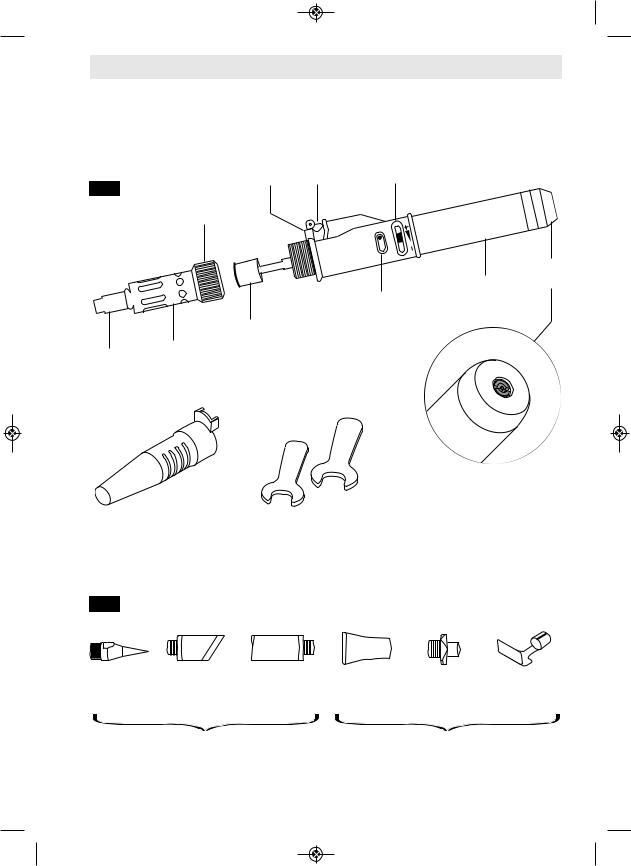
Functional Description
Dremel® VersaTip
|
Safety |
Flame Control |
|
|
Trigger |
Lock |
Slider |
FIG. 1
Flame
Guard Nut
Tank
Lock-On
Button
Ceramic
Insulator
Flame
Flame Guard
Diffuser
|
Protective |
7mm & 8mm |
|
Cap |
Wrench |
FIG. 2
|
Soldering |
Cutting |
Shaping |
Wide Tip |
Hot Air Tip |
Deflector |
|
Tip |
Knife |
Knife |
Blower |
Contact Attachments Non-Contact Attachments
-5-
 DM 2610Z06356 05-14 copy_2000 5/7/14 11:47 AM Page 6
Operating Instructions
|
Observe |
all provided |
|
|
! WARNING |
||
|
warnings |
and safety |
instructions when using the torch.
In cold weather size of flame will be smaller. To produce larger flame, pre-warm torch to room temperature prior to use.
Ensure all accessories are securely tightened before igniting the torch.
Familiarize yourself with the construction of the Dremel VersaTip components (Figure 1), and its accessories (Figure 2) before use.
Filling / Refilling Operation
Filling / refilling of the fuel tank must be done in a well-ventilated place far away from any possible sources of ignition. Be sure to observe the safety instructions and warning notices provided by the manufacturer of the liquid butane fuel. Make sure the gas you are using is a refined butane gas that can also be used for lighters.
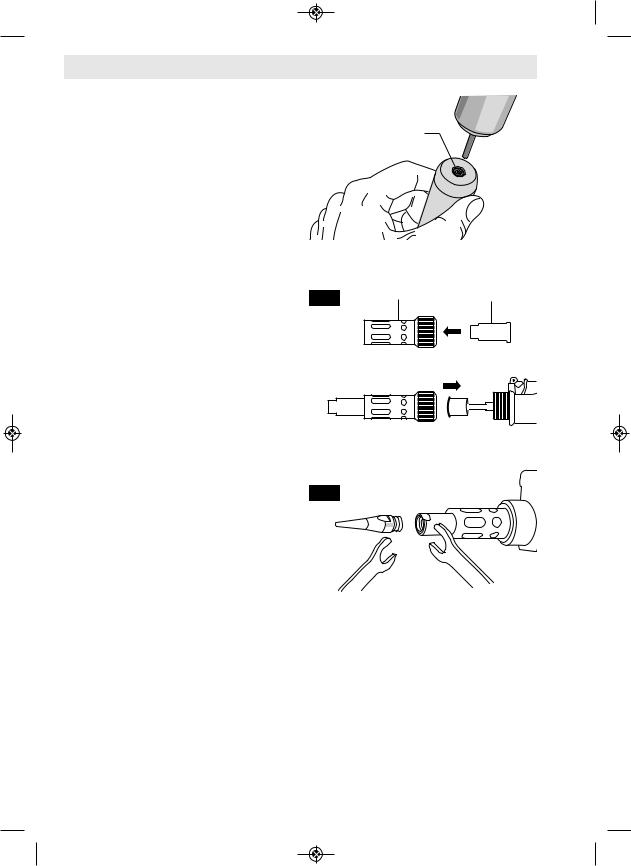
1.Hold the VersaTip with the Filling Valve facing up, then invert fuel container and insert the tip into the Filling Valve as shown in Figure 3.
2.Push the fuel container and VersaTip together to allow fuel to flow into the torch fuel tank. The VersaTip fuel tank should be filled in about 10 seconds.
3.Stop refilling once the fuel begins to escape at the Filling Valve.
4.Wait at least 3 minutes to allow fuel gas to stabilize before igniting the VersaTip.
Installing or Changing Tips
Use of the Soldering Tip, Cutting Knife, Shaping Knife, Hot Air Tip, Wide Tip Blower, and Deflector requires the Flame Diffuser to be installed.
To install the Flame Diffuser: Unscrew the Flame Guard nut and remove the Flame Guard. Slide the Flame Diffuser into the Flame Guard by inserting the narrow end of the Flame Diffuser into the Flame Guard first. Figure 4 shows correct assembly of the Flame Diffuser. Place the Flame Guard with Flame Diffuser back on to the tool and securely tighten the Flame Guard nut.
To install threaded attachment tips:
Thread the desired tip into the Flame Diffuser and tighten using the 7mm wrench while
|
Flame |
Flame |
||
|
Guard |
|||
|
FIG. 4 |
Diffuser |
||
FIG. 5
using the 8mm wrench to hold the Flame Diffuser in place, Figure 5. To remove follow the installation steps in reverse order.
To install the Wide Tip Blower: Slide the Wide Tip Blower over the Flame Diffuser and Flame Guard until the Wide Tip Blower is firmly secured to the Flame Guard. Make sure there is no tip installed in the Flame Diffuser before installing the Wide Tip Blower. To remove, slide the Wide Tip Blower off the Flame Guard and Flame Diffuser.
-6-

 DM 2610Z06356 05-14 copy_2000 5/7/14 11:47 AM Page 7
To install the Deflector: Slide the Deflector over the end of the Flame Diffuser until the
Deflector is firmly secured to the Flame FIG. 6 Diffuser. To remove, slide the Deflector off
the Flame Diffuser.
Lighting and Operation of the
Dremel VersaTip
The Dremel VersaTip igniter is equipped with a safety mechanism intended to protect against unintended ignition.
To ignite the VersaTip:
a.Turn the Flame Control Slider to the minimum position,
b.Grasp the torch body placing your thumb on the safety lock,
c.Using your thumb, rotate the Safety Lock forward (Figure 6) and pull back the Trigger (Figure 7),
d.Observe the Flame Guard to see if glow of the flame is visible. Also, listen for a sound of flame.
If there is no flame glow and the sound is of the escaping gas, then release the Trigger and repeat steps c and d. If ignition occurs, continue to step e.
e.Once the torch is ignited, you can hold on to the Trigger to maintain the flame, or slide the Lock-On Button to the lock position for continuous operation (Figure 8).
To turn off the Dremel VersaTip, let go of the Trigger, and move the Lock-On Button to the right if it was engaged during use. This will immediately stop the flow of butane gas and extinguish the torch flame.
Flame Length and Temperature
Adjustment
Adjustment of the flame length / temperature can be made by adjusting the Flame Control Slider. To increase flame length and temperature, move the Flame Control Slider to the right (+). To decrease flame length and temperature, move the Flame Control Slider to the left (-).
When using with any of the contact attachments (Figure 2) allow 25 seconds for tips to reach full temperature. When using non-contact attachments (figure 2) the full temperature is available immediately after ignition.
Flame
Control
Slider
FIG. 7
FIG. 8
Lock-On
Button
Safety
lock
LOCK


 Trigger
LOCK
LOCK
-7-
 DM 2610Z06356 05-14 copy_2000 5/7/14 11:47 AM Page 8
Applications
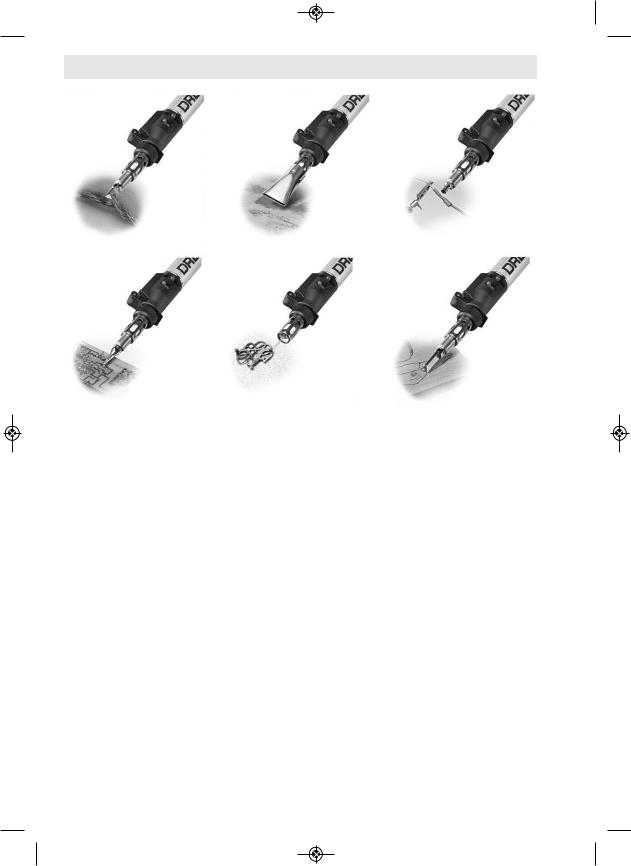
Using with an Open Flame
When configured for open flame, the VersaTip can be used for tasks such as culinary caramelizing, brazing, copper pipe sweating, and freeing of seized nuts and bolts.
To use the Dremel VersaTip with an open flame, unscrew the flame guard, remove the flame diffuser and tip (if attached), screw the flame guard back onto the tool, and securely tighten the flame guard nut.
Using with Soldering Tip
The soldering tip (to be used with the flame diffuser) can be used for regular soldering activities, including joining wire and component installation on printed circuit boards.
Using with Hot Air Tip
The Hot Air Tip (to be used with the flame diffuser): can be used for heating of heatsensitive materials.
The hot air tip generates air temperature of 1256°F (680 °C)
Using with Cutting Knife
The Cutting Knife (to be used with the flame diffuser) can be used for cutting of nylon rope to prevent ‘feathering’.
Using with Shaping Knife
The Shaping Knife (to be used with the flame diffuser) can be used for cutting to size of sheets of plastic and other heat sensitive materials.
Using Wide Tip Blower
The Blower can be used for preparing surface areas for detailed paint and coating removal.
Use with Deflector
The Deflector (to be used with the flame diffuser) is for shrinking of heat sensitive insulation around electrical wiring.
Follow instructions provided with materials being used and worked on.
-8-

 DM 2610Z06356 05-14 copy_2000 5/7/14 11:47 AM Page 9
Maintenance & Storage
Maintenance
Clean the exterior of the tool with a clean dry cloth. If necessary, use a damp cloth.
When soldering, to clean the Soldering Tip, wipe the tip on a wet sponge while it is still hot and solder is molten.
Never clean the Soldering Tip with sandpaper as this reduces its lifetime.
The torch gas nozzle can get clogged due to butane gas impurities. To return the torch to full operating condition the nozzle needs to be replaced. Contact Dremel customer service to order the replacement nozzle and instructions.
Storage
Ensure that the Lock-On Button is in the unlocked position and Trigger is locked out with the Safety Lock.
Allow several minutes for torch to cool.
When torch is cool, store torch out of reach of children.
-9-
 Loading…
You can only view or download manuals with
Sign Up and get 5 for free
Upload your files to the site. You get 1 for each file you add
Get 1 for every time someone downloads your manual
Buy as many as you need

Dremel
The Netherlands
2610Z03816 11/2012
www.dremel.com
All Rights Reserved
GB
DE
FR
IT
NL
DA
SV
NO
FI
ES
PT
EL
TR
CS
PL
BG
HU
RO
RU
ET
LT
SL
LV
HR
SR
SK
UK
AR
Original instructions
4
Übersetzung der Originalbedienungsanleitung
6
Traduction de la notice originale
9
Traduzione delle istruzioni originali
11
Vertaling van de originele gebruiksaanwijzing
14
Oversættelse af betjeningsvejledning
16
Översättning av originalinstruktioner
19
Oversettelse av originalinstruksjonene
21
Käännös alkuperäisistä ohjeista
24
Traducción de las instrucciones originales
26
Tradução das instruções originais
29
Μετάφραση των πρωτοτυπων οδηγιων
32
Orjinal yönergelerin çevirisi
34
Překlad originálních pokynů
37
Tłumaczenie oryginalnej instrukcji
39
Превод на оригиналните инструкции
42
Az eredeti előírások fordítása
45
Traducere a instruţiunilor originale
48
Перевод оригинальных инструкций
50
Algsete juhiste tõlge
53
Originalių instrukcijų vertimas
55
Prevod originalnih navodil
58
Oriģinālās lietošanas pamācības tulkojums
60
Prijevod originalnih uputa
63
Превод Оригиналног Упутства
65
Preklad pôvodných pokynov
68
Переклад головних інструкцій
70
2000
Dremel European Sales Office
The Netherlands
www.dremel.com
2610396778 06/07
All Rights Reserved
GB
D
F
I
NL
DK
S
N
FIN
E
P
GR
TR
CZ
PL
BG
HU
HR
RO
RU
Operating/Safety Instructions
Page
4
Bedienungs-/Sicherheitsanweisungen
Seite
8
Notice d’utilisation/consignes de sécurité
Page
11
Istruzioni di funzionamento/sicurezza
Pagina
14
Bedienings-/veiligheidsvoorschriften
Pagina
18
Betjenings-/sikkerhedsvejledning
Side
22
Anvisningar för användning/säkerhet
Sida
25
Bruksanvisning og sikkerhetsinstruksjoner
Side
28
Käyttö- ja turvallisuusohjeet
Sivu
31
Instrucciones de funcionamiento y seguridad
Página
34
Instruções de utilização/segurança
Página
38
√‰ËÁ›Â˜ ÃÂÈÚÈÛÌÔ‡/∞ÛÊ·Ï›·˜
√ÂÏ›‰·
42
Çal∂μma/Güvenlik Talimatlar∂
Sayfa
46
Provozní/bezpeãnostní pokyny
Strana
50
Instrukcja obs∏ugi/instrukcja dotyczàca
bezpieczeƒstwa Strona
54
Ръководство за работа/безопасност
Cтрaницa 58
Használati/biztonsági utasítások
Oldal
62
Upute za rad/sigurnosne upute
Stranica
66
Instrucøiuni de utilizare/protecøie
Pagina
70
Инструкции по эксплуатации и
технике безопасности
Cтрaницa 74
Kasutusjuhend / Ohutusnõuded
lk
78
Darbo/Saugos Instrukcijos
Psl.
82
Lieto‰anas pamÇc¥ba un darba dro‰¥bas noteikumi Lappuse
86
EST
LT
LV
Dremel European Sales Office
The Netherlands
www.dremel.com
2610396778 06/07 All Rights Reserved
GB
D
F
I
NL
DK
S
N
FIN
E
P
GR
TR
CZ
PL
BG
HU
HR
RO
RU
Operating/Safety Instructions Page
4
Bedienungs-/Sicherheitsanweisungen Seite
8
Notice d’utilisation/consignes de sécurité Page 11
Istruzioni di funzionamento/sicurezza Pagina 14
Bedienings-/veiligheidsvoorschriften Pagina 18
Betjenings-/sikkerhedsvejledning Side 22
Anvisningar för användning/säkerhet Sida 25
Bruksanvisning og sikkerhetsinstruksjoner Side 28
Käyttö- ja turvallisuusohjeet Sivu 31
Instrucciones de funcionamiento y seguridad Página 34
Instruções de utilização/segurança Página 38
√‰ËÁ›Â˜ ÃÂÈÚÈÛÌÔ‡/∞ÛÊ·Ï›·˜ √ÂÏ›‰· 42
Çal∂μma/Güvenlik Talimatlar∂ Sayfa 46
Provozní/bezpeãnostní pokyny Strana 50
Instrukcja obs∏ugi/instrukcja dotyczàca
bezpieczeƒstwa Strona 54
Ръководство за работа/безопасност Cтрaницa 58
Használati/biztonsági utasítások Oldal 62
Upute za rad/sigurnosne upute Stranica 66
Instrucøiuni de utilizare/protecøie Pagina 70
Инструкции по эксплуатации и
технике безопасности Cтрaницa 74
Kasutusjuhend / Ohutusnõuded lk 78
Darbo/Saugos Instrukcijos Psl. 82
Lieto‰anas pamÇc¥ba un darba dro‰¥bas noteikumi Lappuse 86
EST
LT
LV