
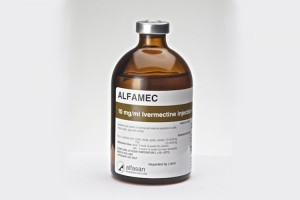
Альфамек — противопаразитарный лекарственный препарат системного действия из класса макроциклических лактонов.
Эффективен в отношении личиночных и половозрелых фаз развития нематод желудочно-кишечного тракта и легких, личинок подкожных, носоглоточных, желудочных оводов, вшей, кровососок и саркоптоидных клещей.
В рекомендуемых дозах препарат не оказывает эмбриотоксического, тератогенного и мутагенного действия; во внешней среде быстро разрушается.
Состав:
В 1 мл в качестве действующего вещества содержит ивермектин – 10 мг, а также вспомогательные компоненты (спирт бензиловый – 10 мг, глицеролформаль – 480 мг и пропиленгликоль – до 1 мл).
Показания:
Альфамек назначают жвачным и свиньям с лечебно-профилактической целью при арахно-энтомозах и нематодозах:
— крупному рогатому скоту – при стронгилятозах, трихоцефалезе, стронгилоидозе, телязиозе, сифункулятозах, гиподерматозе, псороптозе; саркоптозе и хориоптозе;
— овцам и козам – при диктиокаулезе, протостронгилезе, мюллериозе, гемонхозе, остертагиозе, нематодирозе, маршаллагиозе, коопериозе, хабертиозе, эзофагостомозе, буностомозе, трихоцефалезе, стронгилоидозе, мелофагозе, эстрозе, псороптозе и хабертиозе;
— свиньям – при трихоцефалезе, аскаридозе, метастронгилезе, эзофагостамозе, стронгилоидозе, стефанурозе, гематопинозе и саркоптозе
Дозировка и способ применения:
Альфамек вводят животным однократно подкожно:с соблюдением правил асептики в следующих дозах:
— крупному и мелкому рогатому скоту – 1,0 мл Альфамека на 50 кг массы животного (200 мкг ивермектина на 1 кг массы);
— свиньям – 1,0 мл Альфамека на 33 кг массы животного (300 мкг ивермектина на 1 кг массы).
В тяжелых случаях заболевания животных саркоптоидозами обработку проводят двукратно с интервалом 8-10 дней.
Форма выпуска:
Раствор для инъекций. Выпускают лекарственный препарат расфасованным по 50 и 100 мл в полимерные и стеклянные флаконы.
Производитель: «Альфасан Интернэшнл БВ» («Alfasan International B.V»), Нидерланды
Препарат Альфамек – это противопаразитное средство. Эффективен в борьбе с нематодами в фазах — личинки и половозрелой. Также назначается против носоглоточных и желудочных оводов, кровососок, саркоптойдных клещей.
При использовании Альфамека в рекомендуемых дозировках этот препарат не проявляет у животных тератогенного и эмбриотоксического воздействия.
Действующее вещество препарата – ивермектин. Вспомогательные составляющие – бензиловый спирт, глицеролформаль, пропиленгликоль.
Используется для лечения и профилактики заболеваний, вызванных нематодами. Назначается свиньям, жвачным животным.
Для КРС Альфамек назначается для борьбы с стронгилятозом, трихоцефалезом, стронгилоидозом, телязиозом, сифункулятозом, гиподерматозом, псороптозом; саркоптозом и хориоптозом.
Для коз и овец назначается при диагнозах — диктиокаулеоз, коопериоз, хабертиоз, мелофагоз, эстроз, других заболеваниях.
Для свиней назначается при аскаридозе, метастронгилезе, эзофагостамозе, стефанурозе, гематопинозе и саркоптозе, стронгилоидозе.
Препарат вводят посредством подкожной инъекции в дозировках: для коров и мелкого рогатого скота — 1,0 мл/50 кг от веса тела, для свиней – 1,0 мл/33 кг от веса тела. При запущенной форме заболевания инъекцию делают повторно через 8-10 дней после первой.
Назад в раздел
Биологические свойства / показания к применению
Альфамек — противопаразитарный лекарственный препарат системного действия из класса макроциклических лактонов. Эффективен в отношении личиночных и половозрелых фаз развития нематод желудочно-кишечного тракта и легких, личинок подкожных, носоглоточных, желудочных оводов, вшей, кровососок и саркоптоидных клещей. В рекомендуемых дозах препарат не оказывает эмбриотоксического, терато-генного и мутагенного действия; во внешней среде быстро разрушается.
Порядок применения и дозировка
Альфамек назначают жвачным животным и свиньям с лечебно-профилактической целью при арахно-энтомозах и нематодозах:крупному рогатому скоту — при стронгилятозах, трихоцефалезе, стронгилоидозе, телязиозе, сифункулятозах, гиподерматозе, псороптозе; саркоптозе и хориоптозе;овцам и козам — при диктиокаулезе, протосгронгилезе, мюллериозе, гемонхозе, остертагиозе, нематодирозе, маршаллагиозе, коопериозе, хабертиозе, эзофагостомозе, буностомозе, трихоцефалезе, стронгилоидозе, мелофагозе, эстрозе, псороптозе и хабертиозе;свиньям — при трихоцефалезе, аскаридозе, метастронгилезе, эзофагостамозе, стронгилоидозе, стефанурозе, гематопинозе и саркоптозе.Альфамек вводят животным однократно подкожно: с соблюдением правил асептики в следующих дозах:крупному и мелкому рогатому скоту — 1,0 мл Альфамека на 50 кг массы животного (200 мкг ивермектина на 1кг массы);свиньям —1,0 мл Альфамека на 33 кг массы животного (300 мкг ивермектина на 1 кг массы).В тяжелых случаях заболевания живот-ных саркоптоидозами обработку проводят двукратно с интервалом 8-10 дней.
Ограничения
Не применять больным, истощенным и ослабленным животным. Не использовать коровам в период лактации и в последний месяц беременности (за 28 суток до родов).Убой животных на мясо разрешается через 28 суток после последнего применения препарата.
Форма выпуска
полимерные и стеклянные флаконы по 50, 100, 250 и 500 мл.
действующее вещество — ивермектин 10 мг, вспомогательные компоненты (спирт бензиновый — 10 мг, глицеролформаль — 480 мг, пропилен-гликоль — до 1 мл).
Характеристики
Тип
противопаразитное средство
Применение
крс, овцы,козы, свиньи
Альфамек также известен как ивермектин.
Производителем препарата является компания Alfasan International B.V. Альфамек применяется для лечения и профилактики паразитарных болезней у жвачных животных и свиней.
Номер в реестре лекарственных средств для ветеринарного применения ПВИ-3-8.0/03448.
Препарат отпускается без рецепта. Дозировка: 0,04 мг. Фасовка: по 10, 50, 100, 250, 500, 1000, 2000, 2500, 3000, 5000 таблеток в пакетах.
Состав: ивермектин, вспомогательные компоненты- спирт бензиновый, глицеролформаль, пропиленгликоль
Противопоказания: Не допускается дойным, больным инфекционными болезнями,истощенным, беременным самкам, молоко которых будет использоваться в пищевых целях, менее чем за 28 суток до начала лактации,животным с повышенной чувствительностью к ивермектинам
Срок годности: 2 года
Побочные эффекты: не отмечается
Условия хранения: в сухом, защищенном от прямых солнечных лучей месте, отдельно от продуктов питания и кормов, при температуре от 0°С до 25°С

Альфамек
| Форма выпуска | Фл. 100 мл. |
| Оптовая упаковка | — |
| Производитель | Alfasan |
| Цена | 230,00 |
Описание
Альфамек — противопаразитарный лекарственный препарат системного действия из класса макроциклических лактонов.
Состав
В 1 мл в качестве действующего вещества содержит ивермектин – 10 мг, а также вспомогательные компоненты (спирт бензиловый – 10 мг, глицеролформаль – 480 мг и пропиленгликоль – до 1 мл).
Фармакологические свойства
Эффективен в отношении личиночных и половозрелых фаз развития нематод желудочно-кишечного тракта и легких, личинок подкожных, носоглоточных, желудочных оводов, вшей, кровососок и саркоптоидных клещей.
Показания к применению
Альфамек назначают жвачным и свиньям с лечебно-профилактической целью при арахно-энтомозах и нематодозах:
— крупному рогатому скоту – при стронгилятозах, трихоцефалезе, стронгилоидозе, телязиозе, сифункулятозах, гиподерматозе, псороптозе; саркоптозе и хориоптозе;
— овцам и козам – при диктиокаулезе, протостронгилезе, мюллериозе, гемонхозе, остертагиозе, нематодирозе, маршаллагиозе, коопериозе, хабертиозе, эзофагостомозе, буностомозе, трихоцефалезе, стронгилоидозе, мелофагозе, эстрозе, псороптозе и хабертиозе;
— свиньям – при трихоцефалезе, аскаридозе, метастронгилезе, эзофагостамозе, стронгилоидозе, стефанурозе, гематопинозе и саркоптозе.
Дозировка и применение
Альфамек вводят животным однократно подкожно:с соблюдением правил асептики в следующих дозах:
— крупному и мелкому рогатому скоту – 1,0 мл Альфамека на 50 кг массы животного (200 мкг ивермектина на 1 кг массы);
— свиньям – 1,0 мл Альфамека на 33 кг массы животного (300 мкг ивермектина на 1 кг массы).
В тяжелых случаях заболевания животных саркоптоидозами обработку проводят двукратно с интервалом 8-10 дней.


Top 20 medicines with the same components:
Top 20 medicines with the same treatments:

The information provided in of Alfamec
is based on data of another medicine with exactly the same composition as the Alfamec.
. Be careful and be sure to specify the information on the section in the instructions to the drug Alfamec directly from the package or from the pharmacist at the pharmacy.
more…
Alfamec
Qualitative and quantitative composition
The information provided in Qualitative and quantitative composition of Alfamec
is based on data of another medicine with exactly the same composition as the Alfamec.
. Be careful and be sure to specify the information on the section Qualitative and quantitative composition in the instructions to the drug Alfamec directly from the package or from the pharmacist at the pharmacy.
more…
Ivermectin
Therapeutic indications
The information provided in Therapeutic indications of Alfamec
is based on data of another medicine with exactly the same composition as the Alfamec.
. Be careful and be sure to specify the information on the section Therapeutic indications in the instructions to the drug Alfamec directly from the package or from the pharmacist at the pharmacy.
more…
Alfamec (ivermectin) is indicated for the treatment of the following infections:
Strongyloidiasis of the intestinal tract. Alfamec (ivermectin) is indicated for the treatment of intestinal (i.e., nondisseminated) strongyloidiasis due to the nematode parasite Strongyloides stercoralis.
This indication is based on clinical studies of both comparative and open-label designs, in which 64-100% of infected patients were cured following a single 200-mcg/kg dose of ivermectin. (See CLINICAL PHARMACOLOGY, Clinical Studies.)
Onchocerciasis. Alfamec (ivermectin) is indicated for the treatment of onchocerciasis due to the nematode parasite Onchocerca volvulus.
This indication is based on randomized, double-blind, placebo-controlled and comparative studies conducted in 1427 patients in onchocerciasis-endemic areas of West Africa. The comparative studies used diethylcarbamazine citrate (DEC-C).
NOTE: Alfamec (ivermectin) has no activity against adult Onchocerca volvulus parasites. The adult parasites reside in subcutaneous nodules which are infrequently palpable. Surgical excision of these nodules (nodulectomy) may be considered in the management of patients with onchocerciasis, since this procedure will eliminate the microfilariae-producing adult parasites.
Dosage (Posology) and method of administration
The information provided in Dosage (Posology) and method of administration of Alfamec
is based on data of another medicine with exactly the same composition as the Alfamec.
. Be careful and be sure to specify the information on the section Dosage (Posology) and method of administration in the instructions to the drug Alfamec directly from the package or from the pharmacist at the pharmacy.
more…
Strongyloidiasis
The recommended dosage of Alfamec (ivermectin) for the treatment of strongyloidiasis is a single oral dose designed to provide approximately 200 mcg of ivermectin per kg of body weight. See Table 1 for dosage guidelines. Patients should take tablets on an empty stomach with water. (See CLINICAL PHARMACOLOGY, Pharmacokinetics.) In general, additional doses are not necessary. However, follow-up stool examinations should be performed to verify eradication of infection. (See CLINICAL PHARMACOLOGY, Clinical Studies.)
Table 1: Dosage Guidelines for Alfamec (ivermectin) for Strongyloidiasis
| Body Weight (kg) | Single Oral Dose Number of 3-mg Tablets |
| 15-24 | 1 tablet |
| 25-35 | 2 tablets |
| 36-50 | 3 tablets |
| 51-65 | 4 tablets |
| 66-79 | 5 tablets |
| ≥ 80 | 200 mcg/kg |
Onchocerciasis
The recommended dosage of Alfamec (ivermectin) for the treatment of onchocerciasis is a single oral dose designed to provide approximately 150 mcg of ivermectin per kg of body weight. See Table 2 for dosage guidelines. Patients should take tablets on an empty stomach with water. (See CLINICAL PHARMACOLOGY, Pharmacokinetics.) In mass distribution campaigns in international treatment programs, the most commonly used dose interval is 12 months. For the treatment of individual patients, retreatment may be considered at intervals as short as 3 months.
Table 2: Dosage Guidelines for Alfamec (ivermectin) for Onchocerciasis
| Body Weight (kg) | Single Oral Dose Number of 3-mg Tablets |
| 15-25 | 1 tablet |
| 26-44 | 2 tablets |
| 45-64 | 3 tablets |
| 65-84 | 4 tablets |
| ≥ 85 | 150 mcg/kg |
Contraindications
The information provided in Contraindications of Alfamec
is based on data of another medicine with exactly the same composition as the Alfamec.
. Be careful and be sure to specify the information on the section Contraindications in the instructions to the drug Alfamec directly from the package or from the pharmacist at the pharmacy.
more…
Alfamec (ivermectin) is contraindicated in patients who are hypersensitive to any component of this product.
Special warnings and precautions for use
The information provided in Special warnings and precautions for use of Alfamec
is based on data of another medicine with exactly the same composition as the Alfamec.
. Be careful and be sure to specify the information on the section Special warnings and precautions for use in the instructions to the drug Alfamec directly from the package or from the pharmacist at the pharmacy.
more…
WARNINGS
Historical data have shown that microfilaricidal drugs, such as diethylcarbamazine citrate (DEC-C), might cause cutaneous and/or systemic reactions of varying severity (the Mazzotti reaction) and ophthalmological reactions in patients with onchocerciasis. These reactions are probably due to allergic and inflammatory responses to the death of microfilariae. Patients treated with Alfamec (ivermectin) for onchocerciasis may experience these reactions in addition to clinical adverse reactions possibly, probably, or definitely related to the drug itself. (See ADVERSE REACTIONS, Onchocerciasis.)
The treatment of severe Mazzotti reactions has not been subjected to controlled clinical trials. Oral hydration, recumbency, intravenous normal saline, and/or parenteral corticosteroids have been used to treat postural hypotension. Antihistamines and/or aspirin have been used for most mild to moderate cases.
PRECAUTIONS
General
After treatment with microfilaricidal drugs, patients with hyperreactive onchodermatitis (sowda) may be more likely than others to experience severe adverse reactions, especially edema and aggravation of onchodermatitis.
Rarely, patients with onchocerciasis who are also heavily infected with Loa loa may develop a serious or even fatal encephalopathy either spontaneously or following treatment with an effective microfilaricide. In these patients, the following adverse experiences have also been reported: pain (including neck and back pain), red eye, conjunctival hemorrhage, dyspnea, urinary and/or fecal incontinence, difficulty in standing/walking, mental status changes, confusion, lethargy, stupor, seizures, or coma. This syndrome has been seen very rarely following the use of ivermectin. In individuals who warrant treatment with ivermectin for any reason and have had significant exposure to Loa loa-endemic areas of West or Central Africa, pretreatment assessment for loiasis and careful post-treatment follow-up should be implemented.
Carcinogenesis, Mutagenesis, Impairment of Fertility
Long-term studies in animals have not been performed to evaluate the carcinogenic potential of ivermectin.
Ivermectin was not genotoxic in vitro in the Ames microbial mutagenicity assay of Salmonella typhimurium strains TA1535, TA1537, TA98, and TA100 with and without rat liver enzyme activation, the Mouse Lymphoma Cell Line L5178Y (cytotoxicity and mutagenicity) assays, or the unscheduled DNA synthesis assay in human fibroblasts.
Ivermectin had no adverse effects on the fertility in rats in studies at repeated doses of up to 3 times the maximum recommended human dose of 200 mcg/kg (on a mg/m2/day basis).
Pregnancy, Teratogenic Effects
Pregnancy Category C
Ivermectin has been shown to be teratogenic in mice, rats, and rabbits when given in repeated doses of 0.2, 8.1, and 4.5 times the maximum recommended human dose, respectively (on a mg/m2/day basis). Teratogenicity was characterized in the three species tested by cleft palate; clubbed forepaws were additionally observed in rabbits. These developmental effects were found only at or near doses that were maternotoxic to the pregnant female. Therefore, ivermectin does not appear to be selectively fetotoxic to the developing fetus. There are, however, no adequate and well-controlled studies in pregnant women. Ivermectin should not be used during pregnancy since safety in pregnancy has not been established.
Nursing Mothers
Alfamec (ivermectin) is excreted in human milk in low concentrations. Treatment of mothers who intend to breastfeed should only be undertaken when the risk of delayed treatment to the mother outweighs the possible risk to the newborn.
Pediatric Use
Safety and effectiveness in pediatric patients weighing less than 15 kg have not been established.
Geriatric Use
Clinical studies of Alfamec (ivermectin) did not include sufficient numbers of subjects aged 65 and over to determine whether they respond differently from younger subjects. Other reported clinical experience has not identified differences in responses between the elderly and younger patients. In general, treatment of an elderly patient should be cautious, reflecting the greater frequency of decreased hepatic, renal, or cardiac function, and of concomitant disease or other drug therapy.
Strongyloidiasis in Immunocompromised Hosts
In immunocompromised (including HIV-infected) patients being treated for intestinal strongyloidiasis, repeated courses of therapy may be required. Adequate and well-controlled clinical studies have not been conducted in such patients to determine the optimal dosing regimen. Several treatments, i.e., at 2-week intervals, may be required, and cure may not be achievable. Control of extra-intestinal strongyloidiasis in these patients is difficult, and suppressive therapy, i.e., once per month, may be helpful.
Undesirable effects
The information provided in Undesirable effects of Alfamec
is based on data of another medicine with exactly the same composition as the Alfamec.
. Be careful and be sure to specify the information on the section Undesirable effects in the instructions to the drug Alfamec directly from the package or from the pharmacist at the pharmacy.
more…
Strongyloidiasis
In four clinical studies involving a total of 109 patients given either one or two doses of 170 to 200 mcg/kg of Alfamec (ivermectin) , the following adverse reactions were reported as possibly, probably, or definitely related to Alfamec (ivermectin) :
Body as a Whole: asthenia/fatigue (0.9%), abdominal pain (0.9%)
Gastrointestinal: anorexia (0.9%), constipation (0.9%), diarrhea (1.8%), nausea (1.8%), vomiting (0.9%)
Nervous System/Psychiatric: dizziness (2.8%), somnolence (0.9%), vertigo (0.9%), tremor (0.9%)
Skin: pruritus (2.8%), rash (0.9%), and urticaria (0.9%).
In comparative trials, patients treated with Alfamec (ivermectin) experienced more abdominal distention and chest discomfort than patients treated with albendazole. However, Alfamec (ivermectin) was better tolerated than thiabendazole in comparative studies involving 37 patients treated with thiabendazole.
The Mazzotti-type and ophthalmologic reactions associated with the treatment of onchocerciasis or the disease itself would not be expected to occur in strongyloidiasis patients treated with Alfamec (ivermectin). (See ADVERSE REACTIONS, Onchocerciasis.)
Laboratory Test Findings
In clinical trials involving 109 patients given either one or two doses of 170 to 200 mcg/kg Alfamec (ivermectin) , the following laboratory abnormalities were seen regardless of drug relationship: elevation in ALT and/or AST (2%), decrease in leukocyte count (3%). Leukopenia and anemia were seen in one patient.
Onchocerciasis
In clinical trials involving 963 adult patients treated with 100 to 200 mcg/kg Alfamec (ivermectin) , worsening of the following Mazzotti reactions during the first 4 days post-treatment were reported: arthralgia/synovitis (9.3%), axillary lymph node enlargement and tenderness (11.0% and 4.4%, respectively), cervical lymph node enlargement and tenderness (5.3% and 1.2%, respectively), inguinal lymph node enlargement and tenderness (12.6% and 13.9%, respectively), other lymph node enlargement and tenderness (3.0% and 1.9%, respectively), pruritus (27.5%), skin involvement including edema, papular and pustular or frank urticarial rash (22.7%), and fever (22.6%). (See WARNINGS.)
In clinical trials, ophthalmological conditions were examined in 963 adult patients before treatment, at day 3, and months 3 and 6 after treatment with 100 to 200 mcg/kg Alfamec (ivermectin). Changes observed were primarily deterioration from baseline 3 days post-treatment. Most changes either returned to baseline condition or improved over baseline severity at the month 3 and 6 visits. The percentages of patients with worsening of the following conditions at day 3, month 3 and 6, respectively, were: limbitis: 5.5%, 4.8%, and 3.5% and punctate opacity: 1.8%, 1.8%, and 1.4%. The corresponding percentages for patients treated with placebo were: limbitis: 6.2%, 9.9%, and 9.4% and punctate opacity: 2.0%, 6.4%, and 7.2%. (See WARNINGS.)
In clinical trials involving 963 adult patients who received 100 to 200 mcg/kg Alfamec (ivermectin) , the following clinical adverse reactions were reported as possibly, probably, or definitely related to the drug in ≥ 1% of the patients: facial edema (1.2%), peripheral edema (3.2%), orthostatic hypotension (1.1%), and tachycardia (3.5%). Drug-related headache and myalgia occurred in < 1% of patients (0.2% and 0.4%, respectively). However, these were the most common adverse experiences reported overall during these trials regardless of causality (22.3% and 19.7%, respectively).
A similar safety profile was observed in an open study in pediatric patients ages 6 to 13.
The following ophthalmological side effects do occur due to the disease itself but have also been reported after treatment with Alfamec (ivermectin) : abnormal sensation in the eyes, eyelid edema, anterior uveitis, conjunctivitis, limbitis, keratitis, and chorioretinitis or choroiditis. These have rarely been severe or associated with loss of vision and have generally resolved without corticosteroid treatment.
Laboratory Test Findings
In controlled clinical trials, the following laboratory adverse experiences were reported as possibly, probably, or definitely related to the drug in ≥ 1% of the patients: eosinophilia (3%) and hemoglobin increase (1%).
Post-Marketing Experience
The following adverse reactions have been reported since the drug was registered overseas:
Onchocerciasis
Conjunctival hemorrhage
All Indications
Hypotension (mainly orthostatic hypotension), worsening of bronchial asthma, toxic epidermal necrolysis, Stevens-Johnson syndrome, seizures, hepatitis, elevation of liver enzymes, and elevation of bilirubin.
Overdose
The information provided in Overdose of Alfamec
is based on data of another medicine with exactly the same composition as the Alfamec.
. Be careful and be sure to specify the information on the section Overdose in the instructions to the drug Alfamec directly from the package or from the pharmacist at the pharmacy.
more…
Significant lethality was observed in mice and rats after single oral doses of 25 to 50 mg/kg and 40 to 50 mg/kg, respectively. No significant lethality was observed in dogs after single oral doses of up to 10 mg/kg. At these doses, the treatment-related signs that were observed in these animals include ataxia, bradypnea, tremors, ptosis, decreased activity, emesis, and mydriasis.
In accidental intoxication with, or significant exposure to, unknown quantities of veterinary formulations of ivermectin in humans, either by ingestion, inhalation, injection, or exposure to body surfaces, the following adverse effects have been reported most frequently: rash, edema, headache, dizziness, asthenia, nausea, vomiting, and diarrhea. Other adverse effects that have been reported include: seizure, ataxia, dyspnea, abdominal pain, paresthesia, urticaria, and contact dermatitis.
In case of accidental poisoning, supportive therapy, if indicated, should include parenteral fluids and electrolytes, respiratory support (oxygen and mechanical ventilation if necessary) and pressor agents if clinically significant hypotension is present. Induction of emesis and/or gastric lavage as soon as possible, followed by purgatives and other routine anti-poison measures, may be indicated if needed to prevent absorption of ingested material.
Pharmacokinetic properties
The information provided in Pharmacokinetic properties of Alfamec
is based on data of another medicine with exactly the same composition as the Alfamec.
. Be careful and be sure to specify the information on the section Pharmacokinetic properties in the instructions to the drug Alfamec directly from the package or from the pharmacist at the pharmacy.
more…
Following oral administration of ivermectin, plasma concentrations are approximately proportional to the dose. In two studies, after single 12-mg doses of Alfamec (ivermectin) in fasting healthy volunteers (representing a mean dose of 165 mcg/kg), the mean peak plasma concentrations of the major component (H2B1a) were 46.6 (±21.9) (range: 16.4-101.1) and 30.6 (±15.6) (range: 13.9-68.4) ng/mL, respectively, at approximately 4 hours after dosing. Ivermectin is metabolized in the liver, and ivermectin and/or its metabolites are excreted almost exclusively in the feces over an estimated 12 days, with less than 1% of the administered dose excreted in the urine. The plasma half-life of ivermectin in man is approximately 18 hours following oral administration.
The safety and pharmacokinetic properties of ivermectin were further assessed in a multiple-dose clinical pharmacokinetic study involving healthy volunteers. Subjects received oral doses of 30 to 120 mg (333 to 2000 mcg/kg) ivermectin in a fasted state or 30 mg (333 to 600 mcg/kg) ivermectin following a standard high-fat (48.6 g of fat) meal. Administration of 30 mg ivermectin following a high-fat meal resulted in an approximate 2.5fold increase in bioavailability relative to administration of 30 mg ivermectin in the fasted state.
In vitro studies using human liver microsomes and recombinant CYP450 enzymes have shown that ivermectin is primarily metabolized by CYP3A4. Depending on the in vitro method used, CYP2D6 and CYP2E1 were also shown to be involved in the metabolism of ivermectin but to a significantly lower extent compared to CYP3A4. The findings of in vitro studies using human liver microsomes suggest that clinically relevant concentrations of ivermectin do not significantly inhibit the metabolizing activities of CYP3A4, CYP2D6, CYP2C9, CYP1A2, and CYP2E1.
Alfamec price
We have no data on the cost of the drug.
However, we will provide data for each active ingredient
The approximate cost of Ivermectin 3 mg per unit in online pharmacies is from 1.3$ to 7.1$, per package is from 39$ to 142$.
The approximate cost of Ivermectin 1 % per unit in online pharmacies is from 2.1$ to 3$, per package is from 63$ to 90$.
The approximate cost of Ivermectin 6 mg per unit in online pharmacies is from 1.72$ to 6.37$, per package is from 29$ to 109$.
The approximate cost of Ivermectin 12 mg per unit in online pharmacies is from 1.57$ to 4.25$, per package is from 36$ to 157$.