
Главная » Каталог лекарств

- Код товара: s190521
- Производитель: DB Pharma Франция
- Действующее вещество: прометазин
- Наличие: нет в наличии
Препарат Фенерган (прометазин)
Производит Фенерган венгерская и французская фармацевтические компании. Основной действующий компонент – прометазин. Он относится к группе блокаторов Н1-гистаминовых рецепторов. Используется для терапии разных состояний, в частности:
- Лечение аллергических проявлений.
- Для исследований желудочной секреции.
- Для премедикации перед операцией.
- В послеоперационном периоде, в составе литических смесей.
- При купировании алкогольного делирия.
- Для лечения невралгии тройничного нерва, морской и воздушной болезни, психозов.
Механизм действия
Фенерган – это соединение фенотиазиновой группы, имеет ярко выраженный антигистаминный эффект. Также посредством влияния на центральную нервную систему, препарат дает седативный, снотворный, противорвотный, антипсихотический, гипотермический эффекты.
Протокол использования
Фенерган может назначаться перорально, внутривенно, внутримышечно. При пероральом применении назначается 75-100 мг в день в зависимости от состояния. Суточную норму разделяют на 3-4 приема через равные интервалы времени.
Если выбрано внутримышечное введение, то доза составляет 1-2 мл 2,5% раствора препарата. Вводится также за 3-4 раза в сутки. При внутривенных инъекциях используется дозировка до 2 мл в сутки.
Эффективность
Фенерган в виде пипольфена используется давно в качестве антигистаминного и противорвотного средства. Его эффективность удалось подтвердить в ходе нескольких клинических исследований. Преимущества препарата – возможность его комбинирования и многоцелевое действие на организм больного.
Противопоказания:
Среди основных противопоказаний:
- аллергические реакции на прометазин, другие фенотиазины, а также любые иные компоненты, входящие в состав Фенергана;
- Аллергические реакции на прометазин или любой из компонентов препарат.
- Период беременности и грудного вскармливания.
- возраст пациента менее 3 месяцев.
Побочные эффекты:
Среди основных побочных эффектов, которые наблюдались у многих пациентов:
- угнетение сознания;
- головокружение;
- усиление сонливости;
- тревожные состояния и психоэмоциональная лабильность;
- ночные апноэ;
- нарушения зрения и слуха;
- снижение артериального давления;
- изменения частоты сердечных сокращений;
- сухость во рту и носовой полости;
- тошнота, иногда рвота;
- запоры;
- крапивница и дерматит;
- усиление потовыделения и повышение чувствительности к свету.
Взаимодействие с другими препаратами
Требуется тщательного контроля врача использование с такими препаратами:
- Наркотические анальгетики.
- Снотворное, нейролептические и транквилизирующие средства.
- Анестетики.
- Препараты для снижения артериального давления.
- Антихолинэстеразные средства.
- Эфедрин, леводопой, допамин.
- Ингибитор МАО.
Условия транспортировки и хранения
Препарат необходимо хранить в месте, недоступном для детей и прямых солнечных лучей. Температурный режим не превышает +25 градусов.
Важно! Изображение упаковок товаров приведено в иллюстративных целях и не всегда соответствует внешнему виду упаковок имеющихся в наличии товаров разных производителей и дозировок.
Уточняйте интересующую Вас информацию, в том числе о наличии, производителе и цене товара по телефонам интернет-аптеки.
Данная страница содержит информацию, которая не является основанием для самолечения.
Обязательно получите консультацию специалиста и внимательно ознакомьтесь с инструкцией, находящейся в упаковке с препаратом, перед его применением!
Аналоги:
- Фенерган (прометазин) 25 мг тб№20, Db pharma франция
- Фенерган (прометазин) 25 мг тб№20, Db pharma франция
- Фенерган (прометазин) 25 мг тб№20, Db pharma франция
- Фенерган (прометазин) 25 мг тб№20, Db pharma франция
- Фенерган (прометазин) 25 мг тб№20, Db pharma франция
Произношение
Общее название: прометазин (оральный) (pro METH a zeen)
Именамарок:Phenergan

Фенерган (прометазин) относится к группе препаратов, называемых фенотиазинами. Он работает, изменяя действия химических веществ в вашем мозгу. Прометазин также действует как антигистамин. Он блокирует воздействие естественного химического гистамина в вашем теле.
Phenergan используется для лечения симптомов аллергии, таких как зуд, насморк, чихание, зуд или водянистые глаза, крапивница и зуд кожи.
Phenergan также предотвращает морскую болезнь и лечит от тошноты, рвоты или боли после операции. Он также используется в качестве успокоительной или сонной помощи.
Phenergan не используется для лечения симптомов астмы, пневмонии или других инфекций нижних отделов дыхательных путей.
Прекратите использование Phenergan и сразу обратитесь к своему врачу, если у вас есть подергивания или неконтролируемые движения ваших глаз, губ, языка, лица, рук или ног. Это могут быть ранние признаки опасных побочных эффектов. Фенерган не следует давать ребенку в возрасте до 2 лет. Phenergan может вызвать серьезные проблемы с дыханием или смерть у маленьких детей. Внимательно следуйте инструкциям своего врача, когда вы даете это лекарство ребенку любого возраста.
Слайд-шоу Подумайте перед чернилами: риски для здоровья, связанные с татуировками
Phenergan может вызвать побочные эффекты, которые могут ухудшить ваше мышление или реакции. Будьте осторожны, если вы едете или делаете все, что требует от вас бодрствования и тревоги. Избегайте употребления алкоголя, который может увеличить некоторые побочные эффекты Phenergan. Есть много других лекарств, которые могут взаимодействовать с прометазином. Расскажите своему врачу обо всех рецептах и ??внебиржевых лекарствах, которые вы используете. Это включает витамины, минералы, растительные продукты и лекарства, назначаемые другими врачами. Не начинайте использовать новый препарат, не сообщив своему врачу. Держите список с вами всех лекарств, которые вы используете, и покажите этот список любому врачу или другому поставщику медицинских услуг, который относится к вам.

Фенерган не следует давать ребенку в возрасте до 2 лет. Phenergan может вызвать серьезные проблемы с дыханием или смерть у маленьких детей. Внимательно следуйте инструкциям своего врача, когда вы даете это лекарство ребенку любого возраста.
Вы не должны принимать Фенгарган, если у вас аллергия на прометазин или на подобные лекарства, такие как хлорпромазин, флуфеназин, мезоридазин, перфеназин, прохлорперазин, тиоридазин или трифлуперазин.
Чтобы убедиться, что Phenergan безопасен для вас, сообщите своему врачу, если у вас есть:
-
Астма, хроническая обструктивная болезнь легких (ХОБЛ), апноэ во сне или другое расстройство дыхания;
-
Сульфитная аллергия;
-
История судорог;
-
Слабая иммунная система (депрессия костного мозга);
-
глаукома;
-
Увеличенная простата или проблемы с мочеиспусканием;
-
Язва желудка или обструкция;
-
Сердечные заболевания или высокое кровяное давление;
-
болезнь печени;
-
Опухоль надпочечников (феохромоцитома);
-
Низкий уровень кальция в крови (гипокальциемия); или
-
Если у вас когда-либо был серьезный побочный эффект при использовании прометазина или любого другого фенотиазина.
Неизвестно, вредит ли Фенгану нерожденному ребенку. Расскажите своему врачу, если вы беременны или планируете забеременеть при использовании этого лекарства.
Неизвестно, переходит ли прометазин в грудное молоко или может нанести вред кормящемуся ребенку. Вы не должны кормить грудью при использовании Phenergan.
Возьмите Phenergan точно, как предписано вашим доктором. Следуйте всем указаниям на этикетке рецепта. Ваш врач может иногда изменять вашу дозу, чтобы убедиться, что вы получите наилучшие результаты. Не принимайте это лекарство в больших или меньших количествах или дольше, чем рекомендуется.
Phenergan часто принимается перед сном или перед едой. Для болезни движения, Phenergan обычно начинается в течение 1 часа перед поездкой. При использовании для хирургии, Phenergan обычно проводится за ночь до операции.
Как часто вы принимаете Phenergan и время вашей дозы будет зависеть от состояния, которое лечится.
Измерьте жидкое лекарство с помощью дозирующего шприца или специальной дозирующей ложкой или чашкой для лекарств. Если у вас нет устройства для измерения дозы, спросите своего фармацевта за один.
Если ребенок использует это лекарство, сообщите врачу, если у ребенка есть какие-либо изменения в весе. Дозы фенгана основаны на весе у детей, и любые изменения могут повлиять на дозу вашего ребенка.
Позвоните своему врачу, если ваши симптомы не улучшится, или если они ухудшатся при использовании Phenergan.
Это лекарство может вызвать необычные результаты при определенных медицинских тестах. Скажите любому врачу, который относится к вам, что вы используете Phenergan.
Храните Phenergan при комнатной температуре вдали от влаги, тепла и света.
См. Также: Информация дозирования (более подробно)
Примите пропущенную дозу, как только вспомните. Пропустите пропущенную дозу, если это почти время для вашей следующей запланированной дозы. Не принимайте дополнительное лекарство, чтобы восполнить пропущенную дозу.
Читайте так же про препарат Perjeta.
Обратитесь за неотложной медицинской помощью или позвоните в справочную строку Poison по телефону 1-800-222-1222.
Симптомы передозировки могут включать в себя сверхактивные рефлексы, потерю координации, тяжелую сонливость или слабость, обморок, расширенные зрачки, слабое или мелкое дыхание или приступы (судороги).
Это лекарство может ухудшить ваше мышление или реакцию. Будьте осторожны, если вы водите или делаете все, что требует от вас внимания. Избегайте слишком быстрого подъема с сидящего или лежачего положения, или вы можете почувствовать головокружение. Встаньте медленно и устойчиво, чтобы предотвратить падение.
Питье алкоголя может увеличить определенные побочные эффекты Фенрангана.
Избегайте воздействия солнечных лучей или соляриев. Phenergan может сделать вас загара более легко. Носите защитную одежду и используйте солнцезащитный крем (SPF 30 или выше), когда вы находитесь на улице.
Читайте так же про препарат золпимист.
Получите неотложную медицинскую помощь, если у вас есть признаки аллергической реакции : ульи; Затрудненное дыхание; Отек лица, губ, языка или горла.
Прекратите использование Phenergan и сразу же обратитесь к врачу, если у вас есть:
-
Тяжелая сонливость, слабое или мелкое дыхание;
-
Легкомысленное чувство, как вы могли бы исчезнуть;
-
Путаница, агитация, галлюцинации, кошмары;
-
Захват (судороги);
-
Быстрое или медленное сердцебиение;
-
Желтуха (пожелтение кожи или глаз);
-
Неконтролируемые мышечные движения в вашем лице (жующие, губы, нахмуривание, движение языка, моргание или движение глаз);
-
Легкие кровоподтеки или кровотечения (носовые кровотечения, кровоточащие десны);
-
Внезапная слабость или плохое чувство, лихорадка, озноб, боль в горле, язвы рта, красные или опухшие десны, затруднение при глотании; или
-
Сильная реакция нервной системы — очень жесткие (жесткие) мышцы, высокая температура, потоотделение, путаница, быстрое или неравномерное сердцебиение, тремор, ощущение, что вы можете исчезнуть.
Побочные эффекты, такие как путаница и тяжелая сонливость, могут быть более вероятными у пожилых людей.
Общие побочные эффекты Phenergan могут включать:
-
Сонливость, головокружение;
-
Звон в ушах;
-
двойное зрение;
-
нервничать;
-
сухость во рту; или
-
Усталость, проблемы со сном (бессонница).
Это не полный список побочных эффектов, и другие могут возникнуть. Спросите у своего доктора о побочных эффектах. Вы можете сообщить о побочных эффектах FDA на уровне 1-800-FDA-1088.
См. Также: Побочные эффекты (более подробно)
Обычная доза для взрослых для анафилаксии:
Парентерально: 25 мг IV или IM один раз, после чего следует тщательное наблюдение для ответа. Эта доза может быть повторена в течение 2 часов, если это необходимо. Оральную терапию следует начинать как можно скорее, если требуется продолжение лечения.
Устные: 25 мг устно один раз. Эта доза может повторяться каждые 4 часа по мере необходимости.
Ректаль: 25 мг назначают ректально один раз. Эта доза может повторяться каждые 4 часа по мере необходимости.
Обычная доза для взрослых для аллергической реакции:
Устные или ректальные: 12,5 мг до еды и 25 мг перед сном, если это необходимо. Альтернативно, одна доза 25 мг, вводимая во время сна или 6,25 мг до 12,5 мг три раза в день.
IM или IV: 25 мг, может повторяться через 2 часа, если необходимо.
Обычная доза для взрослых при аллергическом рините:
Парентерально: 25 мг IV или IM, после чего следует тщательное наблюдение для ответа. Эта доза может быть повторена в течение 2 часов, если это необходимо. Оральную терапию следует начинать как можно скорее, если требуется продолжение лечения.
Оральный: 25 мг перед сном. Альтернативно, 12,5 мг можно вводить перед ужином и снова перед сном для антигистаминных эффектов.
Ректаль: 25 мг перед сном. Альтернативно, 12,5 мг можно вводить перед ужином и снова перед сном для антигистаминных эффектов.
Безопасность Phenergan для долгосрочного лечения аллергического ринита не установлена.
Обычная доза для взрослых для легкого седации:
Парентерально: 25 мг IV или IM один раз, после чего следует тщательное наблюдение для ответа. Дополнительную дозу, до 50 мг, можно вводить для достижения желаемого клинического эффекта.
Оральный: 25 мг один раз. Дополнительную дозу, до 50 мг, можно вводить для достижения желаемого клинического эффекта.
Ректаль: 25 мг один раз. Дополнительную дозу, до 50 мг, можно вводить для достижения желаемого клинического эффекта.
Обычная доза для взрослых при заболевании:
Устные или ректальные: 25 мг 30-60 минут до вылета, затем каждые 12 часов по мере необходимости.
Обычная доза для взрослых для тошноты / рвоты:
Устные, ректальные, IM или IV: от 12,5 до 25 мг каждые 4-6 часов по мере необходимости.
Обычная доза для взрослых для опиатов:
Устные, ректальные, IM или IV: от 25 до 50 мг каждые 4 часа по мере необходимости для усиления эффектов одновременного введения опиоидов.
Обычная доза для взрослых для крапивницы:
Парентерально: 25 мг IV или IM, после чего следует тщательное наблюдение для ответа. Эта доза может быть повторена в течение 2 часов, если это необходимо. Оральную терапию следует начинать как можно скорее, если требуется продолжение лечения.
Оральный: 25 мг перед сном. Альтернативно, 12,5 мг можно вводить перед ужином и снова перед сном для антигистаминных эффектов.
Ректаль: 25 мг перед сном. Альтернативно, 12,5 мг можно вводить перед ужином и снова перед сном для антигистаминных эффектов.
Обычная доза для взрослых для седации:
Устные, ректальные, IM или IV: от 25 до 50 мг / доза.
Обычная доза для взрослых для головокружения:
Острая головокружение:
Начальное: 25 мг IM, IV, перорально или суппозиторием.
Техническое обслуживание: от 12,5 до 50 мг каждые 4-8 часов.
Максимальная суточная доза не должна превышать 75 мг.
Обычная детская доза для аллергической реакции:
Больше или равно 2 годам: оральная или ректальная: 0,1 мг / кг / доза каждые 6 часов в течение дня и 0,5 мг / кг / доза перед сном по мере необходимости.
Обычная детская доза для двигательной болезни:
Больше или равно 2 годам: пероральная или ректальная: 0,5 мг / кг (не более 25 мг) от 30 минут до 1 часа до вылета, затем каждые 12 часов по мере необходимости.
Обычная детская доза для тошноты / рвоты:
Больше или равно 2 годам: пероральная, ректальная, IM или IV: от 0,25 до 1 мг / кг / доза (не более 25 мг) 4-6 раз в день по мере необходимости.
Обычная детская доза для седации:
Больше или равно 2 годам: Седация: оральная, IM, IV или ректальная: от 0,5 до 1 мг / кг / доза (не более 25 мг) каждые 6 часов при необходимости.
Больше или равно 2 годам: предоперационная аналгезия / снотворное дополнение: IM, IV: 1,1 мг / кг один раз в сочетании с обезболивающим или гипнотическим (при уменьшенной дозировке) и с атропинподобным агентом (при соответствующей дозировке). Примечание. Доза Phenergan не должна превышать половину рекомендованной дозы для взрослых.
Лекарство от холода или аллергии, седативные средства, лекарство от наркотической боли, снотворное, мышечные релаксеры и лекарство от судорог, депрессии или тревоги могут взаимодействовать или беспокоить, могут взаимодействовать с Фенрганом и вызывать медицинские проблемы или увеличивать побочные эффекты. Расскажите своему врачу, если вы регулярно используете какие-либо из этих лекарств.
Также сообщите своему врачу, если вы используете какие-либо из следующих лекарств:
-
Литий (Eskalith, Lithobid);
-
Атропин (Atreza, Sal-Tropine), белладонна (Donnatal и др.), Бензтропин (Cogentin), дименгидратин (драмамин), methscopolamine (Pamine) или скополамин (Transderm-Scop);
-
Препарат артериального давления, такой как гуанадрель (Hylorel), гуанетидин (Исмелин), пропранолол (Inderal) и другие;
-
Кровоточащий, такой как варфарин (кумадин);
-
Бронходилататоры, такие как ипратропий (Atrovent) или тиотропий (Spiriva);
-
Мочевого пузыря или мочевых препаратов, таких как оксибутинин (Ditropan, Oxytrol), солифенацин (Vesicare) и другие;
-
Ингибитор МАО, такой как изокарбоксазид (Марплан), транилципромин (Парнат), фенэльзин (Нардил) или селегилин (Eldepryl, Emsam); или
-
Лекарства для лечения болезни Паркинсона, синдрома беспокойной ноги или опухоли гипофиза (пролактинома); или
-
Медицина для лечения язвы желудка или синдрома раздраженной толстой кишки, такой как дицикломин (бентил), гликопирролат (Robinul), гиосциамин (Anaspaz, Cystospaz, Levsin и др.), Мепензолат (кантил) или пропантелин (Pro-Banthine).
Этот список не является полным, и есть много других лекарств, которые могут взаимодействовать с Phenergan. Расскажите своему врачу обо всех рецептах и ??внебиржевых лекарствах, витаминах, минералах, растительных продуктах и ??лекарствах, назначенных другими врачами. Не начинайте новое лекарство, не сообщив своему врачу. Держите список с вами всех лекарств, которые вы используете, и покажите этот список любому врачу или другому поставщику медицинских услуг, который относится к вам.
- Ваш фармацевт может предоставить дополнительную информацию о Phenergan.
Раствор для в/в и в/м введения
Следует выбирать наименьшую эффективную дозу.
1. В/м (рекомендуется производить глубокую в/м инъекцию).
В/м введение целесообразно в следующих случаях:
— в качестве вспомогательной терапии анафилактических реакций;
— в том случае, когда пероральное применение препарата противопоказано или невозможно;
— в качестве седативного средства в до- и послеоперационный период, а также для усиления эффекта анальгетиков и анестетиков.
Взрослым
Обычная доза — по 25 мг 1 раз в день, при необходимости 12,5–25 мг в/м каждые 4–6 ч.
Для профилактики и лечения тошноты и рвоты эффективно однократное введение 25 мг.
При планируемом хирургическом вмешательстве: по 25–50 мг вечером накануне операции или за 2,5 ч до операции по 50 мг в составе литических смесей, при необходимости через 1 ч можно повторить.
Максимальная суточная доза прометазина для взрослых — 150 мг.
Детям
Детям старше 2 мес: 0,5–1 мг/кг в/м 3–5 раз в день. В тяжелых случаях до 1–2 мг/кг в/м.
2. В/в. В/в введение в дозе 0,15–0,3 мг/кг допустимо при некоторых хирургических процедурах (например при повторной бронхоскопии, офтальмологической операции) с целью пролонгирования анестезии и анальгезии.
Phenergan Description
Each tablet of Phenergan contains 12.5 mg, 25 mg,
or 50 mg promethazine HCl. The inactive ingredients present are lactose,
magnesium stearate, and methylcellulose. Each dosage strength also contains
the following:
12.5 mg–FD&C
Yellow 6 and saccharin sodium;
25 mg–saccharin sodium;
50 mg–FD&C
Red 40.
Each rectal suppository of Phenergan
contains 12.5 mg, 25 mg, or 50 mg promethazine HCl with ascorbyl
palmitate, silicon dioxide, white wax, and cocoa butter. Phenergan Suppositories
are for rectal administration only.
Promethazine
HCl is a racemic compound; the empirical formula is C17H20N2S•HCl
and its molecular weight is 320.88.
Promethazine
HCl, a phenothiazine derivative, is designated chemically as 10H-Phenothiazine-10-ethanamine, N,N,α-trimethyl-, monohydrochloride, (±)- with the following
structural formula:
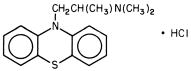
Promethazine HCl occurs as a white to
faint yellow, practically odorless, crystalline powder which slowly oxidizes
and turns blue on prolonged exposure to air. It is freely soluble in water
and soluble in alcohol.
Phenergan — Clinical Pharmacology
Promethazine is a phenothiazine derivative which differs
structurally from the antipsychotic phenothiazines by the presence of a branched
side chain and no ring substitution. It is thought that this configuration
is responsible for its relative lack (1/10 that of chlorpromazine) of dopamine
antagonist properties.
Promethazine is an H1 receptor
blocking agent. In addition to its antihistaminic action, it provides clinically
useful sedative and antiemetic effects.
Promethazine
is well absorbed from the gastrointestinal tract. Clinical effects are apparent
within 20 minutes after oral administration and generally last four to six
hours, although they may persist as long as 12 hours. Promethazine is metabolized
by the liver to a variety of compounds; the sulfoxides of promethazine and
N-demethylpromethazine are the predominant metabolites appearing in the urine.
Indications and Usage for Phenergan
Phenergan, either orally or by suppository, is useful
for:
Perennial and seasonal allergic rhinitis.
Vasomotor rhinitis.
Allergic
conjunctivitis due to inhalant allergens and foods.
Mild,
uncomplicated allergic skin manifestations of urticaria and angioedema.
Amelioration of allergic reactions to blood or plasma.
Dermographism.
Anaphylactic
reactions, as adjunctive therapy to epinephrine and other standard measures,
after the acute manifestations have been controlled.
Preoperative,
postoperative, or obstetric sedation.
Prevention
and control of nausea and vomiting associated with certain types of anesthesia
and surgery.
Therapy adjunctive to meperidine
or other analgesics for control of post-operative pain.
Sedation in both children and adults, as well as relief of apprehension
and production of light sleep from which the patient can be easily aroused.
Active and prophylactic treatment of motion sickness.
Antiemetic therapy in postoperative patients.
Contraindications
Phenergan Tablets and Suppositories are contraindicated
for use in pediatric patients less than two years of age.
Phenergan Tablets and Suppositories are contraindicated in comatose
states, and in individuals known to be hypersensitive or to have had an idiosyncratic
reaction to promethazine or to other phenothiazines.
Antihistamines
are contraindicated for use in the treatment of lower respiratory tract symptoms
including asthma.
Warnings
CNS Depression
Phenergan Tablets and Suppositories may impair the
mental and/or physical abilities required for the performance of potentially
hazardous tasks, such as driving a vehicle or operating machinery. The impairment
may be amplified by concomitant use of other central-nervous-system depressants
such as alcohol, sedatives/hypnotics (including barbiturates), narcotics,
narcotic analgesics, general anesthetics, tricyclic antidepressants, and tranquilizers;
therefore such agents should either be eliminated or given in reduced dosage
in the presence of promethazine HCl (see PRECAUTIONS−Information for Patients and Drug Interactions).
Respiratory Depression
Phenergan Tablets and Suppositories may lead to
potentially fatal respiratory depression.
Use
of Phenergan Tablets and Suppositories in patients with compromised respiratory
function (e.g., COPD, sleep apnea) should be avoided.
Lower Seizure Threshold
Phenergan Tablets and Suppositories may lower seizure
threshold. It should be used with caution in persons with seizure disorders
or in persons who are using concomitant medications, such as narcotics or
local anesthetics, which may also affect seizure threshold.
Bone-Marrow Depression
Phenergan Tablets and Suppositories should be used
with caution in patients with bone-marrow depression. Leukopenia and agranulocytosis
have been reported, usually when Phenergan has been used in association with
other known marrow-toxic agents.
Neuroleptic Malignant Syndrome
A potentially fatal symptom complex sometimes referred
to as Neuroleptic Malignant Syndrome (NMS) has been reported in association
with promethazine HCl alone or in combination with antipsychotic drugs. Clinical
manifestations of NMS are hyperpyrexia, muscle rigidity, altered mental status
and evidence of autonomic instability (irregular pulse or blood pressure,
tachycardia, diaphoresis and cardiac dysrhythmias).
The
diagnostic evaluation of patients with this syndrome is complicated. In arriving
at a diagnosis, it is important to identify cases where the clinical presentation
includes both serious medical illness (e.g. pneumonia, systemic infection,
etc.) and untreated or inadequately treated extrapyramidal signs and symptoms
(EPS). Other important considerations in the differential diagnosis include
central anticholinergic toxicity, heat stroke, drug fever and primary central
nervous system (CNS) pathology.
The management
of NMS should include 1) immediate discontinuation of promethazine HCl, antipsychotic
drugs, if any, and other drugs not essential to concurrent therapy, 2) intensive
symptomatic treatment and medical monitoring, and 3) treatment of any concomitant
serious medical problems for which specific treatments are available. There
is no general agreement about specific pharmacological treatment regimens
for uncomplicated NMS.
Since recurrences of
NMS have been reported with phenothiazines, the reintroduction of promethazine
HCl should be carefully considered.
Use in Pediatric Patients
PHENERGAN TABLETS
AND SUPPOSITORIES ARE CONTRAINDICATED FOR USE IN PEDIATRIC PATIENTS LESS THAN
TWO YEARS OF AGE.
CAUTION SHOULD BE EXERCISED WHEN ADMINISTERING
PHENERGAN TABLETS AND SUPPOSITORIES TO PEDIATRIC PATIENTS 2 YEARS OF AGE AND
OLDER BECAUSE OF THE POTENTIAL FOR FATAL RESPIRATORY DEPRESSION. RESPIRATORY
DEPRESSION AND APNEA, SOMETIMES ASSOCIATED WITH DEATH, ARE STRONGLY ASSOCIATED
WITH PROMETHAZINE PRODUCTS AND ARE NOT DIRECTLY RELATED TO INDIVIDUALIZED
WEIGHT-BASED DOSING, WHICH MIGHT OTHERWISE PERMIT SAFE ADMINISTRATION. CONCOMITANT
ADMINISTRATION OF PROMETHAZINE PRODUCTS WITH OTHER RESPIRATORY DEPRESSANTS
HAS AN ASSOCIATION WITH RESPIRATORY DEPRESSION, AND SOMETIMES DEATH, IN PEDIATRIC
PATIENTS.
ANTIEMETICS ARE NOT RECOMMENDED FOR TREATMENT OF UNCOMPLICATED
VOMITING IN PEDIATRIC PATIENTS, AND THEIR USE SHOULD BE LIMITED TO PROLONGED
VOMITING OF KNOWN ETIOLOGY. THE EXTRAPYRAMIDAL SYMPTOMS WHICH CAN OCCUR SECONDARY
TO PHENERGAN TABLETS AND SUPPOSITORIES ADMINISTRATION MAY BE CONFUSED WITH
THE CNS SIGNS OF UNDIAGNOSED PRIMARY DISEASE, e.g., ENCEPHALOPATHY OR REYE’S
SYNDROME. THE USE OF PHENERGAN TABLETS AND SUPPOSITORIES SHOULD BE AVOIDED
IN PEDIATRIC PATIENTS WHOSE SIGNS AND SYMPTOMS MAY SUGGEST REYE’S SYNDROME
OR OTHER HEPATIC DISEASES.
Excessively
large dosages of antihistamines, including Phenergan Tablets and Suppositories,
in pediatric patients may cause sudden death (see OVERDOSAGE). Hallucinations and
convulsions have occurred with therapeutic doses and overdoses of Phenergan
in pediatric patients. In pediatric patients who are acutely ill associated
with dehydration, there is an increased susceptibility to dystonias with the
use of promethazine HCl.
Other Considerations
Administration of promethazine HCl has been associated
with reported cholestatic jaundice.
Precautions
General
Drugs having anticholinergic properties should be
used with caution in patients with narrow-angle glaucoma, prostatic hypertrophy,
stenosing peptic ulcer, pyloroduodenal obstruction, and bladder-neck obstruction.
Phenergan Tablets and Suppositories should be used cautiously
in persons with cardiovascular disease or with impairment of liver function.
Information for Patients
Phenergan Tablets and Suppositories may cause marked
drowsiness or impair the mental and/or physical abilities required for the
performance of potentially hazardous tasks, such as driving a vehicle or operating
machinery. The use of alcohol or other central-nervous-system depressants
such as sedatives/hypnotics (including barbiturates), narcotics, narcotic
analgesics, general anesthetics, tricyclic antidepressants, and tranquilizers,
may enhance impairment (see WARNINGS-CNS
Depression and PRECAUTIONS-Drug
Interactions). Pediatric patients should be supervised
to avoid potential harm in bike riding or in other hazardous activities.
Patients should be advised to report any involuntary muscle
movements.
Avoid prolonged exposure to the
sun.
Drug Interactions
CNS Depressants — Phenergan Tablets and Suppositories may increase, prolong, or
intensify the sedative action of other central-nervous-system depressants,
such as alcohol, sedatives/hypnotics (including barbiturates), narcotics,
narcotic analgesics, general anesthetics, tricyclic antidepressants, and tranquilizers;
therefore, such agents should be avoided or administered in reduced dosage
to patients receiving promethazine HCl. When given concomitantly with Phenergan
Tablets and Suppositories, the dose of barbiturates should be reduced by at
least one-half, and the dose of narcotics should be reduced by one-quarter
to one-half. Dosage must be individualized. Excessive amounts of promethazine
HCl relative to a narcotic may lead to restlessness and motor hyperactivity
in the patient with pain; these symptoms usually disappear with adequate control
of the pain.
Epinephrine — Because of the potential for Phenergan to reverse epinephrine’s
vasopressor effect, epinephrine should NOT be used to treat hypotension associated
with Phenergan Tablets and Suppositories overdose.
Anticholinergics — Concomitant use of other agents with anticholinergic properties
should be undertaken with caution.
Monoamine
Oxidase Inhibitors (MAOI) — Drug interactions, including an increased
incidence of extrapyramidal effects, have been reported when some MAOI and
phenothiazines are used concomitantly. This possibility should be considered
with Phenergan Tablets and Suppositories.
Drug/Laboratory Test Interactions
The following laboratory tests may be affected in
patients who are receiving therapy with promethazine HCl:
Pregnancy Tests
Diagnostic pregnancy tests based on immunological
reactions between HCG and anti-HCG may result in false-negative or false-positive
interpretations.
Glucose Tolerance Test
An increase in blood glucose has been reported
in patients receiving promethazine HCl.
Carcinogenesis, Mutagenesis, Impairment of Fertility
Long-term animal studies have not been performed
to assess the carcinogenic potential of promethazine, nor are there other
animal or human data concerning carcinogenicity, mutagenicity, or impairment
of fertility with this drug. Promethazine was nonmutagenic in the Salmonella test system of Ames.
Pregnancy
Teratogenic Effects-Pregnancy Category C
Teratogenic effects have not been demonstrated
in rat-feeding studies at doses of 6.25 and 12.5 mg/kg of promethazine
HCl. These doses are from approximately 2.1 to 4.2 times the maximum
recommended total daily dose of promethazine for a 50-kg subject, depending
upon the indication for which the drug is prescribed. Daily doses of 25 mg/kg
intraperitoneally have been found to produce fetal mortality in rats.
Specific studies to test the action of the drug on parturition,
lactation, and development of the animal neonate were not done, but a general
preliminary study in rats indicated no effect on these parameters. Although
antihistamines have been found to produce fetal mortality in rodents, the
pharmacological effects of histamine in the rodent do not parallel those in
man. There are no adequate and well-controlled studies of Phenergan® Tablets
and Suppositories in pregnant women.
Phenergan
Tablets and Suppositories should be used during pregnancy only if the potential
benefit justifies the potential risk to the fetus.
Nonteratogenic Effects
Phenergan Tablets and Suppositories administered
to a pregnant woman within two weeks of delivery may inhibit platelet aggregation
in the newborn.
Labor and Delivery
Promethazine HCl may be used alone or as an adjunct
to narcotic analgesics during labor (see DOSAGE AND ADMINISTRATION). Limited data
suggest that use of Phenergan during labor and delivery does not have an appreciable
effect on the duration of labor or delivery and does not increase the risk
of need for intervention in the newborn. The effect on later growth and development
of the newborn is unknown. (See also Nonteratogenic Effects.)
Nursing Mothers
It is not known whether promethazine HCl is excreted
in human milk. Because many drugs are excreted in human milk and because of
the potential for serious adverse reactions in nursing infants from Phenergan
Tablets and Suppositories, a decision should be made whether to discontinue
nursing or to discontinue the drug, taking into account the importance of
the drug to the mother.
Pediatric Use
PHENERGAN TABLETS
AND SUPPOSITORIES ARE CONTRAINDICATED FOR USE IN PEDIATRIC PATIENTS LESS THAN
TWO YEARS OF AGE (see WARNINGS–Black
Box Warning and Use
in Pediatric Patients).
Phenergan
Tablets and Suppositories should be used with caution in pediatric patients
2 years of age and older (see WARNINGS-Use
in Pediatric Patients).
Geriatric Use
Clinical studies of Phenergan formulations did not
include sufficient numbers of subjects aged 65 and over to determine whether
they respond differently from younger subjects. Other reported clinical experience
has not identified differences in responses between the elderly and younger
patients. In general, dose selection for an elderly patient should be cautious,
usually starting at the low end of the dosing range, reflecting the greater
frequency of decreased hepatic, renal or cardiac function, and of concomitant
disease or other drug therapy.
Sedating drugs
may cause confusion and over-sedation in the elderly; elderly patients generally
should be started on low doses of Phenergan Tablets and Suppositories and
observed closely.
Adverse Reactions/Side Effects
Central Nervous System
Drowsiness is the most prominent CNS effect of this
drug. Sedation, somnolence, blurred vision, dizziness; confusion, disorientation,
and extrapyramidal symptoms such as oculogyric crisis, torticollis, and tongue
protrusion; lassitude, tinnitus, incoordination, fatigue, euphoria, nervousness,
diplopia, insomnia, tremors, convulsive seizures, excitation, catatonic-like
states, hysteria. Hallucinations have also been reported.
Cardiovascular–Increased
or decreased blood pressure, tachycardia, bradycardia, faintness.
Dermatologic–Dermatitis,
photosensitivity, urticaria.
Hematologic–Leukopenia, thrombocytopenia,
thrombocytopenic purpura, agranulocytosis.
Gastrointestinal –Dry
mouth, nausea, vomiting, jaundice.
Respiratory –Asthma, nasal
stuffiness, respiratory depression (potentially fatal) and apnea (potentially
fatal). (See WARNINGS-Respiratory
Depression.)
Other –Angioneurotic edema.
Neuroleptic malignant syndrome (potentially fatal) has also been reported.
(See WARNINGS-Neuroleptic
Malignant Syndrome.)
Paradoxical Reactions
Hyperexcitability and abnormal movements have been
reported in patients following a single administration of promethazine HCl.
Consideration should be given to the discontinuation of promethazine HCl and
to the use of other drugs if these reactions occur. Respiratory depression,
nightmares, delirium, and agitated behavior have also been reported in some
of these patients.
Overdosage
Signs and symptoms of overdosage with promethazine
HCl range from mild depression of the central nervous system and cardiovascular
system to profound hypotension, respiratory depression, unconsciousness,
and sudden death. Other reported reactions include hyperreflexia, hypertonia,
ataxia, athetosis, and extensor-plantar reflexes (Babinski reflex).
Stimulation may be evident, especially in children and geriatric
patients. Convulsions may rarely occur. A paradoxical-type reaction has been
reported in children receiving single doses of 75 mg to 125 mg
orally, characterized by hyperexcitability and nightmares.
Atropine-like signs and symptoms–dry mouth, fixed, dilated
pupils, flushing, as well as gastrointestinal symptoms–may occur.
Treatment
Treatment of overdosage is essentially symptomatic
and supportive. Only in cases of extreme overdosage or individual sensitivity
do vital signs, including respiration, pulse, blood pressure, temperature,
and EKG, need to be monitored. Activated charcoal orally or by lavage may
be given, or sodium or magnesium sulfate orally as a cathartic. Attention
should be given to the reestablishment of adequate respiratory exchange through
provision of a patent airway and institution of assisted or controlled ventilation.
Diazepam may be used to control convulsions. Acidosis and electrolyte losses
should be corrected. Note that any depressant effects of promethazine HCl
are not reversed by naloxone. Avoid analeptics which may cause convulsions.
The treatment of choice for resulting hypotension is administration
of intravenous fluids, accompanied by repositioning if indicated. In the event
that vasopressors are considered for the management of severe hypotension
which does not respond to intravenous fluids and repositioning, the administration
of norepinephrine or phenylephrine should be considered. EPINEPHRINE SHOULD
NOT BE USED, since its use in patients with partial adrenergic blockade may
further lower the blood pressure. Extrapyramidal reactions may be treated
with anticholinergic antiparkinsonian agents, diphenhydramine, or barbiturates.
Oxygen may also be administered.
Limited experience
with dialysis indicates that it is not helpful.
Phenergan Dosage and Administration
Phenergan Tablets
and Phenergan Rectal Suppositories are contraindicated for children under
2 years of age (see WARNINGS–Black
Box Warning and Use
in Pediatric Patients).
Phenergan Suppositories are
for rectal administration only.
Allergy
The average oral dose is 25 mg taken before
retiring; however, 12.5 mg may be taken before meals and on retiring,
if necessary. Single 25-mg doses at bedtime or 6.25 to 12.5 mg taken
three times daily will usually suffice. After initiation of treatment
in children or adults, dosage should be adjusted to the smallest amount adequate
to relieve symptoms. The administration of promethazine HCl in 25-mg doses
will control minor transfusion reactions of an allergic nature.
Motion Sickness
The average adult dose is 25 mg taken twice
daily. The initial dose should be taken one-half to one hour before
anticipated travel and be repeated 8 to 12 hours later, if necessary. On succeeding
days of travel, it is recommended that 25 mg be given on arising and
again before the evening meal. For children, Phenergan Tablets, Syrup, or
Rectal Suppositories, 12.5 to 25 mg, twice daily, may be administered.
Nausea and Vomiting
Antiemetics should not be used in vomiting of unknown
etiology in children and adolescents (see WARNINGS-Use in Pediatric Patients).
The average effective dose of Phenergan for the active therapy
of nausea and vomiting in children or adults is 25 mg. When oral medication
cannot be tolerated, the dose should be given parenterally (cf. Phenergan
Injection) or by rectal suppository. 12.5- to 25-mg doses may be repeated,
as necessary, at 4- to 6-hour intervals.
For
nausea and vomiting in children, the usual dose is 0.5 mg per pound of
body weight, and the dose should be adjusted to the age and weight of the
patient and the severity of the condition being treated.
For prophylaxis of nausea and vomiting, as during surgery and
the postoperative period, the average dose is 25 mg repeated at 4- to
6-hour intervals, as necessary.
Sedation
This product relieves apprehension and induces a
quiet sleep from which the patient can be easily aroused. Administration of
12.5 to 25 mg Phenergan by the oral route or by rectal suppository at
bedtime will provide sedation in children. Adults usually require 25 to 50 mg
for nighttime, presurgical, or obstetrical sedation.
Pre- and Postoperative Use
Phenergan in 12.5- to 25-mg doses for children and
50-mg doses for adults the night before surgery relieves apprehension and
produces a quiet sleep.
For preoperative medication,
children require doses of 0.5 mg per pound of body weight in combination
with an appropriately reduced dose of narcotic or barbiturate and the appropriate
dose of an atropine-like drug. Usual adult dosage is 50 mg Phenergan
with an appropriately reduced dose of narcotic or barbiturate and the required
amount of a belladonna alkaloid.
Postoperative
sedation and adjunctive use with analgesics may be obtained by the administration
of 12.5 to 25 mg in children and 25- to 50-mg doses in adults.
Phenergan Tablets and Phenergan Rectal Suppositories are
contraindicated for children under 2 years of age.
How is Phenergan supplied
Phenergan® (promethazine HCl) Tablets
are available as follows:
12.5 mg, orange
tablet with “WYETH” on one side and “19” on the
scored reverse side.
NDC 0008-0019-01,
bottle of 100 tablets.
25 mg, white tablet
with “WYETH” and “27” on one side and scored on
the reverse side.
NDC 0008-0027-02, bottle
of 100 tablets.
NDC 0008-0027-07, Redipak® carton
of 100 tablets (10 blister strips of 10).
50 mg,
pink tablet with “WYETH” on one side and “227”
on the other side.
NDC 0008-0227-01, bottle
of 100 tablets.
Keep
tightly closed.
Store at controlled room temperature 20º to 25ºC
(68º to 77ºF).
Protect from light.
Dispense in light-resistant,
tight container.
Use carton to protect contents from light.
Phenergan® (promethazine HCl)
Rectal Suppositories are available in boxes of 12 as follows:
12.5 mg, ivory, torpedo-shaped suppository wrapped in
copper-colored foil, NDC 0008-0498-01.
25 mg,
ivory, torpedo-shaped suppository wrapped in light-green foil, NDC 0008-0212-01.
50 mg, ivory, torpedo-shaped suppository wrapped in blue
foil, NDC 0008-0229-01.
Store refrigerated between 2°-8°C (36°-46°F).
Dispense in well-closed container.
Wyeth®
Wyeth Pharmaceuticals Inc.
Philadelphia,
PA 19101
W10448C003
ET02
Rev 07/05
- Overview
- Uses
- Side-effects
- Precautions
- Interactions
- Contraindications
Overview
Phenergan Cream works by blocking histamines or nitrogenous compounds; killing the bacteria;
Detailed information related to Phenergan Cream’s uses, composition, dosage, side effects and reviews is listed below.
Uses
Side-effects
Precautions
Before using Phenergan Cream, inform your doctor about your current list of medications, over the counter products (e.g. vitamins, herbal supplements, etc.), allergies, pre-existing diseases, and current health conditions (e.g. pregnancy, upcoming surgery, etc.). Some health conditions may make you more susceptible to the side-effects of the drug. Take as directed by your doctor or follow the direction printed on the product insert. Dosage is based on your condition. Tell your doctor if your condition persists or worsens. Important counseling points are listed below.
- Breast feeding
- Do not drive or operate machinery
- Do not use in children younger than 2 years old
- Do not use this drug for more than 7 days without doctor’s consultation
- May cause breathing problems
- Notify doctor if have breathing problems such as asthma, COPD, sleep apnea
- Notify doctor if have redness, burning, pain, leaking fluid from injection site
- Pregnant
- Take doctor’s advice if you have severe coronary artery disease, narrow angle glaucoma, epilepsy or liver or kidney problems
- do not take by mouth. Consult with your doctor before using this medicine on open wounds, dry, chapped, irritated, or sun-burned skin.
- wash your hands before and after applying Phenergan Cream. Clean and dry the skin area to be treated.
- do not wash the treated area after immediately applying Phenergan Cream. Also avoid the use of other products on the treated area unless directed by your doctor.
- applying an excessive amount may result in pilling. Use a thinner layer or lesser quantity of medicine to avoid pilling.
- avoid getting this medication in your eyes or nose or mouth.
Interactions with Phenergan Cream
If you use other drugs or over the counter products at the same time, the effects of Phenergan Cream may change. This may increase your risk for side-effects or cause your drug not to work properly. Tell your doctor about all the drugs, vitamins, and herbal supplements you are using, so that you doctor can help you prevent or manage drug interactions. Phenergan Cream may interact with the following drugs and products:
- Acetaminophen
- Aminoglycoside Antibiotics
- Amiodarone
- Anagrelide
- Bepridil
- Bupropion
- Citalopram
- Dolasetron
- Droperidol
- Escitalopram
When not to use Phenergan Cream
Hypersensitivity to Phenergan Cream is a contraindication. In addition, Phenergan Cream should not be used if you have the following conditions:
- Children below the age of two years
- Coma
- Concomitant therapy with monoamine oxidase inhibitor inhibitors
- Depression
- Do not use for more than a few days at a time
- Hypersensitivity
- Lactation
- Narrow angle glaucoma
Composition and Active Ingredients
Packages and Strengths
Phenergan Cream is available in the following packages and strengths
Frequently asked Questions
-
Is Phenergan Cream safe to use when pregnant?
- Promethazine: No
- Dibromopropamidine Isethionate: Please consult with your doctor for case-specific recommendations.
-
Is Phenergan Cream safe while breastfeeding?
- Promethazine: No
- Dibromopropamidine Isethionate: Please discuss the risks and benefits with your doctor.
-
Can Phenergan Cream be used for skin infection and nausea?
Yes, skin infection and nausea are among the most common reported uses for Phenergan Cream. Please do not use Phenergan Cream for skin infection and nausea without consulting first with your doctor. Click here and view survey results to find out what other patients report as common uses for Phenergan Cream.
-
Should I use Phenergan Cream empty stomach, before food or after food?
TabletWise.com website users have most commonly reported using Phenergan Cream before food. However, this may not be reflective of how you should use this medicine. Please follow your doctor’s advice on how you should use this medicine. Click here and view survey results to find out what other patients report as timing of using Phenergan Cream.
-
Is it safe to drive or operate heavy machinery when using this product?
If you experience drowsiness, dizziness, hypotension or a headache as side-effects when using Phenergan Cream medicine then it may not be safe to drive a vehicle or operate heavy machinery. One should not drive a vehicle if using the medicine makes you drowsy, dizzy or lowers your blood-pressure extensively. Pharmacists also advise patients not to drink alcohol with medicines as alcohol intensifies drowsiness side-effects. Please check for these effects on your body when using Phenergan Cream. Always consult with your doctor for recommendations specific to your body and health conditions.
-
Is this medicine or product addictive or habit forming?
Most medicines don’t come with a potential for addiction or abuse. Usually, the government’s categorizes medicines that can be addictive as controlled substances. Examples include schedule H or X in India and schedule II-V in the US. Please consult the product package to make sure that the medicine does not belong to such special categorizations of medicines. Lastly, do not self-medicate and increase your body’s dependence to medicines without the advice of a doctor.
-
Can i stop using this product immediately or do I have to slowly wean off the use?
Some medicines need to be tapered or cannot be stopped immediately because of rebound effects. Please consult with your doctor for recommendations specific to your body, health and other medications that you may be using.
Other important Information on Phenergan Cream
Missing a dose
In case you miss a dose, use it as soon as you notice. If it is close to the time of your next dose, skip the missed dose and resume your dosing schedule. Do not use extra dose to make up for a missed dose. If you are regularly missing doses, consider setting an alarm or asking a family member to remind you. Please consult your doctor to discuss changes in your dosing schedule or a new schedule to make up for missed doses, if you have missed too many doses recently.
Overdosage of Phenergan Cream
- Do not use more than prescribed dose. Taking more medication will not improve your symptoms; rather they may cause poisoning or serious side-effects. If you suspect that you or anyone else who may have overdosed of Phenergan Cream, please go to the emergency department of the closest hospital or nursing home. Bring a medicine box, container, or label with you to help doctors with necessary information.
- Do not give your medicines to other people even if you know that they have the same condition or it seems that they may have similar conditions. This may lead to overdosage.
- Please consult your physician or pharmacist or product package for more information.
Storage of Phenergan Cream
- Store medicines at room temperature, away from heat and direct light. Do not freeze medicines unless required by package insert. Keep medicines away from children and pets.
- Do not flush medications down the toilet or pour them into drainage unless instructed to do so. Medication discarded in this manner may contaminate the environment. Please consult your pharmacist or doctor for more details on how to safely discard Phenergan Cream.
Expired Phenergan Cream
- Taking a single dose of expired Phenergan Cream is unlikely to produce an adverse event. However, please discuss with your primary health provider or pharmacist for proper advice or if you feel unwell or sick. Expired drug may become ineffective in treating your prescribed conditions. To be on the safe side, it is important not to use expired drugs. If you have a chronic illness that requires taking medicine constantly such as heart condition, seizures, and life-threatening allergies, you are much safer keeping in touch with your primary health care provider so that you can have a fresh supply of unexpired medications.
Dosage Information
Please consult your physician or pharmacist or refer to the product package.
Cite this page
Page URL
HTML Link
APA Style Citation
- Phenergan Cream — Product — tabletwise.net. (n.d.). Retrieved October 22, 2023, from https://www.tabletwise.net/southafrica/phenergan-cream
MLA Style Citation
- «Phenergan Cream — Product — tabletwise.net» Tabletwise.com. N.p., n.d. Web. 22 Oct. 2023.
Chicago Style Citation
- «Phenergan Cream — Product — tabletwise.net» Tabletwise. Accessed October 22, 2023. https://www.tabletwise.net/southafrica/phenergan-cream.
More about Phenergan Cream
- Uses
- Reviews
- What are the uses of Phenergan Cream?
- What are the side-effects of Phenergan Cream?
- What other medicines does Phenergan Cream interact with?
- When should you not use Phenergan Cream?
- What precautions should you take while using Phenergan Cream?
Last updated date
This page was last updated on 9/27/2020.
This page provides information for Phenergan Cream Product in English.
-
Skin Infections
Your skin helps protect you from germs, but sometimes it can get …
-
Nausea and Vomiting
Nausea is an uneasy or unsettled feeling in the stomach together …
-
Sneezing
A symptom consisting of the involuntary expulsion of air from …
-
Itching
Itching is skin tingling or irritation that makes you want to …
Components:
Method of action:
Treatment option:
Medically reviewed by Oliinyk Elizabeth Ivanovna, PharmD. Last updated on 2022-03-29


Attention!
Information on this page is intended only for medical professionals!
Information is collected in open sources and may contain significant errors!
Be careful and double-check all the information on this page!
Top 20 medicines with the same components:
Top 20 medicines with the same treatments:
Name of the medicinal product
The information provided in Name of the medicinal product of Phénergan 2.5%
is based on data of another medicine with exactly the same composition as the Phénergan 2.5%.
. Be careful and be sure to specify the information on the section Name of the medicinal product in the instructions to the drug Phénergan 2.5% directly from the package or from the pharmacist at the pharmacy.
more…
Phénergan 2.5%
Qualitative and quantitative composition
The information provided in Qualitative and quantitative composition of Phénergan 2.5%
is based on data of another medicine with exactly the same composition as the Phénergan 2.5%.
. Be careful and be sure to specify the information on the section Qualitative and quantitative composition in the instructions to the drug Phénergan 2.5% directly from the package or from the pharmacist at the pharmacy.
more…
Promethazine
Therapeutic indications
The information provided in Therapeutic indications of Phénergan 2.5%
is based on data of another medicine with exactly the same composition as the Phénergan 2.5%.
. Be careful and be sure to specify the information on the section Therapeutic indications in the instructions to the drug Phénergan 2.5% directly from the package or from the pharmacist at the pharmacy.
more…
As symptomatic treatment for allergic conditions of the upper respiratory tract and skin including allergic rhinitis, urticaria and anaphylactic reactions to drugs and foreign proteins.
As an antiemetic.
For short term use:
Treatment of insomnia in adults.
For short term use as a paediatric sedative.
Dosage (Posology) and method of administration
The information provided in Dosage (Posology) and method of administration of Phénergan 2.5%
is based on data of another medicine with exactly the same composition as the Phénergan 2.5%.
. Be careful and be sure to specify the information on the section Dosage (Posology) and method of administration in the instructions to the drug Phénergan 2.5% directly from the package or from the pharmacist at the pharmacy.
more…
Route of administration: Oral.
Not for use in children under the age of 2 years.
As an antihistamine in allergy:
|
Children 2-5 years |
The use of Phénergan 2.5% Elixir is recommended for this age group. |
|
Children 5-10 years |
25 mg as a single dose*. Maximum daily dose 25 mg. |
|
Children over 10 years and adults (including elderly) |
25 mg as a single dose*. Increasing to a maximum of 25 mg bd as required. |
*Single doses are best taken at night.
As an antiemetic:
|
Children 2-5 years |
The use of Phénergan 2.5% Elixir is recommended for this age group. |
|
Children 5-10 years |
The use of Phénergan 2.5% Elixir or Phénergan 2.5% 10 mg Tablets is recommended. |
|
Children over 10 years and adults (including elderly) |
25 mg to be taken the night before the journey. To be repeated after 6-8 hours as required. |
As a paediatric sedative for short term use and for short term treatment of insomnia in adults:
|
Children 2-5 years |
The use of Phénergan 2.5% Elixir is recommended for this age group. |
|
Children 5-10 years |
25 mg as a single night time dose. |
|
Children over 10 years and adults (including elderly) |
25 or 50 mg as a single night time dose. |
Contraindications
The information provided in Contraindications of Phénergan 2.5%
is based on data of another medicine with exactly the same composition as the Phénergan 2.5%.
. Be careful and be sure to specify the information on the section Contraindications in the instructions to the drug Phénergan 2.5% directly from the package or from the pharmacist at the pharmacy.
more…
Phénergan 2.5% should not be used in patients in coma or suffering from CNS depression of any cause.
Phénergan 2.5% should not be given to patients with a known hypersensitivity to promethazine or to any of the excipients.
Promethazine is contraindicated for use in children less than two years of age because of the potential for fatal respiratory depression..
Phénergan 2.5% should be avoided in patients taking monoamine oxidase inhibitors up to 14 days previously.
Special warnings and precautions for use
The information provided in Special warnings and precautions for use of Phénergan 2.5%
is based on data of another medicine with exactly the same composition as the Phénergan 2.5%.
. Be careful and be sure to specify the information on the section Special warnings and precautions for use in the instructions to the drug Phénergan 2.5% directly from the package or from the pharmacist at the pharmacy.
more…
Phénergan 2.5% may thicken or dry lung secretions and impair expectoration. It should therefore be used with caution in patients with asthma, bronchitis or bronchiectasis.
Use with care in patients with severe coronary artery disease, narrow angle glaucoma, epilepsy or hepatic and renal insufficiency.
Caution should be exercised in patients with bladder neck or pyloro-duodenal obstruction.
The use of promethazine should be avoided in children and adolescents with signs and symptoms suggestive of Reye’s Syndrome.
Promethazine may mask the warning signs of ototoxicity caused by ototoxic drugs e.g. salicylates. It may also delay the early diagnosis of intestinal obstruction or raised intracranial pressure through the suppression of vomiting.
Patients with rare hereditary problems of galactose intolerance, the Lapp lactase deficiency or glucose-galactose malabsorption should not take this medicine.
Phénergan 2.5% should not be used for longer than 7 days without seeking medical advice.
Effects on ability to drive and use machines
The information provided in Effects on ability to drive and use machines of Phénergan 2.5%
is based on data of another medicine with exactly the same composition as the Phénergan 2.5%.
. Be careful and be sure to specify the information on the section Effects on ability to drive and use machines in the instructions to the drug Phénergan 2.5% directly from the package or from the pharmacist at the pharmacy.
more…
Because the duration of action may be up to 12 hours, patients should be advised that if they feel drowsy they should not drive or operate heavy machinery.
Undesirable effects
The information provided in Undesirable effects of Phénergan 2.5%
is based on data of another medicine with exactly the same composition as the Phénergan 2.5%.
. Be careful and be sure to specify the information on the section Undesirable effects in the instructions to the drug Phénergan 2.5% directly from the package or from the pharmacist at the pharmacy.
more…
The following CIOMS frequency rating is used: Very common (>1/10); common (>1/100 to <1/10); uncommon (>1/1000 to <1/100); rare (>1/10 00 to <1/1000); very rare (<1/10 000), not known (cannot be estimated from the available data).
Side effects may be seen in a few patients: drowsiness, dizziness, restlessness, headaches, nightmares, tiredness, and disorientation. Anticholinergic side effects such as blurred vision, dry mouth and urinary retention occur occasionally. Infants are susceptible to the anticholinergic effects of promethazine, while other children may display paradoxical hyperexcitability. The elderly are particularly susceptible to the anticholinergic effects and confusion due to promethazine. Other side-effects include urticaria, rash, pruritus, anorexia, gastric irritation, palpitations, hypotension, arrhythmias, extrapyramidal effects, muscle spasms and tic-like movements of the head and face. Anaphylaxis, jaundice and blood dyscrasias including haemolytic anaemia rarely occur. Photosensitive skin reactions have been reported. Strong sunlight should be avoided during treatment.
Reporting of suspected adverse reactions
Reporting suspected adverse reactions after authorisation of the medicinal product is important. It allows continued monitoring of the benefit/risk balance of the medicinal product. Healthcare professionals are asked to report any suspected adverse reactions via Yellow Card Scheme at: www.mhra.gov.uk/yellowcard.
Overdose
The information provided in Overdose of Phénergan 2.5%
is based on data of another medicine with exactly the same composition as the Phénergan 2.5%.
. Be careful and be sure to specify the information on the section Overdose in the instructions to the drug Phénergan 2.5% directly from the package or from the pharmacist at the pharmacy.
more…
Symptoms of severe overdosage are variable. They are characterised in children by various combinations of excitation, ataxia, incoordination, athetosis and hallucinations, while adults may become drowsy and lapse into coma. Convulsions may occur in both adults and children: coma or excitement may precede their occurrence. Cardiorespiratory depression is uncommon. If the patient is seen soon enough after ingestion, it should be possible to induce vomiting with ipecacuanha despite the antiemetic effect of promethazine; alternatively, gastric lavage may be used.
Treatment is otherwise supportive with attention to maintenance of adequate respiratory and circulatory status. Convulsions should be treated with diazepam or other suitable anticonvulsant.
Pharmacodynamic properties
The information provided in Pharmacodynamic properties of Phénergan 2.5%
is based on data of another medicine with exactly the same composition as the Phénergan 2.5%.
. Be careful and be sure to specify the information on the section Pharmacodynamic properties in the instructions to the drug Phénergan 2.5% directly from the package or from the pharmacist at the pharmacy.
more…
Pharmacotherapeutic group: Antihistamines for systemic use; Phenothiazine derivatives, ATC code: R06AD02
Potent, long acting, antihistamine with additional anti-emetic central sedative and anti-cholinergic properties.
Pharmacokinetic properties
The information provided in Pharmacokinetic properties of Phénergan 2.5%
is based on data of another medicine with exactly the same composition as the Phénergan 2.5%.
. Be careful and be sure to specify the information on the section Pharmacokinetic properties in the instructions to the drug Phénergan 2.5% directly from the package or from the pharmacist at the pharmacy.
more…
Promethazine is distributed widely in the body. It enters the brain and crosses the placenta. Promethazine is slowly excreted via urine and bile. Phenothiazines pass into the milk at low concentrations.
Pharmacotherapeutic group
The information provided in Pharmacotherapeutic group of Phénergan 2.5%
is based on data of another medicine with exactly the same composition as the Phénergan 2.5%.
. Be careful and be sure to specify the information on the section Pharmacotherapeutic group in the instructions to the drug Phénergan 2.5% directly from the package or from the pharmacist at the pharmacy.
more…
Antihistamines for systemic use; Phenothiazine derivatives, ATC code: R06AD02
Preclinical safety data
The information provided in Preclinical safety data of Phénergan 2.5%
is based on data of another medicine with exactly the same composition as the Phénergan 2.5%.
. Be careful and be sure to specify the information on the section Preclinical safety data in the instructions to the drug Phénergan 2.5% directly from the package or from the pharmacist at the pharmacy.
more…
No additional preclinical data of relevance to the prescriber.
Incompatibilities
The information provided in Incompatibilities of Phénergan 2.5%
is based on data of another medicine with exactly the same composition as the Phénergan 2.5%.
. Be careful and be sure to specify the information on the section Incompatibilities in the instructions to the drug Phénergan 2.5% directly from the package or from the pharmacist at the pharmacy.
more…
Not applicable
Special precautions for disposal and other handling
The information provided in Special precautions for disposal and other handling of Phénergan 2.5%
is based on data of another medicine with exactly the same composition as the Phénergan 2.5%.
. Be careful and be sure to specify the information on the section Special precautions for disposal and other handling in the instructions to the drug Phénergan 2.5% directly from the package or from the pharmacist at the pharmacy.
more…
No special requirements
Phénergan 2.5% price
We have no data on the cost of the drug.
However, we will provide data for each active ingredient
The approximate cost of Promethazine 25 mg per unit in online pharmacies is from 0.32$ to 0.43$, per package is from 25$ to 43$.
The approximate cost of Promethazine 10 mg per unit in online pharmacies is from 0.33$ to 0.43$, per package is from 26$ to 30$.
References:
- https://www.drugs.com/search.php?searchterm=ph-nergan-2-5
- https://pubmed.ncbi.nlm.nih.gov/?term=ph-nergan-2-5