
Топ 20 лекарств с такими-же компонентами:
Топ 20 лекарств с таким-же применением:

Предоставленная в разделе Delodayинформация составлена на основе данных о другом лекарстве с точно таким же составом как лекарство Deloday. Будьте
внимательны и обязательно уточняйте информацию по разделу в инструкции к лекарству Deloday непосредственно из упаковки или у фармацевта в аптеке.
more…
Deloday
Предоставленная в разделе Delodayинформация составлена на основе данных о другом лекарстве с точно таким же составом как лекарство Deloday. Будьте
внимательны и обязательно уточняйте информацию по разделу в инструкции к лекарству Deloday непосредственно из упаковки или у фармацевта в аптеке.
more…
Desloratadine
Терапевтические показания
Предоставленная в разделе Терапевтические показания Delodayинформация составлена на основе данных о другом лекарстве с точно таким же составом как лекарство Deloday. Будьте
внимательны и обязательно уточняйте информацию по разделу Терапевтические показания
в инструкции к лекарству Deloday непосредственно из упаковки или у фармацевта в аптеке.
more…
Таблетки, покрытые пленочной оболочкой; Пастилки жевательные; Оральный лиофилизат; Ородисперсная таблетка; Сироп
Покрытые таблетки; Оральный сироп
аллергический ринит (устранение или облегчение чиханья, заложенности носа, выделения слизи из носа, зуда в носу, зуда неба, зуда и покраснения глаз, слезотечения);
крапивница (уменьшение или устранение кожного зуда, сыпи).
аллергический ринит (устранение или облегчение чиханья, заложенности носа, выделения слизи из носа, зуда в носу, зуда неба, зуда и покраснения глаз, слезотечения);
крапивница (уменьшение или устранение кожного зуда, сыпи).
Способ применения и дозы
Предоставленная в разделе Способ применения и дозы Delodayинформация составлена на основе данных о другом лекарстве с точно таким же составом как лекарство Deloday. Будьте
внимательны и обязательно уточняйте информацию по разделу Способ применения и дозы
в инструкции к лекарству Deloday непосредственно из упаковки или у фармацевта в аптеке.
more…
Внутрь, независимо от времени приема пищи.
Таблетки, не разжевывая, запивая водой, взрослым и детям старше 12 лет — по 5 мг/сут (1 табл.).
Сироп, запивая небольшим количеством воды, детям от 6 до 12 мес — по 1 мг (2 мл сиропа) 1 раз в день, от 1 до 5 лет — по 1,25 мг/сут (2,5 мл), от 6 до 11 лет — по 2,5 мг/сут (5 мл), взрослым и детям старше 12 лет — по 5 мг/сут (10 мл).
Противопоказания
Предоставленная в разделе Противопоказания Delodayинформация составлена на основе данных о другом лекарстве с точно таким же составом как лекарство Deloday. Будьте
внимательны и обязательно уточняйте информацию по разделу Противопоказания
в инструкции к лекарству Deloday непосредственно из упаковки или у фармацевта в аптеке.
more…
повышенная чувствительность к какому-либо из веществ, входящих в состав препарата, или лоратадину;
наследственно передаваемые заболевания: непереносимость фруктозы, нарушение всасывания глюкозы-галактозы или недостаточность сахаразы-изомальтазы — для сиропа (в связи с наличием сахарозы и сорбитола в составе);
беременность;
лактация;
детский возраст до 6 мес — для сиропа; до 12 лет — для таблеток.
С осторожностью: тяжелая почечная недостаточность.
Побочные эффекты
Предоставленная в разделе Побочные эффекты Delodayинформация составлена на основе данных о другом лекарстве с точно таким же составом как лекарство Deloday. Будьте
внимательны и обязательно уточняйте информацию по разделу Побочные эффекты
в инструкции к лекарству Deloday непосредственно из упаковки или у фармацевта в аптеке.
more…
Таблетки, покрытые пленочной оболочкой; Пастилки жевательные; Оральный лиофилизат; Ородисперсная таблетка; Сироп
Покрытые таблетки; Оральный сироп
У детей 12–17 лет, по результатам клинических исследований, наиболее часто встречающийся побочный эффект — головная боль (5,9%), частота которой была не выше, чем при приеме плацебо (6,9%).
Информация о побочных эффектах представлена по результатам клинических исследований и наблюдений пострегистрационного периода.
По данным ВОЗ, побочные эффекты классифицированы в соответствии с их частотой развития следующим образом: очень часто (≥1/10); часто (от ≥1/100 до<1/10); нечасто (от ≥1/1000 до <1/100); редко (от ≥1/10000 до <1/1000); очень редко (<1/10000); частота неизвестна (по имеющимся данным установить частоту возникновения не представлялось возможным).
Со стороны психики: очень редко — галлюцинации.
Со стороны нервной системы: часто — головная боль, бессонница (дети до 2 лет); очень редко — головокружение, сонливость, бессонница, психомоторная гиперактивность, судороги.
Со стороны печени и желчевыводящих путей: очень редко — повышение активности ферментов печени, повышение концентрации билирубина, гепатит; частота неизвестна — желтуха.
Со стороны пищеварительной системы: часто — сухость во рту, диарея (дети до 2 лет); очень редко — боль в животе, тошнота, рвота, диспепсия, диарея.
Со стороны ССС: очень редко — тахикардия, сердцебиение; частота неизвестна — удлинение интервала QT.
Со стороны опорно-двигательного аппарата: очень редко — миалгия.
Со стороны кожи и подкожных тканей: частота неизвестна — фотосенсибилизация.
Общие расстройства: часто — повышенная утомляемость, лихорадка (дети до 2 лет); очень редко — анафилаксия, ангионевротический отек, одышка, зуд, сыпь, в т.ч. крапивница; частота неизвестна — астения.
Пострегистрационный период. Дети: частота неизвестна — удлинение интервала QT, аритмия, брадикардия.
Если любые из указанных в описании побочных эффектов усугубляются, или пациент заметил любые другие побочные эффекты, не указанные в описании, следует сообщить об этом врачу.
Таблетки, покрытые пленочной оболочкой
Наиболее часто встречающиеся побочные эффекты (≥1/100 до <1/10), частота которых была несколько выше, чем при приеме плацебо («пустышки»): повышенная утомляемость (1,2%), сухость во рту (0,8%) и головная боль (0,6%).
Сироп
У детей от 6 до 23 мес отмечались следующие побочные эффекты, частота которых была несколько выше, чем при применении плацебо: диарея (3,7%), повышение температуры тела (2,3%), бессонница (2,3%).
У детей от 2 до 11 лет при применении лекарственного препарата Эриус® в форме сиропа частота побочных эффектов была такой же, как при применении плацебо.
По результатам клинических исследований, у детей от 6 до 11 лет при приеме препарата в рекомендуемых дозах (2,5 мг/день) побочных эффектов выявлено не было.
У взрослых и подростков (12 лет и старше), по результатам клинических исследований, побочные эффекты были зафиксированы у 3% пациентов по сравнению с группой пациентов, применявших плацебо, из них чаще всего отмечались: повышенная утомляемость (1,2%), сухость во рту (0,8%), головная боль (0,6%).
У детей 12–17 лет, по результатам клинических исследований, наиболее часто встречающийся побочный эффект — головная боль (5,9%), частота которой была не выше, чем при приеме плацебо (6,9%).
Информация о побочных эффектах представлена по результатам клинических исследований и наблюдений пострегистрационного периода.
По данным ВОЗ, побочные эффекты классифицированы в соответствии с их частотой развития следующим образом: очень часто (≥1/10); часто (от ≥1/100 до<1/10); нечасто (от ≥1/1000 до <1/100); редко (от ≥1/10000 до <1/1000); очень редко (<1/10000); частота неизвестна (по имеющимся данным установить частоту возникновения не представлялось возможным).
Со стороны психики: очень редко — галлюцинации.
Со стороны нервной системы: часто — головная боль, бессонница (дети до 2 лет); очень редко — головокружение, сонливость, бессонница, психомоторная гиперактивность, судороги.
Со стороны печени и желчевыводящих путей: очень редко — повышение активности ферментов печени, повышение концентрации билирубина, гепатит; частота неизвестна — желтуха.
Со стороны пищеварительной системы: часто — сухость во рту, диарея (дети до 2 лет); очень редко — боль в животе, тошнота, рвота, диспепсия, диарея.
Со стороны ССС: очень редко — тахикардия, сердцебиение; частота неизвестна — удлинение интервала QT.
Со стороны опорно-двигательного аппарата: очень редко — миалгия.
Со стороны кожи и подкожных тканей: частота неизвестна — фотосенсибилизация.
Общие расстройства: часто — повышенная утомляемость, лихорадка (дети до 2 лет); очень редко — анафилаксия, ангионевротический отек, одышка, зуд, сыпь, в т.ч. крапивница; частота неизвестна — астения.
Пострегистрационный период. Дети: частота неизвестна — удлинение интервала QT, аритмия, брадикардия.
Если любые из указанных в описании побочных эффектов усугубляются, или пациент заметил любые другие побочные эффекты, не указанные в описании, следует сообщить об этом врачу.
Таблетки, покрытые пленочной оболочкой
Наиболее часто встречающиеся побочные эффекты (≥1/100 до <1/10), частота которых была несколько выше, чем при приеме плацебо («пустышки»): повышенная утомляемость (1,2%), сухость во рту (0,8%) и головная боль (0,6%).
Сироп
У детей от 6 до 23 мес отмечались следующие побочные эффекты, частота которых была несколько выше, чем при применении плацебо: диарея (3,7%), повышение температуры тела (2,3%), бессонница (2,3%).
У детей от 2 до 11 лет при применении лекарственного препарата Deloday® в форме сиропа частота побочных эффектов была такой же, как при применении плацебо.
По результатам клинических исследований, у детей от 6 до 11 лет при приеме препарата в рекомендуемых дозах (2,5 мг/день) побочных эффектов выявлено не было.
У взрослых и подростков (12 лет и старше), по результатам клинических исследований, побочные эффекты были зафиксированы у 3% пациентов по сравнению с группой пациентов, применявших плацебо, из них чаще всего отмечались: повышенная утомляемость (1,2%), сухость во рту (0,8%), головная боль (0,6%).
Передозировка
Предоставленная в разделе Передозировка Delodayинформация составлена на основе данных о другом лекарстве с точно таким же составом как лекарство Deloday. Будьте
внимательны и обязательно уточняйте информацию по разделу Передозировка
в инструкции к лекарству Deloday непосредственно из упаковки или у фармацевта в аптеке.
more…
Симптомы: прием дозы, превышающей рекомендованную в 5 раз, не приводил к появлению каких-либо симптомов. В ходе клинических испытаний ежедневное применение у взрослых и подростков дезлоратадина в дозе до 20 мг в течение 14 дней не сопровождалось статистически или клинически значимыми изменениями со стороны ССС. В клинико-фармакологическом исследовании применение дезлоратадина в дозе 45 мг/сут (в 9 раз выше рекомендуемой) в течение 10 дней не вызывало удлинение интервала QT и не сопровождалось появлением серьезных побочных эффектов.
Лечение: при случайном приеме внутрь большого количества препарата необходимо незамедлительно обратиться к врачу. Рекомендуется промывание желудка, прием активированного угля; при необходимости — симптоматическая терапия. Дезлоратадин не выводится при гемодиализе, эффективность перитонеального диализа не установлена.
Фармакодинамика
Предоставленная в разделе Фармакодинамика Delodayинформация составлена на основе данных о другом лекарстве с точно таким же составом как лекарство Deloday. Будьте
внимательны и обязательно уточняйте информацию по разделу Фармакодинамика
в инструкции к лекарству Deloday непосредственно из упаковки или у фармацевта в аптеке.
more…
Таблетки, покрытые пленочной оболочкой; Пастилки жевательные; Оральный лиофилизат; Ородисперсная таблетка; Сироп
Покрытые таблетки; Оральный сироп
Неседативный антигистаминный препарат длительного действия. Является первичным активным метаболитом лоратадина. Подавляет высвобождение гистамина из тучных клеток. Ингибирует каскад реакций аллергического воспаления, в т.ч. высвобождение провоспалительных цитокинов, включая ИЛ-4, ИЛ-6, ИЛ-8, ИЛ-13, выделение молекул адгезии, таких как Р-селектин. Таким образом, предупреждает развитие и облегчает течение аллергических реакций, обладает противозудным и противоэкссудативным действием, уменьшает проницаемость капилляров, предупреждает развитие отека тканей, спазма гладкой мускулатуры.
Препарат не оказывает воздействие на ЦНС, не вызывает сонливость (применение дезлоратадина в рекомендованной дозе 5 мг/сут не сопровождается увеличением частоты возникновения сонливости по сравнению с группой плацебо) и не влияет на скорость психомоторных реакций. В клинико-фармакологических исследованиях применения дезлоратадина в рекомендуемой терапевтической дозе не отмечалось удлинения интервала QT.
Действие препарата Эриус® начинается в течение 30 мин после приема внутрь и продолжается в течение 24 ч.
Неседативный антигистаминный препарат длительного действия. Является первичным активным метаболитом лоратадина. Подавляет высвобождение гистамина из тучных клеток. Ингибирует каскад реакций аллергического воспаления, в т.ч. высвобождение провоспалительных цитокинов, включая ИЛ-4, ИЛ-6, ИЛ-8, ИЛ-13, выделение молекул адгезии, таких как Р-селектин. Таким образом, предупреждает развитие и облегчает течение аллергических реакций, обладает противозудным и противоэкссудативным действием, уменьшает проницаемость капилляров, предупреждает развитие отека тканей, спазма гладкой мускулатуры.
Препарат не оказывает воздействие на ЦНС, не вызывает сонливость (применение дезлоратадина в рекомендованной дозе 5 мг/сут не сопровождается увеличением частоты возникновения сонливости по сравнению с группой плацебо) и не влияет на скорость психомоторных реакций. В клинико-фармакологических исследованиях применения дезлоратадина в рекомендуемой терапевтической дозе не отмечалось удлинения интервала QT.
Действие препарата Deloday® начинается в течение 30 мин после приема внутрь и продолжается в течение 24 ч.
Фармакокинетика
Предоставленная в разделе Фармакокинетика Delodayинформация составлена на основе данных о другом лекарстве с точно таким же составом как лекарство Deloday. Будьте
внимательны и обязательно уточняйте информацию по разделу Фармакокинетика
в инструкции к лекарству Deloday непосредственно из упаковки или у фармацевта в аптеке.
more…
Дезлоратадин хорошо всасывается в ЖКТ. Определяется в плазме крови через 30 мин после приема внутрь. Tmax — в среднем 3 ч. Не проникает через ГЭБ. Связь с белками плазмы составляет 83–87%. При применении у взрослых и подростков в течение 14 дней в дозе от 5 до 20 мг 1 раз в сутки клинически значимая кумуляция препарата не отмечается. Одновременный прием пищи или грейпфрутового сока не влияет на распределение дезлоратадина при применении в дозе 7,5 мг 1 раз в день. Дезлоратадин не является ингибитором CYP3A4 и CYP2D6, субстратом или ингибитором Р-gp. Интенсивно метаболизируется в печени путем гидроксилирования с образованием 3-ОН-дезлоратадина, соединенного с глюкуронидом. Лишь небольшая часть принятой внутрь дозы выводится почками (<2%) и через кишечник (<7%) в неизмененном виде. T1/2 в среднем 27 ч.
Фармокологическая группа
Предоставленная в разделе Фармокологическая группа Delodayинформация составлена на основе данных о другом лекарстве с точно таким же составом как лекарство Deloday. Будьте
внимательны и обязательно уточняйте информацию по разделу Фармокологическая группа
в инструкции к лекарству Deloday непосредственно из упаковки или у фармацевта в аптеке.
more…
- Противоаллергическое средство — H1-гистаминовых рецепторов блокатор [H1-антигистаминные средства]
Взаимодействие
Предоставленная в разделе Взаимодействие Delodayинформация составлена на основе данных о другом лекарстве с точно таким же составом как лекарство Deloday. Будьте
внимательны и обязательно уточняйте информацию по разделу Взаимодействие
в инструкции к лекарству Deloday непосредственно из упаковки или у фармацевта в аптеке.
more…
Таблетки, покрытые пленочной оболочкой; Пастилки жевательные; Оральный лиофилизат; Ородисперсная таблетка; Сироп
Покрытые таблетки; Оральный сироп
Взаимодействие с другими ЛС не выявлено в исследованиях с азитромицином, кетоконазолом, эритромицином, флуоксетином и циметидином.
Прием пищи или употребление грейпфрутового сока не оказывает влияния на эффективность препарата.
Эриус® не усиливает действие алкоголя на ЦНС. Тем не менее во время пострегистрационного применения были зарегистрированы случаи непереносимости алкоголя и алкогольного опьянения. Поэтому дезлоратадин одновременно с алкоголем следует применять с осторожностью.
Взаимодействие с другими ЛС не выявлено в исследованиях с азитромицином, кетоконазолом, эритромицином, флуоксетином и циметидином.
Прием пищи или употребление грейпфрутового сока не оказывает влияния на эффективность препарата.
Deloday® не усиливает действие алкоголя на ЦНС. Тем не менее во время пострегистрационного применения были зарегистрированы случаи непереносимости алкоголя и алкогольного опьянения. Поэтому дезлоратадин одновременно с алкоголем следует применять с осторожностью.
Deloday цена
У нас нет точных данных по стоимости лекарства.
Однако мы предоставим данные по каждому действующему веществу
Средняя стоимость Desloratadine 5 mg за единицу в онлайн аптеках от 0.33$ до 1.17$, за упаковку от 20$ до 79$.
Источники:
- https://www.drugs.com/search.php?searchterm=deloday
- https://pubmed.ncbi.nlm.nih.gov/?term=deloday
Доступно в странах
Найти в стране:
А
Б
В
Г
Д
Е
З
И
Й
К
Л
М
Н
О
П
Р
С
Т
У
Ф
Х
Ч
Ш
Э
Ю
Я
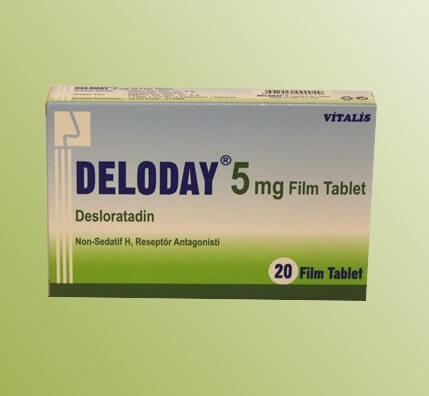 Deloday — это антигистаминный препарат, который снижает действие природного химического гистамина в организме. Используется для облегчения таких симптомов, как чихание, насморк, покраснение, зуд в глазах и слезотечение, а также кожная сыпь, вызванная аллергией.
Deloday: инструкция по применению
Deloday 5 mg таблетки для приема внутрь
1. Состав:
Активный компонент: одна таблетка содержит 5 мг дезлоратадина.
Вспомогательные компоненты: кальция гидрофосфата дигидрат, микрокристаллическая целлюлоза (Avicel pH 102), кукурузный крахмал, тальк, индигокармин (E 132), диоксид титана (E 171).
2. Описание:
Deloday — противоаллергический препарат, не вызывающий сонливости. Помогает контролировать аллергическую реакцию и симптомы. Можно использовать взрослым и детям старше 12 лет.
Deloday устраняет симптомы аллергического ринита, такие как чихание, зуд и выделения из носа, зуд неба и глаз, слезотечение и кашель, связанные с сенной лихорадкой, аллергию на пылевых клещей и т. д.
Средство также используется для облегчения таких симптомов, как зуд, сыпь и покраснение кожи, а также кожное заболевание (хроническая идиопатическая крапивница), вызванное аллергией.
Deloday облегчает аллергические симптомы на весь день и помогает вернуться к нормальной жизнедеятельности и полноценному сну.
3. Особые указания:
3.1. Не используйте препарат в следующих случаях:
- При сильной чувствительности (аллергии) к дезлоратадину, лоратадину или любому другому компоненту, содержащемся в этом лекарстве.
3.2. Используйте препарат с осторожностью в следующих случаях:
- При нарушении функции почек и печени.
Перед применением проконсультируйтесь с врачом.
3.3. Взаимодействие с едой и напитками
Делодей можно принимать как натощак, так и на полный желудок.
3.4. Беременность и кормление грудью
Перед применением проконсультируйтесь с врачом. Не рекомендуется принимать беременным и кормящим женщинам.
3.5. Влияние на использование транспортных средств
В редких случаях средство Deloday в рекомендуемых дозах может вызывать сонливость, в этом случае следует отказаться от управления транспортными средствами.
3.6. Использование с другими лекарственными препаратами
Не взаимодействует с другими препаратами.
Если вы в настоящее время принимаете какие-либо лекарства, отпускаемые по рецепту или без рецепта, или принимали их недавно, сообщите об этом своему врачу или фармацевту.
4. Способ приема и дозировка:
Взрослые и дети от 12 лет:
Для облегчения симптомов, связанных с аллергическим ринитом и хронической идиопатической крапивницей, принимается одна таблетка Deloday (5 мг) один раз в день.
Что касается продолжительности лечения, ваш врач определит тип вашего аллергического ринита и решит, как долго вам следует принимать препарат.
Если у вас сенная лихорадка, аллергия на пылевых клещей (аллергический ринит) или периодическая аллергия, ваш врач оценит историю болезни и назначит вам соответствующее лечение.
Принимать средство можно после еды или натощак.
Пожилой возраст:
Эффективность и безопасность препарата у пожилых людей еще не установлены. Поэтому Делодей не рекомендуется использовать пожилым людям.
4.1. Если вы использовали большую дозу лекарства, чем предусмотрено:
Обратитесь к врачу или фармацевту.
Принимайте препарат в соответствии с назначенной вам дозировкой. Побочных эффектов, связанных со случайной передозировкой, не наблюдалось.
4.2. Если вы забыли принять препарат вовремя:
Если вы забыли принять необходимую дозу вовремя, примите ее, как только вспомните, а затем продолжайте прием в обычном режиме.
Не принимайте двойную дозу, чтобы восполнить пропущенные дозы.
5. Побочные эффекты:
Если вы обнаружите у себя следующие побочные эффекты, прекратите использование препарата и обратитесь к врачу. Это очень серьезные и редкие побочные эффекты, вам может потребоваться срочная медицинская помощь.
- Если у вас развиваются общие аллергические симптомы (например, кожная сыпь, отек рта или горла, затрудняющий глотание или дыхание).
- Проблемы с печенью.
- Проблемы со зрением или со слухом (галлюцинации).
- Судороги.
- Учащенное сердцебиение.
К частым побочным эффектам относятся следующие:
- Сухость во рту.
- Головная боль.
- Головокружение.
- Боль в животе.
- Боль в мышцах.
- Нервозность.
- Утомляемость.
- Сонливость.
- Бессонница.
- Несварение.
- Тошнота.
- Рвота.
6. Условия хранения:
Храните препарат при комнатной температуре ниже 25ºC, в недоступном для детей месте.
Используйте в соответствии со сроком годности, указанном на упаковке.
7. Производитель:
Neutec, Турция
Components:
Method of action:
Treatment option:
Medically reviewed by Kovalenko Svetlana Olegovna, PharmD. Last updated on 2022-04-08

Attention!
Information on this page is intended only for medical professionals!
Information is collected in open sources and may contain significant errors!
Be careful and double-check all the information on this page!
Top 20 medicines with the same components:
Top 20 medicines with the same treatments:
The information provided in of Deloday
is based on data of another medicine with exactly the same composition as the Deloday.
. Be careful and be sure to specify the information on the section in the instructions to the drug Deloday directly from the package or from the pharmacist at the pharmacy.
more…
Deloday
The information provided in of Deloday
is based on data of another medicine with exactly the same composition as the Deloday.
. Be careful and be sure to specify the information on the section in the instructions to the drug Deloday directly from the package or from the pharmacist at the pharmacy.
more…
Desloratadine
Therapeutic indications
The information provided in Therapeutic indications of Deloday
is based on data of another medicine with exactly the same composition as the Deloday.
. Be careful and be sure to specify the information on the section Therapeutic indications in the instructions to the drug Deloday directly from the package or from the pharmacist at the pharmacy.
more…
Film-coated tablet; Oral lyophilisate; Orodispersible tablet; Syrup
Substance-powder
Deloday is indicated in adults and adolescents aged 12 years and older for the relief of symptoms associated with:
— allergic rhinitis
— urticaria
Deloday is indicated in adults, adolescents and children over the age of 1 year for the relief of symptoms associated with:
— allergic rhinitis
— urticaria.
Dosage (Posology) and method of administration
The information provided in Dosage (Posology) and method of administration of Deloday
is based on data of another medicine with exactly the same composition as the Deloday.
. Be careful and be sure to specify the information on the section Dosage (Posology) and method of administration in the instructions to the drug Deloday directly from the package or from the pharmacist at the pharmacy.
more…
Film-coated tablet; Oral lyophilisate; Orodispersible tablet; Syrup
Substance-powder
Posology
Adults and adolescents (12 years of age and over)
The recommended dose of Deloday is one tablet once a day.
Intermittent allergic rhinitis (presence of symptoms for less than 4 days per week or for less than 4 weeks) should be managed in accordance with the evaluation of patient’s disease history and the treatment could be discontinued after symptoms are resolved and reinitiated upon their reappearance.
In persistent allergic rhinitis (presence of symptoms for 4 days or more per week and for more than 4 weeks), continued treatment may be proposed to the patients during the allergen exposure periods.
Paediatric population
There is limited clinical trial efficacy experience with the use of desloratadine in adolescents 12 through 17 years of age.
The safety and efficacy of Deloday 5 mg film-coated tablets in children below the age of 12 years have not been established. No data are available.
Method of administration
Oral use.
The dose can be taken with or without food.
Posology
Adults and adolescents 12 years of age and over.
The recommended dose of Deloday oral solution is 10ml (5mg) oral solution once a day.
Paediatric Population
The prescriber should be aware that most cases of rhinitis below 2 years of age are of infectious origin and there are no data supporting the treatment of infectious rhinitis with Deloday oral solution.
Children 1 through 5 years of age: 2.5 ml (1.25 mg) Deloday oral solution once a day.
Children 6 through 11 years of age: 5 ml (2.5 mg) Deloday oral solution once a day.
The safety and efficacy of Deloday 0.5mg/ml oral solution in children below the age of 1 year have not been established. No data are available.
There is limited clinical trial efficacy experience with the use of Deloday in children 1 through 11 years of age and adolescents 12 through 17 years of age.
Intermittent allergic rhinitis (presence of symptoms for less than 4 days per week or for less than 4 weeks) should be managed in accordance with the evaluation of patient’s disease history and the treatment could be discontinued after symptoms are resolved and reinitiated upon their reappearance.
In persistent allergic rhinitis (presence of symptoms for 4 days or more per week and for more than 4 weeks), continued treatment may be proposed to the patients during the allergen exposure periods.
Method of Administration
Oral use.
The dose can be taken with or without food.
Contraindications
The information provided in Contraindications of Deloday
is based on data of another medicine with exactly the same composition as the Deloday.
. Be careful and be sure to specify the information on the section Contraindications in the instructions to the drug Deloday directly from the package or from the pharmacist at the pharmacy.
more…
Special warnings and precautions for use
The information provided in Special warnings and precautions for use of Deloday
is based on data of another medicine with exactly the same composition as the Deloday.
. Be careful and be sure to specify the information on the section Special warnings and precautions for use in the instructions to the drug Deloday directly from the package or from the pharmacist at the pharmacy.
more…
Film-coated tablet; Oral lyophilisate; Orodispersible tablet; Syrup
Substance-powder
In the case of severe renal insufficiency, Deloday should be used with caution.
Desloratadine should be administered with caution in patients with medical or familial history of seizures, and mainly young children, being more susceptible to develop new seizures under desloratadine treatment. Healthcare providers may consider discontinuing desloratadine in patients who experience a seizure while on treatment.
Patients with rare hereditary problems of galactose intolerance, the Lapp lactase deficiency or glucose-galactose malabsorption should not take this medicine.
Paediatric population
In children below 2 years of age, the diagnosis of allergic rhinitis is particularly difficult to distinguish from other forms of rhinitis. The absence of upper respiratory tract infection or structural abnormalities, as well as patient history, physical examinations, and appropriate laboratory and skin tests should be considered.
Approximately 6 % of adults and children 2- to 11-year old are phenotypic poor metabolisers of Deloday and exhibit a higher exposure. The safety of Deloday in children 2- to 11-years of age who are poor metabolisers is the same as in children who are normal metabolisers. The effects of Deloday in poor metabolisers < 2 years of age have not been studied.
In the case of severe renal insufficiency, Deloday oral solution should be used with caution.
This medicinal product contains sorbitol. Patients with rare hereditary problems of fructose intolerance should not take this medicine.
Effects on ability to drive and use machines
The information provided in Effects on ability to drive and use machines of Deloday
is based on data of another medicine with exactly the same composition as the Deloday.
. Be careful and be sure to specify the information on the section Effects on ability to drive and use machines in the instructions to the drug Deloday directly from the package or from the pharmacist at the pharmacy.
more…
Film-coated tablet; Oral lyophilisate; Orodispersible tablet; Syrup
Substance-powder
Deloday has no or negligible influence on the ability to drive and use machines based on clinical trials. Patients should be informed that most people do not experience drowsiness. Nevertheless, as there is individual variation in response to all medicinal products, it is recommended that patients are advised not to engage in activities requiring mental alertness, such as driving a car or using machines, until they have established their own response to the medicinal product.
Deloday oral solution has no or negligible influence on the ability to drive and use machines based on clinical trials. Patients should be informed that most people do not experience drowsiness. Nevertheless, as there is individual variation in response to all medicinal products, it is recommended that patients are advised not to engage in activities requiring mental alertness, such as driving a car or using machines, until they have established their own response to the medicinal product.
Undesirable effects
The information provided in Undesirable effects of Deloday
is based on data of another medicine with exactly the same composition as the Deloday.
. Be careful and be sure to specify the information on the section Undesirable effects in the instructions to the drug Deloday directly from the package or from the pharmacist at the pharmacy.
more…
Film-coated tablet; Oral lyophilisate; Orodispersible tablet; Syrup
Substance-powder
Summary of the safety profile
In clinical trials in a range of indications including allergic rhinitis and chronic idiopathic urticaria, at the recommended dose of 5 mg daily, undesirable effects with Deloday were reported in 3 % of patients in excess of those treated with placebo. The most frequent of adverse reactions reported in excess of placebo were fatigue (1.2 %), dry mouth (0.8 %) and headache (0.6 %).
Paediatric population
In a clinical trial with 578 adolescent patients, 12 through 17 years of age, the most common adverse event was headache; this occurred in 5.9 % of patients treated with desloratadine and 6.9 % of patients receiving placebo.
Tabulated list of adverse reactions
The frequency of the clinical trial adverse reactions reported in excess of placebo and other undesirable effects reported during the post-marketing period are listed in the following table. Frequencies are defined as very common (> 1/10), common (> 1/100 to < 1/10), uncommon (> 1/1,000 to < 1/100), rare (> 1/10,000 to < 1/1,000), very rare (< 1/10,000) and not known (cannot be estimated from the available data).
|
System Organ Class |
Frequency |
Adverse reactions seen with Deloday |
|
Metabolism and nutrition disorders |
Not known |
Increased appetite |
|
Psychiatric disorders |
Very rare Not known |
Hallucinations Abnormal behaviour, aggression |
|
Nervous system disorders |
Common Very rare |
Headache Dizziness, somnolence, insomnia, psychomotor hyperactivity, seizures |
|
Cardiac disorders |
Very rare Not known |
Tachycardia, palpitations QT prolongation |
|
Gastrointestinal disorders |
Common Very rare |
Dry mouth Abdominal pain, nausea, vomiting, dyspepsia, diarrhoea |
|
Hepatobiliary disorders |
Very rare Not known |
Elevations of liver enzymes, increased bilirubin, hepatitis Jaundice |
|
Skin and subcutaneous tissue disorders |
Not known |
Photosensitivity |
|
Musculoskeletal and connective tissue disorders |
Very rare |
Myalgia |
|
General disorders and administration site conditions |
Common Very rare Not known |
Fatigue Hypersensitivity reactions (such as anaphylaxis, angioedema, dyspnoea, pruritus, rash, and urticaria) Asthenia |
|
Investigations |
Not Known |
Weight increased |
Paediatric population
Other undesirable effects reported during the post-marketing period in paediatric patients with an unknown frequency included QT prolongation, arrhythmia, bradycardia, abnormal behaviour, and aggression.
Reporting of suspected adverse reactions
Reporting suspected adverse reactions after authorisation of the medicinal product is important. It allows continued monitoring of the benefit/risk balance of the medicinal product. Healthcare professionals are asked to report any suspected adverse reactions via the Yellow Card Scheme at: www.mhra.gov.uk/yellowcard or search for MHRA Yellow Card in the Google Play or Apple App Store.
Summary of the safety profile
Paediatric population
In clinical trials in a paediatric population, the Deloday syrup formulation was administered to a total of 246 children aged 6 months through 11 years. The overall incidence of adverse events in children 2 through 11 years of age was similar for the Deloday and the placebo groups. In infants and toddlers aged 6 to 23 months, the most frequent adverse events reported in excess of placebo were diarrhoea (3.7 %), fever (2.3 %) and insomnia (2.3 %). In an additional study, no adverse events were seen in subjects between 6 and 11 years of age following a single 2.5 mg dose of Deloday oral solution.
In a clinical trial with 578 adolescent patients, 12 through 17 years of age, the most common adverse event was headache, this occurred in 5.9% of patients treated with Deloday and 6.9% of patients receiving placebo.
Adults and adolescents
At the recommended dose, in clinical trials involving adults and adolescents in a range of indications including allergic rhinitis and chronic idiopathic urticaria, undesirable effects with Deloday were reported in 3 % of patients in excess of those treated with placebo. The most frequent of adverse events reported in excess of placebo were fatigue (1.2 %), dry mouth (0.8 %) and headache (0.6 %).
Tabulated list of adverse reactions
The frequency of the clinical trial adverse reactions reported in excess of placebo and other undesirable effects reported during the post-marketing period are listed in the following table.
Frequencies are defined as very common (>1/10), common (>1/100 to <1/10), uncommon (>1/1,000 to <1/100), rare (>1/10,000 to <1/1,000), very rare (<1/10,000) and not known (cannot be estimated from the available data).
|
System Organ Class |
Frequency |
Adverse reactions seen with Deloday oral solution |
|
Psychiatric disorders |
Very rare |
Hallucinations |
|
Nervous system disorders |
Common Common (children less than 2 years) Very rare |
Headache Insomnia Dizziness, somnolence, insomnia, psychomotor hyperactivity, seizures |
|
Cardiac disorders |
Very rare Not known |
Tachycardia, palpitations QT prolongation |
|
Gastrointestinal disorders |
Common Common (children less than 2 years) Very rare |
Dry mouth Diarrhoea Abdominal pain, nausea, vomiting, dyspepsia, diarrhoea |
|
Hepatobiliary disorders |
Very rare Not known |
Elevations of liver enzymes, increased bilirubin, hepatitis Jaundice |
|
Skin and subcutaneous skin disorders |
Not known |
Photosensitivity |
|
Musculoskeletal and connective tissue disorders |
Very rare |
Myalgia |
|
General disorders and administration site conditions |
Common Common (children less than 2 years) Very rare Not known |
Fatigue Fever Hypersensitivity reactions (such as anaphylaxis, angioedema, dyspnoea, pruritus, rash, and urticaria) Asthenia |
Paediatric population
Other undesirable effects reported during the post-marketing period in paediatric patients with an unknown frequency included QT prolongation, arrhythmia and bradycardia.
Reporting of suspected adverse reactions
Reporting suspected adverse reactions after authorization of the medicinal product is important. It allows continued monitoring of the benefit/risk balance of the medicinal product. Healthcare professionals are asked to report any suspected adverse reactions via the Yellow Card Scheme at www.mhra.gov.uk/yellowcard
Overdose
The information provided in Overdose of Deloday
is based on data of another medicine with exactly the same composition as the Deloday.
. Be careful and be sure to specify the information on the section Overdose in the instructions to the drug Deloday directly from the package or from the pharmacist at the pharmacy.
more…
Film-coated tablet; Oral lyophilisate; Orodispersible tablet; Syrup
Substance-powder
The adverse event profile associated with overdosage, as seen during post-marketing use, is similar to that seen with therapeutic doses, but the magnitude of the effects can be higher.
Treatment
In the event of overdose, consider standard measures to remove unabsorbed active substance. Symptomatic and supportive treatment is recommended.
Desloratadine is not eliminated by haemodialysis; it is not known if it is eliminated by peritoneal dialysis.
Symptoms
Based on a multiple dose clinical trial, in which up to 45 mg of desloratadine was administered (nine times the clinical dose), no clinically relevant effects were observed.
Paediatric population
The adverse event profile associated with overdosage, as seen during post-marketing use, is similar to that seen with therapeutic doses, but the magnitude of the effects can be higher.
The adverse event profile associated with overdosage, as seen during post-marketing use, is similar to that seen with therapeutic doses, but the magnitude of the effects can be higher.
Treatment
In the event of overdose, consider standard measures to remove unabsorbed active substance. Symptomatic and supportive treatment is recommended.
Deloday is not eliminated by haemodialysis; it is not known if it is eliminated by peritoneal dialysis.
Symptoms
Based on a multiple dose clinical trial in adults and adolescents, in which up to 45 mg of Deloday was administered (nine times the clinical dose), no clinically relevant effects were observed.
Paediatric population
The adverse event profile associated with overdosage, as seen during post-marketing use, is similar to that seen with therapeutic doses, but the magnitude of the effects can be higher.
Pharmacodynamic properties
The information provided in Pharmacodynamic properties of Deloday
is based on data of another medicine with exactly the same composition as the Deloday.
. Be careful and be sure to specify the information on the section Pharmacodynamic properties in the instructions to the drug Deloday directly from the package or from the pharmacist at the pharmacy.
more…
Film-coated tablet; Oral lyophilisate; Orodispersible tablet; Syrup
Substance-powder
Pharmacotherapeutic group: antihistamines — H1 antagonist, ATC code: R06A X27
Mechanism of action
Desloratadine is a non-sedating, long-acting histamine antagonist with selective peripheral H1-receptor antagonist activity. After oral administration, desloratadine selectively blocks peripheral histamine H1-receptors because the substance is excluded from entry to the central nervous system.
Desloratadine has demonstrated antiallergic properties from in vitro studies. These include inhibiting the release of proinflammatory cytokines such as IL-4, IL-6, IL-8, and IL-13 from human mast cells/basophils, as well as inhibition of the expression of the adhesion molecule P-selectin on endothelial cells. The clinical relevance of these observations remains to be confirmed.
Clinical efficacy and safety
In a multiple dose clinical trial, in which up to 20 mg of desloratadine was administered daily for 14 days, no statistically or clinically relevant cardiovascular effect was observed. In a clinical pharmacology trial, in which desloratadine was administered at a dose of 45 mg daily (nine times the clinical dose) for ten days, no prolongation of QTc interval was seen.
No clinically relevant changes in desloratadine plasma concentrations were observed in multiple-dose ketoconazole and erythromycin interaction trials.
Desloratadine does not readily penetrate the central nervous system. In controlled clinical trials, at the recommended dose of 5 mg daily, there was no excess incidence of somnolence as compared to placebo. Deloday given at a single daily dose of 7.5 mg did not affect psychomotor performance in clinical trials. In a single dose study performed in adults, desloratadine 5 mg did not affect standard measures of flight performance including exacerbation of subjective sleepiness or tasks related to flying.
In clinical pharmacology trials, co-administration with alcohol did not increase the alcohol-induced impairment in performance or increase in sleepiness. No significant differences were found in the psychomotor test results between desloratadine and placebo groups, whether administered alone or with alcohol.
In patients with allergic rhinitis, Deloday was effective in relieving symptoms such as sneezing, nasal discharge and itching, as well as ocular itching, tearing and redness, and itching of palate. Deloday effectively controlled symptoms for 24 hours.
Paediatric population
The efficacy of Deloday tablets has not been clearly demonstrated in trials with adolescent patients 12 through 17 years of age.
In addition to the established classifications of seasonal and perennial, allergic rhinitis can alternatively be classified as intermittent allergic rhinitis and persistent allergic rhinitis according to the duration of symptoms. Intermittent allergic rhinitis is defined as the presence of symptoms for less than 4 days per week or for less than 4 weeks. Persistent allergic rhinitis is defined as the presence of symptoms for 4 days or more per week and for more than 4 weeks.
Deloday was effective in alleviating the burden of seasonal allergic rhinitis as shown by the total score of the rhino-conjunctivitis quality of life questionnaire. The greatest amelioration was seen in the domains of practical problems and daily activities limited by symptoms.
Chronic idiopathic urticaria was studied as a clinical model for urticarial conditions, since the underlying pathophysiology is similar, regardless of etiology, and because chronic patients can be more easily recruited prospectively. Since histamine release is a causal factor in all urticarial diseases, desloratadine is expected to be effective in providing symptomatic relief for other urticarial conditions, in addition to chronic idiopathic urticaria, as advised in clinical guidelines.
In two placebo-controlled six week trials in patients with chronic idiopathic urticaria, Deloday was effective in relieving pruritus and decreasing the size and number of hives by the end of the first dosing interval. In each trial, the effects were sustained over the 24 hour dosing interval. As with other antihistamine trials in chronic idiopathic urticaria, the minority of patients who were identified as non-responsive to antihistamines was excluded. An improvement in pruritus of more than 50 % was observed in 55 % of patients treated with desloratadine compared with 19 % of patients treated with placebo. Treatment with Deloday also significantly reduced interference with sleep and daytime function, as measured by a four-point scale used to assess these variables.
Pharmacotherapeutic group: antihistamines — H1 antagonist
ATC code: R06A X27
Mechanism of action
Deloday is a non-sedating, long-acting histamine antagonist with selective peripheral H1-receptor antagonist activity. After oral administration, Deloday selectively blocks peripheral histamine H1-receptors because the substance is excluded from entry to the central nervous system.
Deloday has demonstrated antiallergic properties from in vitro studies. These include inhibiting the release of proinflammatory cytokines such as IL-4, IL-6, IL-8, and IL-13 from human mast cells/basophils, as well as inhibition of the expression of the adhesion molecule P-selectin on endothelial cells. The clinical relevance of these observations remains to be confirmed.
Clinical efficacy and safety
Paediatric population
Efficacy of Deloday oral solution has not been investigated in separate paediatric trials. However, the safety of Deloday syrup, which contains the same concentration of Deloday as Deloday oral solution, was demonstrated in three paediatric trials. Children, 1-11 years of age, who were candidates for antihistamine therapy received a daily Deloday dose of 1.25 mg (1 through 5 years of age) or 2.5 mg (6 through 11 years of age). Treatment was well tolerated as documented by clinical laboratory tests, vital signs, and ECG interval data, including QTc. When given at the recommended doses, the plasma concentrations of Deloday were comparable in the paediatric and adult populations. Thus, since the course of allergic rhinitis/chronic idiopathic urticaria and the profile of Deloday are similar in adults and paediatric patients, Deloday efficacy data in adults can be extrapolated to the paediatric population. Efficacy of Deloday syrup has not been investigated in paediatric trials in children less than 12 years of age.
Adults and adolescents
In a multiple dose clinical trial, in adults and adolescents, in which up to 20 mg of Deloday was administered daily for 14 days, no statistically or clinically relevant cardiovascular effect was observed. In a clinical pharmacology trial, in adults and adolescents, in which Deloday was administered to adults at a dose of 45 mg daily (nine times the clinical dose) for ten days, no prolongation of QTc interval was seen.
Deloday does not readily penetrate the central nervous system. In controlled clinical trials, at the recommended dose of 5 mg daily for adults and adolescents, there was no excess incidence of somnolence as compared to placebo. Deloday tablets given at a single daily dose of 7.5 mg to adults and adolescents did not affect psychomotor performance in clinical trials. In a single dose study performed in adults, Deloday 5 mg did not affect standard measures of flight performance including exacerbation of subjective sleepiness or tasks related to flying.
In clinical pharmacology trials in adults, co-administration with alcohol did not increase the alcohol-induced impairment in performance or increase in sleepiness. No significant differences were found in the psychomotor test results between Deloday and placebo groups, whether administered alone or with alcohol.
No clinically relevant changes in Deloday plasma concentrations were observed in multiple-dose ketoconazole and erythromycin interaction trials.
In adult and adolescent patients with allergic rhinitis, Deloday tablets were effective in relieving symptoms such as sneezing, nasal discharge and itching, as well as ocular itching, tearing and redness, and itching of palate. Deloday effectively controlled symptoms for 24 hours. The efficacy of Deloday tablets has not been clearly demonstrated in trials with adolescent patients 12 through 17 years of age.
In addition to the established classifications of seasonal and perennial, allergic rhinitis can alternatively be classified as intermittent allergic rhinitis and persistent allergic rhinitis according to the duration of symptoms. Intermittent allergic rhinitis is defined as the presence of symptoms for less than 4 days per week or for less than 4 weeks. Persistent allergic rhinitis is defined as the presence of symptoms for 4 days or more per week and for more than 4 weeks.
Deloday tablets were effective in alleviating the burden of seasonal allergic rhinitis as shown by the total score of the rhino-conjunctivitis quality of life questionnaire. The greatest amelioration was seen in the domains of practical problems and daily activities limited by symptoms.
Chronic idiopathic urticaria was studied as a clinical model for urticarial conditions, since the underlying pathophysiology is similar, regardless of etiology, and because chronic patients can be more easily recruited prospectively. Since histamine release is a causal factor in all urticarial diseases, Deloday is expected to be effective in providing symptomatic relief for other urticarial conditions, in addition to chronic idiopathic urticaria, as advised in clinical guidelines.
In two placebo-controlled six week trials in patients with chronic idiopathic urticaria, Deloday was effective in relieving pruritus and decreasing the size and number of hives by the end of the first dosing interval. In each trial, the effects were sustained over the 24 hour dosing interval. As with other antihistamine trials in chronic idiopathic urticaria, the minority of patients who were identified as non-responsive to antihistamines was excluded. An improvement in pruritus of more than 50 % was observed in 55 % of patients treated with Deloday compared with 19 % of patients treated with placebo. Treatment with Deloday also significantly reduced interference with sleep and daytime function, as measured by a four-point scale used to assess these variables.
Pharmacokinetic properties
The information provided in Pharmacokinetic properties of Deloday
is based on data of another medicine with exactly the same composition as the Deloday.
. Be careful and be sure to specify the information on the section Pharmacokinetic properties in the instructions to the drug Deloday directly from the package or from the pharmacist at the pharmacy.
more…
Film-coated tablet; Oral lyophilisate; Orodispersible tablet; Syrup
Substance-powder
Absorption
Desloratadine plasma concentrations can be detected within 30 minutes of administration. Desloratadine is well absorbed with maximum concentration achieved after approximately 3 hours; the terminal phase half-life is approximately 27 hours. The degree of accumulation of desloratadine was consistent with its half-life (approximately 27 hours) and a once daily dosing frequency. The bioavailability of desloratadine was dose proportional over the range of 5 mg to 20 mg.
In a pharmacokinetic trial in which patient demographics were comparable to those of the general seasonal allergic rhinitis population, 4 % of the subjects achieved a higher concentration of desloratadine. This percentage may vary according to ethnic background. Maximum desloratadine concentration was about 3-fold higher at approximately 7 hours with a terminal phase half-life of approximately 89 hours. The safety profile of these subjects was not different from that of the general population.
Distribution
Desloratadine is moderately bound (83 % — 87 %) to plasma proteins. There is no evidence of clinically relevant medicine accumulation following once daily dosing of desloratadine (5 mg to 20 mg) for 14 days.
Biotransformation
The enzyme responsible for the metabolism of desloratadine has not been identified yet, and therefore, some interactions with other medicinal products cannot be fully excluded. Desloratadine does not inhibit CYP3A4 in vivo, and in vitro studies have shown that the medicinal product does not inhibit CYP2D6 and is neither a substrate nor an inhibitor of P-glycoprotein.
Elimination
In a single dose trial using a 7.5 mg dose of desloratadine, there was no effect of food (high-fat, high caloric breakfast) on the disposition of desloratadine. In another study, grapefruit juice had no effect on the disposition of desloratadine.
Renally impaired patients
The pharmacokinetics of desloratadine in patients with chronic renal insufficiency (CRI) was compared with that of healthy subjects in one single-dose study and one multiple dose study. In the single-dose study, the exposure to desloratadine was approximately 2 and 2.5-fold greater in subjects with mild to moderate and severe CRI, respectively, than in healthy subjects. In the multiple-dose study, steady state was reached after Day 11, and compared to healthy subjects the exposure to desloratadine was ~1.5-fold greater in subjects with mild to moderate CRI and ~2.5-fold greater in subjects with severe CRI. In both studies, changes in exposure (AUC and Cmax) of desloratadine and 3-hydroxydesloratadine were not clinically relevant.
Absorption
Deloday plasma concentrations can be detected within 30 minutes of Deloday administration in adults and adolescents. Deloday is well absorbed with maximum concentration achieved after approximately 3 hours; the terminal phase half-life is approximately 27 hours. The degree of accumulation of Deloday was consistent with its half-life (approximately 27 hours) and a once daily dosing frequency. The bioavailability of Deloday was dose proportional over the range of 5 mg to 20 mg.
In a series of pharmacokinetic and clinical trials, 6 % of the subjects reached a higher concentration of Deloday. The prevalence of this poor metaboliser phenotype was comparable for adult (6 %) and paediatric subjects 2- to 11-year old (6 %), and greater among Blacks (18 % adult, 16 % paediatric) than Caucasians (2 % adult, 3 % paediatric) in both populations.
In a multiple-dose pharmacokinetic study conducted with the tablet formulation in healthy adult subjects, four subjects were found to be poor metabolisers of Deloday. These subjects had a Cmax concentration about 3-fold higher at approximately 7 hours with a terminal phase half-life of approximately 89 hours.
Similar pharmacokinetic parameters were observed in a multiple-dose pharmacokinetic study conducted with the syrup formulation in paediatric poor metaboliser subjects 2- to 11-year old diagnosed with allergic rhinitis. The exposure (AUC) to Deloday was about 6-fold higher and the Cmax was about 3 to 4 fold higher at 3-6 hours with a terminal half-life of approximately 120 hours. Exposure was the same in adult and paediatric poor metabolisers when treated with age-appropriate doses. The overall safety profile of these subjects was not different from that of the general population. The effects of Deloday in poor metabolizers < 2 years of age have not been studied.
In separate single dose studies, at the recommended doses, paediatric patients had comparable AUC and Cmax values of Deloday to those in adults who received a 5 mg dose of Deloday syrup.
Distribution
Deloday is moderately bound (83 % — 87 %) to plasma proteins. There is no evidence of clinically relevant active substance accumulation following once daily adult and adolescent dosing of Deloday (5 mg to 20 mg) for 14 days.
In a single dose, crossover study of Deloday, the tablet and the syrup formulations were found to be bioequivalent. As Deloday oral solution contains the same concentration of Deloday, no bioequivalence study was required and it is expected to be equivalent to the syrup and tablet.
Biotransformation
The enzyme responsible for the metabolism of Deloday has not been identified yet, and therefore, some interactions with other medicinal products cannot be fully excluded. Deloday does not inhibit CYP3A4 in vivo, and in vitro studies have shown that the medicinal product does not inhibit CYP2D6 and is neither a substrate nor an inhibitor of P-glycoprotein.
Elimination
In a single dose trial using a 7.5 mg dose of Deloday, there was no effect of food (high-fat, high caloric breakfast) on the disposition of Deloday. In another study, grapefruit juice had no effect on the disposition of Deloday.
Renally impaired patients
The pharmacokinetics of Deloday in patients with chronic renal insufficiency (CRI) was compared with that of healthy subjects in one-single-dose study and one multiple dose study. In the single-dose study, the exposure to Deloday was approximately 2 and 2.5-fold greater in subjects with mild to moderate and severe CRI, respectively, than in healthy subjects. In the multiple-dose study, steady state was reached after Day 11, and compared to healthy subjects the exposure to Deloday was ~1.5-fold greater in subjects with mild to moderate CRI and ~2.5-fold greater in subjects with severe CRI. In both studies, changes in exposure (AUC and Cmax) of Deloday and 3-hydroxyDeloday were not clinically relevant.
Pharmacotherapeutic group
The information provided in Pharmacotherapeutic group of Deloday
is based on data of another medicine with exactly the same composition as the Deloday.
. Be careful and be sure to specify the information on the section Pharmacotherapeutic group in the instructions to the drug Deloday directly from the package or from the pharmacist at the pharmacy.
more…
Film-coated tablet; Oral lyophilisate; Orodispersible tablet; Syrup
Substance-powder
antihistamines — H1 antagonist, ATC code: R06A X27
antihistamines — H1 antagonist
Preclinical safety data
The information provided in Preclinical safety data of Deloday
is based on data of another medicine with exactly the same composition as the Deloday.
. Be careful and be sure to specify the information on the section Preclinical safety data in the instructions to the drug Deloday directly from the package or from the pharmacist at the pharmacy.
more…
Film-coated tablet; Oral lyophilisate; Orodispersible tablet; Syrup
Substance-powder
Desloratadine is the primary active metabolite of loratadine. Non-clinical studies conducted with desloratadine and loratadine demonstrated that there are no qualitative or quantitative differences in the toxicity profile of desloratadine and loratadine at comparable levels of exposure to desloratadine.
Non-clinical data reveal no special hazard for humans based on conventional studies of safety pharmacology, repeated dose toxicity, genotoxicity, carcinogenic potential, toxicity to reproduction and development. The lack of carcinogenic potential was demonstrated in studies conducted with desloratadine and loratadine.
Deloday is the primary active metabolite of loratadine. Non-clinical studies conducted with Deloday and loratadine demonstrated that there are no qualitative or quantitative differences in the toxicity profile of Deloday and loratadine at comparable levels of exposure to Deloday.
Non-clinical data with Deloday reveal no special hazard for humans based on conventional studies of safety pharmacology, repeated dose toxicity, genotoxicity, carcinogenic potential, toxicity to reproduction and development. The lack of carcinogenic potential was demonstrated in studies conducted with Deloday and loratadine.
Incompatibilities
The information provided in Incompatibilities of Deloday
is based on data of another medicine with exactly the same composition as the Deloday.
. Be careful and be sure to specify the information on the section Incompatibilities in the instructions to the drug Deloday directly from the package or from the pharmacist at the pharmacy.
more…
Film-coated tablet; Oral lyophilisate; Orodispersible tablet; Syrup
Substance-powder
Not applicable.
Not applicable
Special precautions for disposal and other handling
The information provided in Special precautions for disposal and other handling of Deloday
is based on data of another medicine with exactly the same composition as the Deloday.
. Be careful and be sure to specify the information on the section Special precautions for disposal and other handling in the instructions to the drug Deloday directly from the package or from the pharmacist at the pharmacy.
more…
Film-coated tablet; Oral lyophilisate; Orodispersible tablet; Syrup
Substance-powder
No special requirements.
Any unused medicinal product or waste material should be disposed of in accordance with local requirements.
Deloday price
We have no data on the cost of the drug.
However, we will provide data for each active ingredient
The approximate cost of Desloratadine 5 mg per unit in online pharmacies is from 0.33$ to 1.17$, per package is from 20$ to 79$.
Available in countries
Find in a country:
Дезлоратадин-ВЕРТЕКС (Desloratadine-VERTEX)
💊 Состав препарата Дезлоратадин-ВЕРТЕКС
✅ Применение препарата Дезлоратадин-ВЕРТЕКС
Описание активных компонентов препарата
Дезлоратадин-ВЕРТЕКС
(Desloratadine-VERTEX)
Приведенная научная информация является обобщающей и не может быть использована для принятия
решения о возможности применения конкретного лекарственного препарата.
Дата обновления: 2020.04.07
Владелец регистрационного удостоверения:
Код ATX:
R06AX27
(Дезлоратадин)
Лекарственная форма
| Дезлоратадин-ВЕРТЕКС |
Таб., покр. пленочной оболочкой, 5 мг: 7, 10 или 30 шт. рег. №: ЛП-002473 |
Форма выпуска, упаковка и состав
препарата Дезлоратадин-ВЕРТЕКС
Таблетки, покрытые пленочной оболочкой голубого цвета, круглые, двояковыпуклые; на поперечном разрезе ядро белого или почти белого цвета.
Вспомогательные вещества: кальция гидрофосфата дигидрат — 53 мг, целлюлоза микрокристаллическая — 27.5 мг, крахмал кукурузный — 11 мг, тальк — 2.5 мг, магния стеарат — 1 мг.
Состав пленочной оболочки: сухая смесь для пленочного покрытия (поливиниловый спирт — 40%, титана диоксид — 22.1%, макрогол 3350 (полиэтиленгликоль 3350) — 20.2%, тальк — 14.8%, лак алюминиевый на основе красителя индигокармин — 2.8%, железа оксид желтый (железа оксид) — 0.1%) — 3 мг.
7 шт. — упаковки ячейковые контурные (1) — пачки картонные.
10 шт. — упаковки ячейковые контурные (1) — пачки картонные.
10 шт. — упаковки ячейковые контурные (3) — пачки картонные.
15 шт. — упаковки ячейковые контурные (2) — пачки картонные.
30 шт. — упаковки ячейковые контурные (1) — пачки картонные.
Фармакологическое действие
Блокатор гистаминовых Н1-рецепторов (длительного действия). Является первичным активным метаболитом лоратадина. Ингибирует высвобождение гистамина и лейкотриена С4 из тучных клеток. Предупреждает развитие и облегчает течение аллергических реакций. Обладает противоаллергическим, противозудным и противоэкссудативным действием. Уменьшает проницаемость капилляров, предупреждает развитие отека тканей, снимает спазм гладкой мускулатуры. Практически не обладает седативным эффектом и при приеме в дозе 7.5 мг не влияет на скорость психомоторных реакций. В сравнительных исследованиях дезлоратадина и лоратадина качественных или количественных различий токсичности двух препаратов в сопоставимых дозах (с учетом концентрации дезлоратадина) не выявлено.
Фармакокинетика
После приема внутрь начинает определяться в плазме через 30 мин. Пища не оказывает влияния на распределение. Биодоступность пропорциональна дозе в диапазоне от 5 мг до 20 мг. Связывание с белками плазмы составляет 83-87%. После однократного приема в дозе 5 мг или 7.5 мг Cmax достигается через 2-6 ч (в среднем через 3 ч). Не проникает через ГЭБ. Интенсивно метаболизируется в печени путем гидроксилирования с образованием 3-ОН-дезлоратадина, соединенного с глюкуронидом, лишь небольшая часть принятой внутрь дозы выводится почками (<2%) и с калом (<7%). T1/2 – 20-30 ч (в среднем — 27 ч). При применении дезлоратадина в дозе от 5 мг до 20 мг 1 раз/сут в течение 14 дней признаков клинически значимой кумуляции не выявлено.
Показания активных веществ препарата
Дезлоратадин-ВЕРТЕКС
Сезонный аллергический ринит, хроническая идиопатическая крапивница.
Режим дозирования
Способ применения и режим дозирования конкретного препарата зависят от его формы выпуска и других факторов. Оптимальный режим дозирования определяет врач. Следует строго соблюдать соответствие используемой лекарственной формы конкретного препарата показаниям к применению и режиму дозирования.
Взрослым и подросткам в возрасте 12 лет и старше назначают внутрь, независимо от приема пищи, в дозе 5 мг/сут.
Детям в возрасте от 1 года до 5 лет — 1.25 мг 1 раз/сут, в возрасте от 6 до 11 лет — 2.5 мг 1 раз/сут.
Побочное действие
Со стороны нервной системы: головная боль, галлюцинации, психомоторная гиперреактивность, судороги.
Со стороны пищеварительной системы: сухость во рту, гепатит.
Прочие: фотосенсибилизация, миалгия, одышка, чувство усталости.
Противопоказания к применению
Фенилкетонурия, беременность, лактация, детский возраст до 1 года, повышенная чувствительность к дезлоратадину.
Применение при беременности и кормлении грудью
Дезлоратадин противопоказан к применению при беременности и в период лактации (грудного вскармливания).
Применение при нарушениях функции почек
С осторожностью назначают дезлоратадин при тяжелой почечной недостаточности.
Применение у детей
Противопоказан в детском возрасте до 2 лет.
Особые указания
С осторожностью назначают дезлоратадин при тяжелой почечной недостаточности.
Влияние на способность к управлению транспортными средствами и механизмами
Неблагоприятного воздействия на управление автомобилем или сложными техническими устройствами не отмечалось.
Лекарственное взаимодействие
Изучение взаимодействия с кетоконазолом и эритромицином клинически значимых изменений не выявило.
Не влияет на эффекты этанола.
Если вы хотите разместить ссылку на описание этого препарата — используйте данный код
Аналоги препарата
Блогир-3®
(BELUPO, Pharmaceuticals & Cosmetics, Хорватия)
Дезал
(ACTAVIS GROUP PTC ehf., Исландия)
Дезлоратадин
(ТАТХИМФАРМПРЕПАРАТЫ, Россия)
Дезлоратадин
(СИНТЕЗ, Россия)
Дезлоратадин
(Березовский фармацевтический завод, Россия)
Дезлоратадин
(БИОКОМ, Россия)
Дезлоратадин
(РИФ, Россия)
Дезлоратадин
(БРАЙТ ВЭЙ, Россия)
Дезлоратадин Велфарм
(АТОЛЛ, Россия)
Дезлоратадин ВП
(VETPROM, Болгария)
Все аналоги
Description
Within the confines of each Deloday film tablet lies a harmonious blend, with 5 mg of desloratadine as the lead performer. This ensemble includes excipients such as calcium hydrogen phosphate dihydrate, microcrystalline cellulose, pregelatinized corn starch, talc, colloidal silicon dioxide, magnesium stearate, and the vivid Opadry II OY-L-20906 Blue. The latter, a composition in itself, features lactose monohydrate, hypromellose, macrogol/polyethylene glycol, FDC blue no:2 aluminum lake (E132), and titanium dioxide (E171).
Indications
Deloday unfurls its therapeutic wings as an antihistamine luminary. Its healing touch extends to the realms of allergic rhinitis, asthma, and the intricate interplay of comorbid allergic rhinitis. This medicinal virtuoso strives to rein in allergic reactions and their symptomatic manifestations.
Administration
The Deloday journey commences through oral communion, a ritual indifferent to the presence or absence of food. Packaged in round, convex, blue-colored film tablets, each iteration offers 20 or 30 tablets ensconced in PVC/PVDC transparent-aluminum blister strips. The guiding manual stands as a silent custodian to this therapeutic sojourn.
Table: Deloday Film Tablet Dosage Information
| Dosage | Administration |
|---|---|
| 5 mg/tablet | Orally, with or without food |
| Package | 20 or 30 film tablets per PVC/PVDC blister strip |
Precautions
As with any therapeutic narrative, Deloday introduces a chapter of precautions, where prudence becomes the guiding star:
- Hypersensitivity: A stern warning against usage in cases of hypersensitivity to desloratadine, loratadine, or any excipients.
- Kidney Function: A consultative pause if kidney function wavers, urging a dialogue with healthcare custodians.
- Pregnancy: The delicate dance with pregnancy calls for a prelude of consultation, a consideration echoed in the corridors of breastfeeding.
- Medication Ensemble: An orchestration with other medications mandates a consultative overture with healthcare providers.
- Prescribed Dosage Compliance: The dosing script becomes sacrosanct, a melody to be followed diligently, avoiding solo deviations.
Table: Precautions for Deloday Film Tablet
| Consideration | Advisory |
|---|---|
| Hypersensitivity | Avoid in desloratadine, loratadine, or excipient allergies |
| Kidney Function | Consult in impaired kidney function |
| Pregnancy | Consultation during pregnancy or potential pregnancy |
| Breastfeeding | Consultation during breastfeeding |
| Medication Ensemble | Consultation when taking other medications |
| Prescribed Dosage Compliance | Adherence to prescribed dosage |
Side Effects
In the theatrical repertoire of medicinal offerings, Deloday presents its troupe of side effects, a nuanced choreography that includes the common cadence of dry mouth, fatigue, headache, nausea, and a sore throat. It’s imperative to note that this dance card is not exhaustive, and the symphony of side effects may vary across individuals.
Table: Common Side Effects of Deloday
| Side Effect | Frequency |
|---|---|
| Dry mouth | Common |
| Fatigue | Common |
| Headache | Common |
| Nausea | Common |
| Sore throat | Common |
Benefits of Deloday Film Tablet
Deloday Film Tablet stands as a therapeutic boon for those entangled in the labyrinth of allergies, offering an array of benefits:
- Allergic Rhinitis Alleviation: A balm for allergic rhinitis, soothing symptoms like sneezing, runny and itchy nose, palate itching, and ocular discomfort.
- Asthma Symphony: A contributing note in the melody against asthma, combating airway inflammation and constriction.
- Comorbid Allergic Rhinitis: The dual-role player in treating comorbid allergic rhinitis, where the interplay of conditions converges.
- Urticaria Relief: A therapeutic ally against urticaria, easing symptoms of itching, hives, and skin redness.
- Non-Drowsy Elegance: A non-drowsy overture, allowing individuals to partake in daily activities unhindered by somnolence.
Table: Benefits of Deloday Film Tablet
| Therapeutic Realm | Key Benefits |
|---|---|
| Allergic Rhinitis Alleviation | Symptomatic relief from sneezing, runny nose, and itching |
| Asthma Symphony | Contribution to asthma management |
| Comorbid Allergic Rhinitis | Dual-action against concurrent allergic rhinitis |
| Urticaria Relief | Alleviation of itching, hives, and skin redness |
| Non-Drowsy Elegance | Symptom control without inducing drowsiness |
Conclusion
In the tapestry of pharmaceutical narratives, Deloday Film Tablet emerges as a pivotal thread, weaving relief for allergic tribulations. As with any therapeutic journey, caution remains the watchword, with adherence to prescribed dosages and a consultative compass guiding the way. In the pursuit of benefits, it becomes imperative to view this medicinal offering through the lens of healthcare professionals, ensuring a harmonious concord between relief and precaution.
Table: Summary of Deloday Film Tablet
| Component | Details |
|---|---|
| Active Ingredient | Desloratadine |
| Tablet Composition | 5 mg desloratadine, excipients including Opadry II |
| Indications | Allergic rhinitis, asthma, comorbid allergic rhinitis |
| Administration | Orally, with or without food |
| Package | 20 or 30 film tablets per PVC/PVDC blister strip |
| Precautions | Hypersensitivity, impaired kidney function, pregnancy, |
| breastfeeding, other medications, prescribed dosage | |
| Side Effects | Dry mouth, fatigue, headache, nausea, sore throat |
| Benefits | Allergic rhinitis relief, asthma management, comorbid |
| allergic rhinitis treatment, urticaria relief, non-drowsy | |
| Conclusion | Weaving relief in the tapestry of allergies |
Use the form below to report an error
Please answer the questions as thoroughly and accurately as possible. Your answers will help us better understand what kind of mistakes happen, why and where they happen, and in the end the purpose is to build a better archive to guide researchers and professionals around the world.
The information on this page is not intended to be a substitute for professional medical advice, diagnosis, or treatment. always seek the advice for your physician or another qualified health provider with any questions you may have regarding a medical condition. Always remember to
- Ask your own doctor for medical advice.
- Names, brands, and dosage may differ between countries.
- When not feeling well, or experiencing side effects always contact your own doctor.
Cyberchondria
The truth is that when we’re sick, or worried about getting sick, the internet won’t help.
According to Wikipedia, cyberchondria is a mental disorder consisting in the desire to independently make a diagnosis based on the symptoms of diseases described on Internet sites.
Why you can’t look for symptoms on the Internet
If diagnoses could be made simply from a textbook or an article on a website, we would all be doctors and treat ourselves. Nothing can replace the experience and knowledge of specially trained people. As in any field, in medicine there are unscrupulous specialists, differences of opinion, inaccurate diagnoses and incorrect test results.
| Trade Name | Deloday |
| Availability | Prescription only |
| Generic | Desloratadine |
| Desloratadine Other Names | Descarboethoxyloratadine, Desloratadina, Desloratadine |
| Related Drugs | prednisone, cetirizine, loratadine, fluticasone nasal, promethazine, diphenhydramine, Zyrtec, Xolair |
| Type | |
| Formula | C19H19ClN2 |
| Weight | Average: 310.821 Monoisotopic: 310.123676325 |
| Protein binding |
Desloratadine is bound approximately 82 to 87% to plasma proteins, while its active metabolite, 3-hydroxydesloratadine, is bound approximately 85 to 89%. |
| Groups | Approved, Investigational |
| Therapeutic Class | Non-sedating antihistamines |
| Manufacturer | |
| Available Country | Turkey |
| Last Updated: | September 19, 2023 at 7:00 am |
Deloday
Deloday is a long-acting, tricyclic, non-sedating, selective peripheral histamine H1-receptor antagonist which inhibits the release of pro-inflammatory mediators from human mast cells and basophils.
Deloday is a long-acting second-generation H1-receptor antagonist which has a selective and peripheral H1-antagonist action. Histamine is a chemical that causes many of the signs that are part of allergic reactions, such as the swelling of tissues. Histamine is released from histamine-storing cells (mast cells) and attaches to other cells that have receptors for histamine. The attachment of the histamine to the receptors causes the cell to be «activated,» releasing other chemicals which produce the effects that we associate with allergies. Deloday blocks one type of receptor for histamine (the H1 receptor) and thus prevents activation of cells by histamine. Unlike most other antihistamines, Deloday does not enter the brain from the blood and, therefore, does not cause drowsiness.
Uses
Allergic Rhinitis: Deloday is used for the relief of the nasal and non-nasal symptoms of allergic rhinitis (Both seasonal and perennial) in patients 2 years of age and older.
Chronic Idiopathic Urticaria: Deloday is also used for the symptomatic relief of pruritus, reduction in the number of hives, and size of hives, in patients with chronic idiopathic urticaria 2 years of age and older.
Deloday is also used to associated treatment for these conditions:
Allergic Rhinitis (AR), Asthma, Chronic Idiopathic Urticaria, Common Cold, Nasal Congestion, Perennial Allergic Rhinitis (PAR), Seasonal Allergic Rhinitis, Nasal symptoms, Non-nasal symptoms, Antihistamine
How Deloday works
Like other H1-blockers, Deloday competes with free histamine for binding at H1-receptors in the GI tract, uterus, large blood vessels, and bronchial smooth muscle. This blocks the action of endogenous histamine, which subsequently leads to temporary relief of the negative symptoms (eg. nasal congestion, watery eyes) brought on by histamine.
Deloday
Table Of contents
- Deloday
- Uses
- Dosage
- Side Effect
- Precautions
- Interactions
- Uses during Pregnancy
- Uses during Breastfeeding
- Accute Overdose
- Food Interaction
- Half Life
- Volume of Distribution
- Clearance
- Interaction With other Medicine
- Contradiction
- Storage
Dosage
Deloday dosage
Pediatric drops :
- Child 6 -11 months of age: 2 ml drops once daily
- Child 1 -2 years of age: 2.5 ml drops once daily
Syrup:
- Child 6-11 months of age: 2 ml once daily
- Child 1-5 years of age: 2.5 ml once daily
- Child 6-11 years of age: 5 ml once daily
- Adults & > 12 years of age: 10 ml once daily
Tablet:
- Adults and children 12 years of age and over: 5 mg daily
Side Effects
Deloday is generally well tolerated. However, dry mouth, fatigue, somnolence and myalgia are commonly reported side-effects. Less common side-effects may include dizziness, headache and nausea. Rarely rash, pruritus and urticaria may occur.
Toxicity
Information regarding desloratadine overdose is limited, although somnolence has been reported. In case of overdose, symptomatic and supportive treatment, including removing the unabsorbed drug, is recommended; note, however, that desloratadine and its active metabolite 3-hydroxydesloratadine cannot be eliminated by hemodialysis.
In animal studies, lethality was observed at or above doses of 250 mg/kg in rats and of 353 mg/kg in mice (oral LD50), doses that represent 120 and 290 times the human exposure based on the recommended daily oral dose. In monkey, no deaths occurred at doses up to 250 mg/kg, representing an exposure roughly 810 times that of the recommended dose in humans.
Precaution
Hepatic and renal impairment. Pregnancy and lactation.
Interaction
Concomitant administration of Erythromycin, Ketoconazole, Azithromycin, Fluoxetine, and Cimetidine with Deloday increased the plasma concentration of Deloday. But there were no clinically relevant changes in the safety profile of Deloday.
Food Interaction
- Take with or without food. The absorption is unaffected by food.
Elimination Route
Deloday administered orally for ten days to healthy volunteers as a 5 mg tablet once daily resulted in a mean Tmax of approximately 3 hours, a mean steady-state Cmax of 4 ng/ml, and a mean steady-state AUC of 56.9 ng*hr/ml. A similar profile was observed using 10 ml of an oral solution containing 5 mg of desloratadine. Food was found not to affect desloratadine absorption.
Half Life
Deloday has a mean plasma elimination half-life of approximately 27 hours.
Elimination Route
Approximately 87% of a C-desloratadine dose was equally recovered in urine and feces as metabolic products.
Pregnancy & Breastfeeding use
Pregnancy: There are no adequate and well-controlled studies in pregnant women. Because animal reproduction studies are not always predictive of human response, Deloday should be used in pregnancy only if clearly needed.
Lactation: Deloday passes into breast milk. Therefore, a decision should be made whether to discontinue nursing or to discontinue Deloday, taking into account the importance of the drug to the mother.
Contraindication
Deloday is contraindicated in patient having hypersensitivity to this medication or to any of its ingredients or Loratadine.
Special Warning
Paediatric Use: The safety and effectiveness of Deloday in pediatric patients under 2 years of age have not been established.
Geriatric Use: In general, dose selection for an elderly patient should be cautious, reflecting the greater frequency of decreased hepatic, renal, or cardiac function, and of concomitant disease or other drug therapy.
In adult patients with liver or renal impairment: A starting dose of one 5 mg tablet every other day is recommended based on pharmacokinetic data.
Acute Overdose
No clinically relevant adverse events have been reported in case of overdosage. However, in the event of overdosage, symptomatic and supportive treatment is recommended.
Storage Condition
Store in a cool and dry place, protected from light.
Innovators Monograph
You find simplified version here Deloday
FAQ
What is Deloday used for?
Deloday is an antihistamine used to relieve allergy symptoms such as watery eyes, runny nose, itching eyes/nose, sneezing, hives, and itching. Deloday is used to treat allergies. It is an active metabolite of loratadine. It is used to relieve the symptoms of hay fever and hives of the skin.
How safe is Deloday?
Deloday is a safe and effective treatment for allergic diseases.
How does Deloday work?
Deloday works by blocking histamine, a substance in the body that causes allergic symptoms.
What are the common side effects of Deloday?
Common side effects of Deloday are include:
- headache.
- nausea.
- diarrhea.
- dizziness.
- sore throat.
- dry mouth.
- muscle pain.
- extreme tiredness
Is Deloday safe during pregnancy?
As such these findings provide reassurance by indicating that the fetal safety of Deloday is similar to the currently recommended antihistamines during pregnancy and thus Deloday can be considered to be another option for use during pregnancy.
Is Deloday safe during breastfeeding?
Considering the minimal exposure of a nursing infant to the drugs through breast milk, maternal use of Deloday dose is unlikely to result in adverse effects in nursing infants and is considered to be compatible with breastfeeding.
Can I drink alcohol with Deloday?
Deloday alone or in combination with alcohol was safe and well tolerated.
Can I drive after taking Deloday?
Do not drive and do not use tools or machines.
When should be taken of Deloday?
You can take Deloday before or after meals.
Can I take Deloday every day?
The recommended dose of Deloday tablets is one 5 mg tablet once daily.
How long does Deloday take to work?
Deloday is also use to relieve the symptoms of allergic skin conditions such as skin itch and hives. Deloday usually starts to work within 75 minutes and lasts for 24 hours.
What is the half-life of Deloday ?
The 27-hour half-life of Deloday permits once daily administration.
How long can I take Deloday for?
You can limit treatment to 14 days.
Can I take Deloday for a long time?
Deloday is unlikely to do you any harm if you take it for a long time. However, it’s best to take it only for as long as you need to. It’s best not to drink alcohol while you’re taking Deloday, as it can make you feel sleepy.
Who should not take Deloday?
Follow all directions on your medicine label and package. Tell each of your healthcare providers about all your medical conditions, allergies, and all medicines you use.
What happens if I miss a dose?
Take the medicine as soon as you can, but skip the missed dose if it is almost time for your next dose. Do not take two doses at one time.
What happen if I overdose of Deloday?
tiredness. sleepiness. menstrual pain. Increased sleepiness or tiredness can happen if you take more Deloday than your doctor prescribed to you.
Can Deloday cause infertility?
Deloday is not expected to cause other pregnancy problems.
Does Deloday increase blood pressure?
The decongestant in Deloday and pseudoephedrine may cause blood pressure to increase and may also speed up the heart rate.
Can Deloday affects my kidney?
Older patients are more likely to have kidney or liver problems which may make them more sensitive to the effects of Deloday. Your doctor may give you a different Deloday dose if you have kidney or liver problems.